
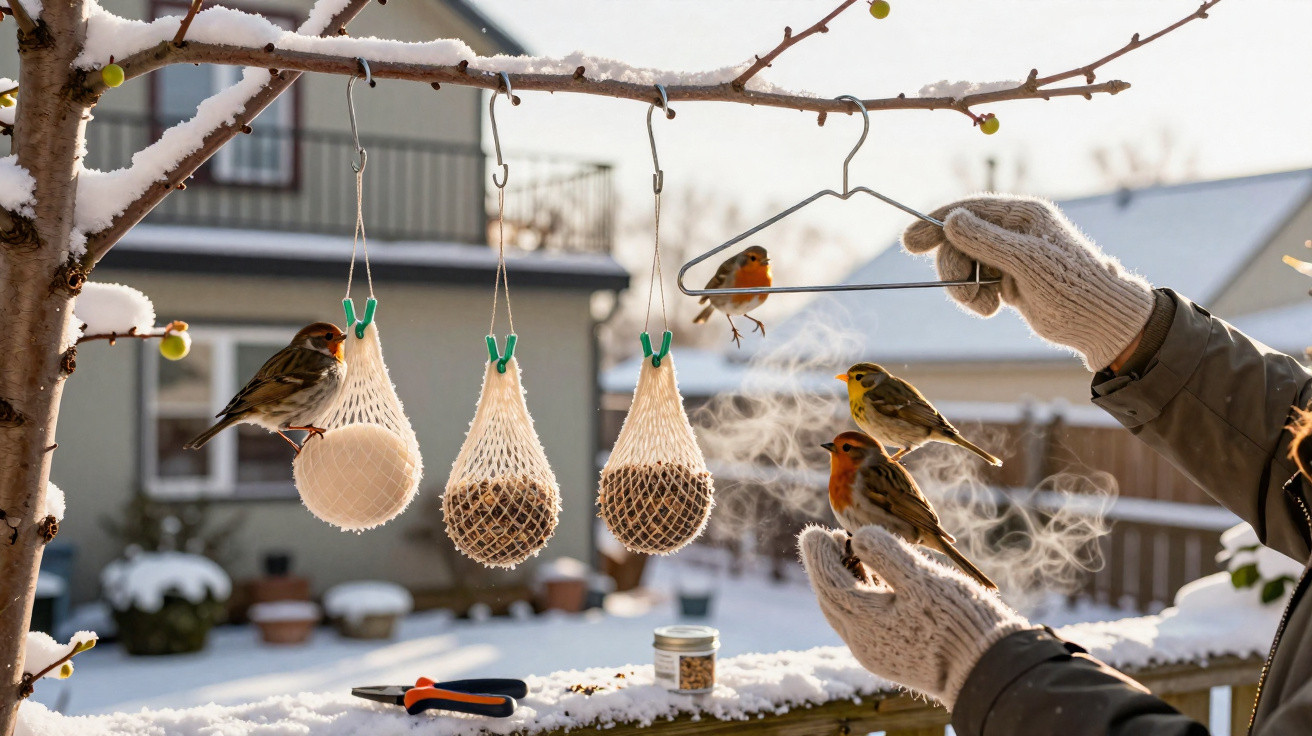
While plenty of people buy costly bird feeders, experienced gardeners and bird enthusiasts rely on an almost absurdly simple solution in winter: an ordinary metal clothes hanger. There is no nostalgic craft project behind it, but a clever approach that protects birds, keeps food secure and also reduces waste.
Why garden birds genuinely need help in winter
When frost persists, blackbirds, tits, robins and other garden birds face a difficult balance. There is little food left in the ground, insects are absent and berry bushes have been stripped bare. What may feel like nothing more than dull, wet weather to us can quickly become a matter of survival for small birds.
- Cold weather significantly increases their energy needs.
- Long nights rapidly use up their fat reserves.
- In towns and cities, natural food sources can almost disappear entirely.
This is where feeding birds privately during winter can help. However, it is not simply a question of providing food: the method and, above all, the location matter too. Poorly positioned feeding areas can attract attacks from cats, rats or martens, or leave the food sitting in mud.
The overlooked tool: a metal clothes hanger
Metal clothes hangers often sit unused in wardrobes or end up in the bin. Bird lovers are now using them as a small but useful component for secure feeding spots. The concept sounds basic, yet it works surprisingly well in everyday use.
With just a few simple adjustments, an old clothes hanger becomes a sturdy suspension point that raises the feeding station to a safe height while keeping it flexible.
Metal is easy to bend, retains its shape and can comfortably support filled feeders or bowls. A disposable item can therefore be turned into a compact protective system for birds in a garden or on a balcony.
How experts reshape a clothes hanger
Using basic pliers or strong hands, the hanger can be made into a tailored hanging system:
- Straighten the hanger until it forms one long length of wire.
- Shape a hook at one end to fit over a branch, pole or balcony railing.
- Bend a loop or second hook at the other end for attaching the feeder.
- Turn sharp edges slightly inwards so that no bird can be injured.
A single hook may be sufficient depending on the type of food, while heavy feeders are better supported by two or three attachment points. As metal remains flexible, it can also be adjusted later if needed.
Benefits of this simple solution
Bird conservation professionals value a metal clothes hanger for its practical qualities, not out of nostalgia.
Protection from predators and accidents
Most importantly, the feeding station can be positioned at a safe height and suspended freely, making it harder for ground-based predators to reach.
- Cats have fewer places from which to jump.
- Rats and mice find it more difficult to access the food.
- Food does not lie on the ground, where it can spoil or be trampled.
The feeder will also move gently in the wind. This can deter many predators without causing much disturbance to birds.
Flexible fitting, from a balcony to an apple tree
The principal advantage of a wire hanger is that it can be adapted to almost any location.
| Location | Possible attachment |
|---|---|
| Balcony | Hung over the railing or clamped to a support pole |
| Garden tree | Placed around a branch, with the hook pointing downwards for the feeder |
| Patio | Hooked onto a pergola, plant support or wall hook |
| Windowsill | Combined with a screw hook in the frame or brickwork |
Anyone using several clothes hangers can create a small “feeding mobile”: multiple hooks, different food types and several heights. This reduces stress among birds because they can keep out of one another’s way more easily.
Suitable types of bird food
The suspension system is only half the solution. Professionals choose food carefully according to bird species:
- Soft food for blackbirds and robins: oats, unsulphured raisins and chopped nuts.
- Seed food for tits and finches: sunflower seeds, hemp seed and millet.
- Fat-rich food in severe frost: fat balls without nets and homemade fat blocks containing seeds.
Many amateur gardeners use a simple cup as a food container: fill it with a fat-and-seed mixture, hang its handle from the clothes hanger and it is ready to use. The cup helps keep the food dry, while the hanger keeps it safely off the ground.
Environmental benefit: recycling instead of a disposable bird feeder
There is also a sustainable benefit: the metal hanger does not have to be thrown away. Instead, it is given a second and genuinely useful purpose. Anyone with several old hangers can create a small “feeding centre” without spending a single pound on new supports.
Anyone who feeds birds supports more than individual animals: they encourage a stable, diverse population in their local environment – and it can be done with the simplest of materials.
This approach suits a wildlife-friendly garden well: less plastic and more reuse of items already available. At a time when energy bills and living costs are rising, many people prefer these low-budget solutions.
What to consider when using the clothes hanger method
Despite its advantages, a few key points must not be overlooked, so that good intentions do not have the opposite effect.
Safety for birds and people
- Round off all wire ends or bend them inwards.
- Check the metal for rust; heavily rusted parts are best avoided.
- Position the hanger high enough that children and pets cannot hang from it or pull on it.
In exposed, windy places, adding a second fixing point is worthwhile so that the feeder does not swing excessively or strike a window. If in doubt, a short length of string or wire can also be used to stabilise the hanger.
Hygiene at the feeding station
Regular cleaning helps protect birds from disease. Old, damp food should go into general waste rather than the compost. Cleaning the feeding station once a week with hot water, without harsh cleaning products, is usually enough.
Turning your garden into a winter refuge
The clothes hanger method is a useful starting point, but it does not replace wildlife-friendly garden design. Those wishing to do more for birds can combine several measures:
- Plant native shrubs that produce berries.
- Leave some fallen leaves in place so insects can overwinter.
- Check water dishes during winter too, removing ice where necessary.
- Clean nest boxes in good time during autumn and inspect them again in late winter.
Many bird species remember safe feeding spots and return year after year. Taking a simple metal clothes hanger from the wardrobe now and investing a little time can therefore create a lively, birdsong-filled setting for the long term, even in the coldest part of the year.


Comments
No comments yet. Be the first to comment!
Leave a Comment