
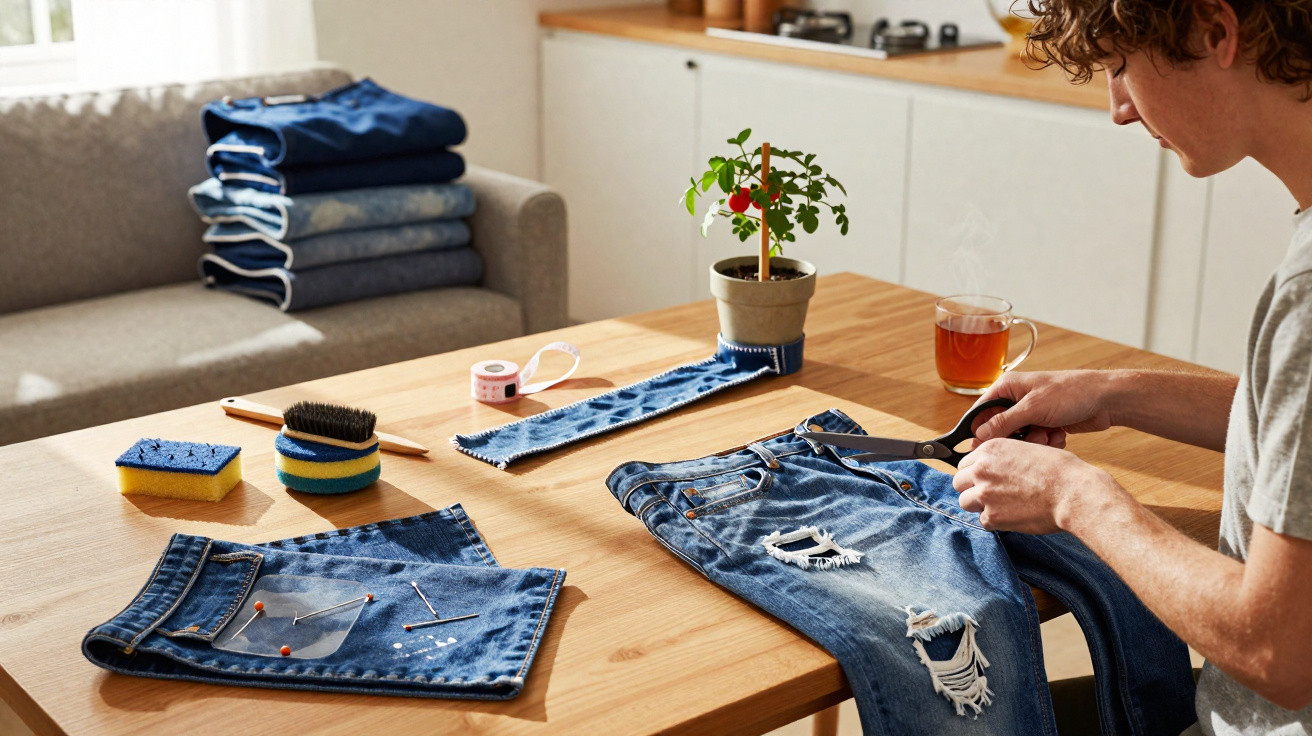
A favourite pair of ripped jeans often ends up in the bin, even though it still has surprising potential for quick, practical everyday helpers.
A hole at the knee, thinning fabric and tired seams: this is when many pairs of trousers are sent to a recycling bank. Textile experts and DIY enthusiasts say that is a mistake. Denim is durable, easy to cut and well suited to simple do-it-yourself projects that genuinely prove useful at home. With just a few steps, damaged trousers can become practical items, without the need for a professional workshop.
Why damaged jeans are far too good for the bin
Throwing away old jeans means discarding more than a garment: it also wastes a textile made with considerable resources. According to environmental authorities, producing a single pair can require up to 10,000 litres of water. There are also pesticides used in cotton cultivation, dyes and transport routes to consider.
Every pair of jeans that is reused saves water, energy and waste – while also providing surprisingly practical helpers for the home and everyday life.
Denim also has another advantage. It is made with a dense diagonal weave, known as a twill weave. This construction makes the material especially hard-wearing. Even where some areas have worn through, other sections often remain remarkably strong. That is precisely what makes damaged trousers so valuable for upcycling.
The strength of denim: what makes the fabric so durable
This classic trouser fabric is created from coloured warp threads and pale weft threads crossing diagonally. The pattern helps to slow tears and prevents cut edges from fraying straight away. That makes it ideal for fast upcycling projects.
Anyone comfortable using fabric scissors can achieve a great deal. Most of these projects do not require a sewing machine, and many need no needle or thread at all. A sharp knife, some adhesive or a few drawing pins will often do the job.
Three quick transformations in under 15 minutes
With a little planning, one damaged pair of jeans can produce several useful items. Three options stand out in particular.
1. Washable denim cleaning and washing-up sponges
Trouser legs can quickly be turned into a reusable replacement for plastic kitchen sponges. Here is how to make them step by step:
- Cut off a trouser leg and slice it into rings 2–3 centimetres wide.
- Cut the rings open into strips and pull them gently lengthways.
- Stretch the strips in a criss-cross pattern over a simple “weaving frame” made from a wooden board and nails.
- Weave the strips together until they form a firm square cloth.
- Secure the edges with a few stitches if needed.
The resulting sponge can be washed in a washing machine, withstands high temperatures and lasts far longer than many conventional foam products. In the bathroom and kitchen, it can replace several single-use items.
One old trouser leg can often provide a full supply of washing sponges for the kitchen and bathroom.
2. Wall organiser made from back pockets
The back pockets of jeans are almost ready-made storage compartments. They work particularly well for bringing order to a desk area or hallway.
Only a few steps are needed for a simple organiser:
- Cut out the back pockets, leaving around 1 centimetre of fabric around each one.
- Prepare a cork or wooden backing board.
- Attach the pockets with textile adhesive or secure them using drawing pins.
- Label them or decorate them with leftover fabric as desired.
They can hold pens, letters, keys or make-up brushes. Anyone with several old pairs of trousers can combine different shades of blue into a patchwork board that almost looks like a decorative feature.
3. Warming dry heat pack for the sofa and bed
A short section of trouser leg can become a simple but effective dry heat pack. It is suitable for cold feet, stomach aches or tense shoulders.
You only need a few things:
- One 20-centimetre section of trouser leg
- Around 500 grams of rice or cherry stones
- A needle and thread or a sewing machine
Sew one end closed securely, fill the inside with the grain filling, then stitch the opening shut. Next, place the denim roll in the microwave for around two minutes. It retains the stored heat surprisingly well, while the fabric feels pleasant against the skin.
Family-friendly ideas: how jeans upcycling works in everyday life
Jeans tend to tear especially quickly in households with children. A realistic example is a pair with knees worn through after one season, while the rest of the trousers remains in good condition. In that case, a two-part approach is worthwhile.
- Cut them off above the hole to create shorts for summer.
- Use the removed lower sections to make dry heat packs or sponges.
- Keep the back pockets for organisers.
In this way, a single garment provides clothing for warmer weather, a source of warmth for the sofa and a useful storage system for a child’s bedroom.
In the garden: jean seams as plant ties
The thick side seams are a frequently overlooked leftover. When cut close to the fabric, they become strong yet soft ties. In a vegetable patch or on a balcony, they are excellent for supporting tomatoes, beans or tall perennials without harming the plants. The cotton fabric has a little give and does not cut into the stems.
Even narrow strips and seams can still be used in the garden – leaving the bin bag almost empty.
What to do with genuinely good jeans or very small leftovers
Before reaching for scissors and needle, take a careful look at the trousers. If they still fit well and only have minor damage, repairing them may be the better option. A new hem, a patch beneath the knee or a replacement button can sometimes be enough.
If the garment is still wearable overall, passing it on also makes sense. Second-hand platforms, swap events and local collection points are often happy to take well-kept items. This extends their useful life considerably, without anyone needing to use tools.
Creative uses for tiny offcuts
At the end, very small pieces often remain, too little for larger projects. They do not automatically have to go in the bin either. They can be used for:
- Filling in handmade draught excluders or neck cushions
- Small coasters for glasses and mugs
- Washable cosmetic pads or glasses-cleaning cloths
- Fabric ribbons for gift wrapping with a rustic appearance
Those who collect several pairs of trousers can also use the flat sections for larger patchwork projects: a throw for the sofa, a hard-wearing shopping bag or a seat cushion for a balcony bench. Nothing needs to be perfect – the slightly uneven appearance is part of the appeal of this material.
What to consider when upcycling jeans
Before cutting, carry out a quick check. If the zip or buttons are still intact, save them for use on other garments later. Very pale or heavily dyed fabrics may release colour in the wash, so it is best to wash them once separately from delicate laundry.
People with sensitive skin should use heavily faded or roughened sections as internal filling, while keeping smoother pieces for the outside. For heat packs, use only heat-resistant fillings such as rice or cherry stones, and increase the microwave heating time gradually.
With a little practice, every old pair of trousers can become a small stockpile of projects: sponges for the kitchen, ties for the garden and organisers for the desk. What once would have gone straight into the bin can suddenly support everyday life in many ways – easing pressure on both the wallet and the environment.


Comments
No comments yet. Be the first to comment!
Leave a Comment