
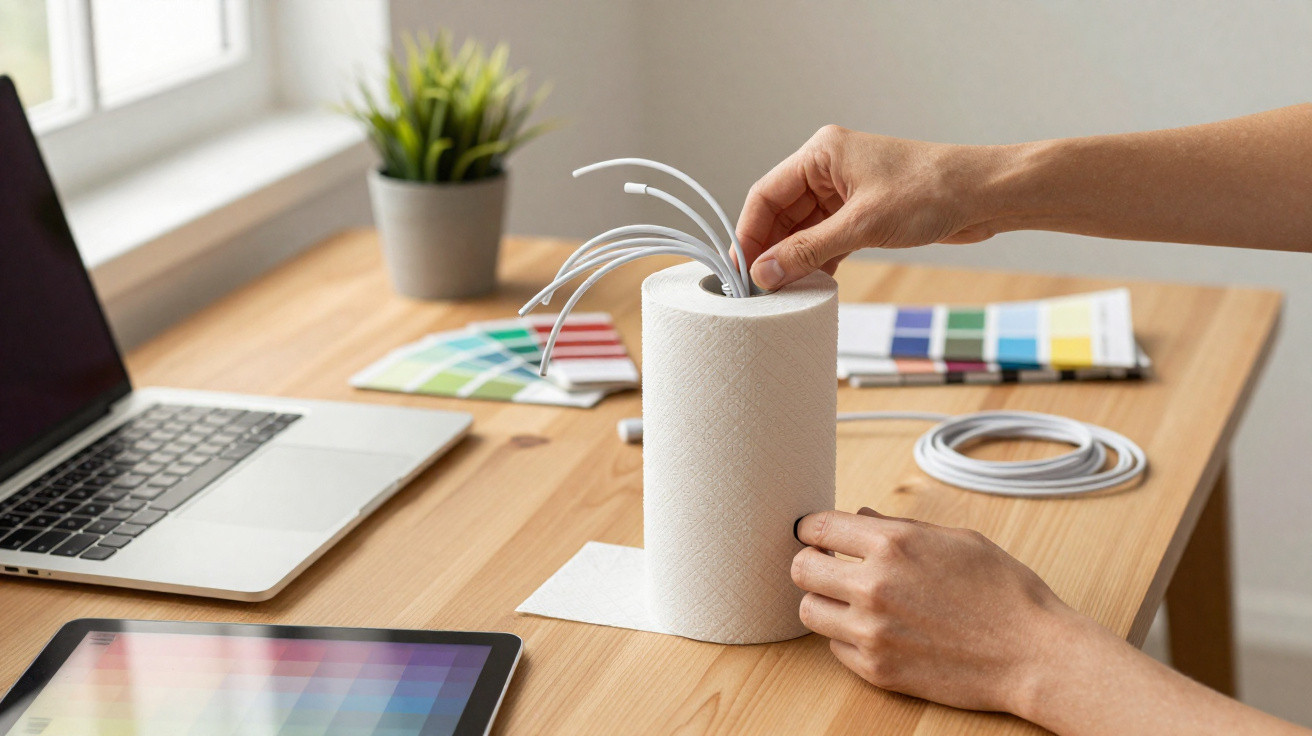
Cables curl around coffee cups, trail over notebooks and snag your sleeve just as an idea clicks. Designers often discuss flow and friction, yet few things break concentration like dusty, tangled black rubber. Most fixes people buy are expensive, loudly “techy” and untidy again by Thursday. That is why a quieter approach developed in studios and at kitchen tables: reuse, conceal, control. The solution seems almost ridiculous until you use it: a cardboard roll from a paper towel.
I first noticed it after arriving early at a Shoreditch co-working space, one of those places with concrete floors and plants that somehow always appear freshly watered. A motion designer unwound her cables in one hand while using the other to slide them into a plain cardboard sleeve marked by a single ink dot. There was no Velcro, plastic or complication. She turned the roll, pushed the excess cable inside and continued discussing colour palettes as though this had always been her routine. The cable mess was not merely neater; it had disappeared. It felt like a small act of desk magic.
Why the cardboard roll trick wins designer hearts
Its appeal is wonderfully unpretentious: it is simple, quick and slightly amusing. Designers are drawn to it because it has the feel of a craft solution rather than a gadget, something improvised on a shoot and worth keeping afterwards. It genuinely does the job. Push the tangled cable into the tube, pinch where it exits, and the desk suddenly becomes a clear, flat surface once more. Instead of reading as a web of leads, it looks like a desk again.
It is also tactile, which counts when your day is spent clicking and swiping. The fibre offers grip, its edges become softer over time, and your hand learns where to reach without needing to look. That understated convenience soon becomes hard to give up.
Consider a branding studio in Lyon: six desks, 11 laptops and a charging bar beneath the bench. By the middle of the week, leads would previously spread over keyboards like spaghetti. Someone then left out a basket of cardboard rolls, a Sharpie and a smiley face. By Friday, eight out of 10 people had adopted them. There were fewer Slack pings during afternoon stand-ups, as no one was rummaging for the correct cable halfway through a sentence. Nobody conducted a formal study, but the atmosphere changed like a room does when a curtain is opened. It was a minor adjustment with substantial relief.
The reasoning extends beyond being “cheap and easy”. Tangled cables are a visibility issue that produces micro-stress, while the roll conceals visual clutter and directs the cable route. Its cylindrical form keeps bends gentle, helping cords last longer, and prevents the grip-and-pull routine that can tug at your laptop. It is the sort of answer that feels like a knowing nod from somebody older and wiser.
Its textured surface is easy to label, allowing you to mark ports or names without a label maker, and the rolls stack tidily in a drawer. It costs practically nothing. That kind of design constraint encourages better habits.
How to pull off the cardboard roll trick in minutes
Find a clean paper-towel or shipping-wrap roll and cut it down with a craft knife; 10 to 12 cm suits most desk cables. Make one narrow notch at an end to secure the lead, then pass the connector through the roll so that the plug protrudes by about an inch. With a light turn of the wrist, wind the spare length inside, then rotate the tube until the cable sits naturally. Finish with a small colour dot or a one-word label, such as “USB-C,” “iPhone,” or “Wacom.” You will be able to understand your desk at a glance instead of searching through it.
Two frequent errors can spoil the effect. First, people force too many leads into one tube, making the sleeve bulge like a burrito. Use one roll per cable for everyday access, or no more than two for storage. Second, they overlook heat: always leave power bricks outside and ensure the roll can breathe near vents. Equally, do not conceal cables that you use all the time; make them calmer instead. Coil the sections you rarely need and retain an easy loop where your hand naturally reaches. We all know how a small snag can split your attention in two. This method guards your focus like a lens cap.
Designers refer to the “affordance” of materials, meaning how an object encourages your hand to use it, and cardboard quietly encourages order. It feels like you, rather than a product attempting to become your personality.
“Constraints are where taste shows up,” says Lina, a product designer who keeps four labeled rolls in a shallow tray. “If you can make the cheap thing look intentional, you’ve already won.”
- Select the right sizes: use narrow rolls for earbuds, standard ones for laptop leads and heavy-duty shipping cores for monitor cables.
- Use colour signals: assign a dot to each device, with warm colours for power, cool colours for data and black for “don’t touch.”
- Stay safe: keep away from active heat sources, leave bricks uncovered and avoid pinching leads at sharp angles.
- Add a finishing detail: a strip of washi tape can turn “recycled” into “considered” in two seconds.
What changes when cables disappear
Removing cables does more than make a desk look tidy; it alters how the workspace feels physically. Fewer snags bring fewer small irritations, and that ease is apparent when you return after lunch without your brain asking, “Where do I put my hands?” The route to your trackpad is unobstructed, your notebook can open flat and your mug can be set down without concern. Honestly, no one keeps this up every day, and there is no need to. Once the rolls are in place, the system sustains itself through tiny actions: slide, tuck, turn. Others notice the atmosphere rather than the trick, while you keep your attention for the work that actually pays the rent.
| Key point | Detail | Benefit for the reader |
|---|---|---|
| Hide visual noise | The roll contains spare cable and directs exit points | Immediate desk calm and fewer snags |
| Customise by hand | Labels, colours and sizes can match your arrangement | Quicker grab-and-go access and less decision fatigue |
| Zero-cost craft | Household rolls are reused without tools | Sustainable, fast and easy to adapt |
FAQ
- Does the cardboard ever look “too DIY” for a client-facing space? Keep the edges neat, apply a slim strip of neutral washi tape and use a simple label-clients will see deliberate minimalism rather than a workaround.
- Is cardboard safe around power cables? Reserve it for low-heat sections and never cover power bricks; allow airflow around everything and avoid tight bends near plugs or adapters.
- What if my pet loves chewing cardboard? When you are away, keep rolled cables in a shallow drawer or tray, and use a thin silicone sleeve for any runs at floor level.
- How do I travel with this trick? Cut shorter rolls and take two: one for a laptop cable and another for earbuds and a phone lead. Flatten them slightly before sliding them into a pouch.
- Won’t the roll get grimy? Replace it every few weeks, or cover the outside with a removable tape layer; as it is recycled material, you can renew it without guilt.
Comments
No comments yet. Be the first to comment!
Leave a Comment