
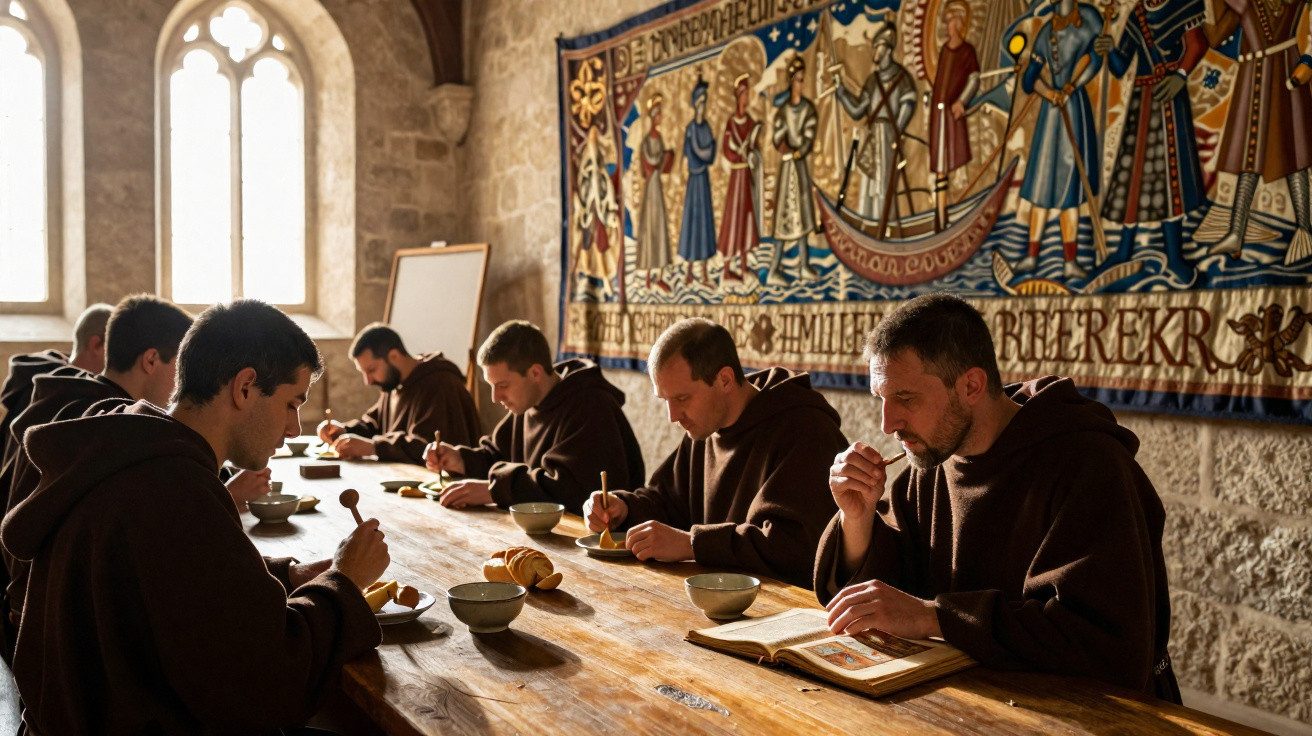
The Bayeux Tapestry - a vast embroidered textile illustrating the events that led to the Battle of Hastings in 1066 - has remained enigmatic for centuries. Yet the artwork, once seemingly forgotten, may finally have a plausible original home.
Although scholars almost unanimously accept that monks at St Augustine's Abbey in Canterbury, England, devised the tapestry and that skilled embroideresses produced it, its purpose and original display location remain uncertain.
The Bayeux Tapestry as monastic mealtime reading
In a new paper, historian Benjamin Pohl argues that the tapestry may have served as reading material during meals for monks at St Augustine's, or at a comparable monastery.
"I wondered whether a refectory setting could help explain some of the apparent and puzzling contradictions identified in existing scholarship," Pohl says, referring to the communal dining halls in which monks ate together.
"Just as today, in the Middle Ages mealtimes were always an important occasion for social gathering, collective reflection, hospitality, and entertainment, and the celebration of communal identities. In this context, the Bayeux Tapestry would have found a perfect setting."
No firm evidence proves that the Bayeux Tapestry was kept at St Augustine's. Nevertheless, Pohl identifies several indications that it could once have been displayed on the abbey refectory's walls.
At more than 68.4 metres (224 feet) in length and weighing roughly 350 kilograms (772 pounds), the huge textile would have needed to be fixed directly to a substantial wall for exhibition.
Earlier researchers have proposed that it may always have been held at Bayeux Cathedral, the site where it was discovered in the 15th century. However, Pohl observes that the cathedral's vaulted bays and colonnaded walls would have made it "one of the least suitable spaces for exhibiting the giant embroidery".
Why St Augustine's monks were a likely audience
Pohl writes that the tapestry was probably still created for a religious audience. This is because "its conspicuous (and perhaps deliberate) political ambiguity and lack of partisanship… seems difficult to square with the identity and self-perception of England's post-Conquest aristocracy".
Its numerous Latin captions were straightforward, but would still have demanded literacy that was unusual among 11th-century nobles. Monks, by contrast, would have had little difficulty reading the inscriptions.
The case for a monastic audience is further strengthened by the strict rules governing meals. Monks were required to remain entirely silent, even using sign language to request something as simple as the salt. The tapestry may therefore have provided morally instructive and educational entertainment during dining.
"With the monastic community of St. Augustine's as its primary audience, the Bayeux Tapestry did not have to tell the stories of patriotism and national pride/resentment read into it by modern commentators," Pohl writes.
Instead, he proposes that its story may have been understood as "one that revealed God's workings through the actions of human agents in much the same way as the episodes from scripture and other kinds of historiography/hagiography read to them during mealtimes."
A refectory large enough for the tapestry
St Augustine's refectory would have offered a particularly suitable location for such an awkwardly sized artwork. The building had at least 70 metres of internal wall space, enough to accommodate the tapestry even if its lost final section extended for several additional metres.
A replacement refectory was planned for the abbey in the 1080s, but repeated setbacks delayed construction. The first was the unexpected death in 1087 of Scolland, St Augustine's first post-Conquest abbot, who had supported the refurbishment.
Afterwards, Scolland's unpopular successor, Wido, died following an open rebellion by the monks. His death left the abbacy unfilled for more than a decade.
When Hugh I eventually assumed the role, St Augustine's had other priorities, and the refectory was not finished until the 1120s.
Pohl suggests that the tapestry may have been packed away during this prolonged rebuilding project and gradually faded from the monastic community's shared memory.
"Consequently, the Tapestry might have been put in storage for more than a generation and forgotten about until it eventually found its way to Bayeux three centuries later," Pohl says.
Such a scenario could account for both its survival through disasters at the abbey - including a fire, an earthquake and a 13th-century renovation - and its lack of documentary mention before appearing in a Bayeux inventory in 1476.
"There still is no way to prove conclusively the Bayeux Tapestry's whereabouts prior to 1476, and perhaps there never will be," explains Pohl.
"But the evidence presented here makes the monastic refectory of St Augustine's a serious contender."
The complete Bayeux Tapestry can be viewed on Wikipedia.
The paper appears in Historical Research.

Comments
No comments yet. Be the first to comment!
Leave a Comment