
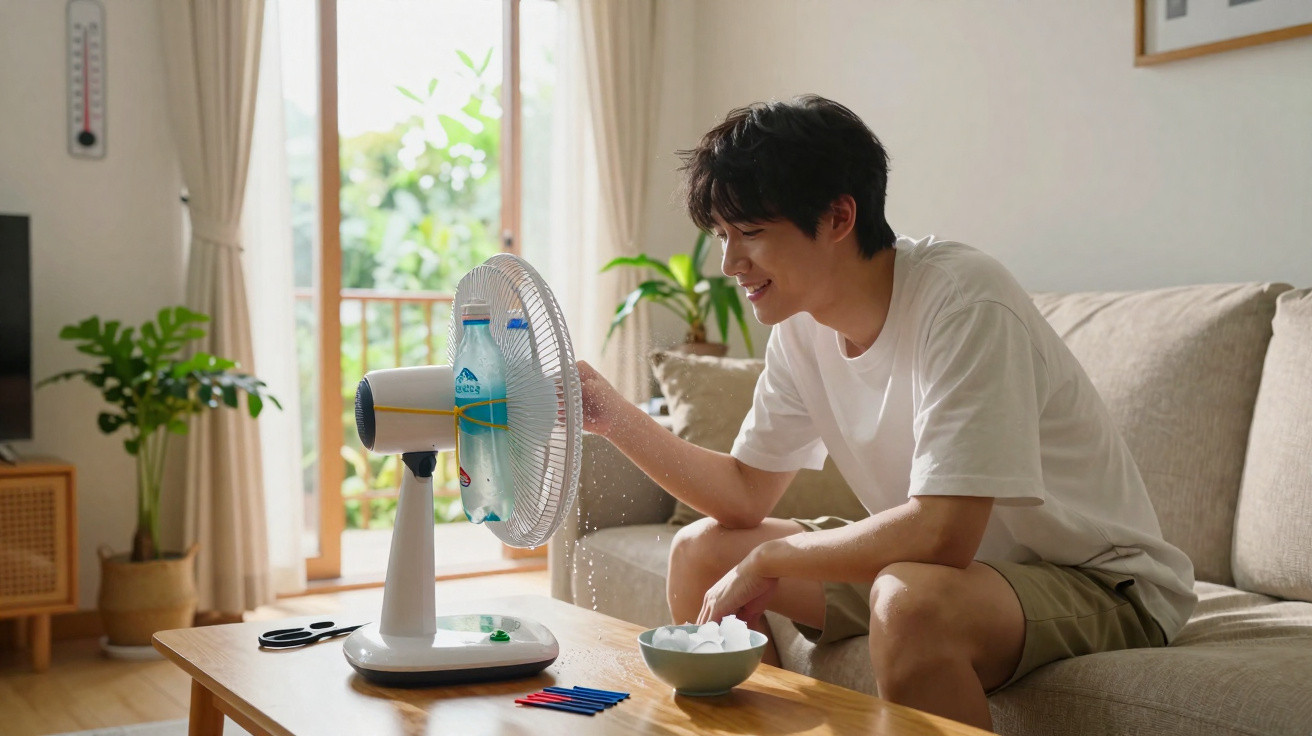
During periods of intense heat, many people turn to straightforward ways of making their homes more comfortable without paying for expensive equipment. One alternative that has become popular on social media involves attaching a PET bottle filled with frozen water to a fan, creating a kind of “homemade air conditioner” from everyday household items.
How does a fan with a frozen PET bottle work?
The idea is straightforward: the fan directs air towards the PET bottle containing frozen water, and as the air passes over the cold surface, it can become cooler before circulating around the room. It is not a genuine air conditioner, but an improvised cooling method that may provide temporary thermal relief in small spaces.
In this set-up, the bottle is secured to the grille with tape, wire or brackets, while the moving air loses some of its heat as it flows around the ice. Its effectiveness decreases as the ice melts, so the bottle must be refrozen or replaced. The result is generally most noticeable during the first few hours after the bottle has been taken out of the freezer.
Does a fan with a frozen PET bottle actually cool the room?
From a physics perspective, ice absorbs heat from the air as it changes from a solid into a liquid, contributing to localised cooling. The sensation may resemble air conditioning on a far smaller scale, with its reach largely limited to the area close to the fan and the person sitting in front of it.
Energy-efficiency specialists note that the outcome varies according to the room size, the number of bottles used, the fan’s power and the outdoor temperature. In very hot places or rooms exposed to strong sunlight, the effect is slight; in small, enclosed bedrooms, however, the feeling of relief is likely to be more noticeable.
- Advantage: reused materials can be used, with a low set-up cost.
- Limitation: its effect is confined to areas near the appliance and lasts only for a limited time.
- Duration: determined by how long the ice in the bottle takes to melt completely.
What precautions are important when using a PET bottle on a fan?
Although this is a simple solution, the safety and condition of the appliance require attention. The bottle must not put excessive weight on the grille or motor, and it needs to be attached securely to prevent it from falling, breaking or causing excessive vibration that could damage the fan.
Water created by condensation and melting ice is another consideration, as it can drip onto floors, furniture or areas close to electrical components. To minimise risks, many people place containers beneath the bottle or use absorbent cloths, while keeping sockets, extension leads and power strips away from any moisture.
- Freeze the bottle completely before using it.
- Attach the bottle firmly and securely in front of the fan.
- Prevent water from coming into contact with cables, plugs and electrical parts.
- Monitor the fan during its first few uses so that the position can be adjusted if necessary.
When can a fan with a frozen bottle be most useful?
This “homemade air conditioner” is usually more useful on warm nights, during moderately hot spells or in places that do not receive direct sunlight for many hours. Small bedrooms, home offices and compact living rooms with little outside air circulation are settings where the effect is likely to be more noticeable.
It can also be used alongside other simple measures, such as closing curtains during periods of strong sunshine, limiting the use of lamps and electronic devices that warm up the room, and airing the property during the cooler hours of the day. In this way, a fan with a frozen bottle can serve as a practical, low-cost option for adding a little more thermal comfort on hot days.





Comments
No comments yet. Be the first to comment!
Leave a Comment