
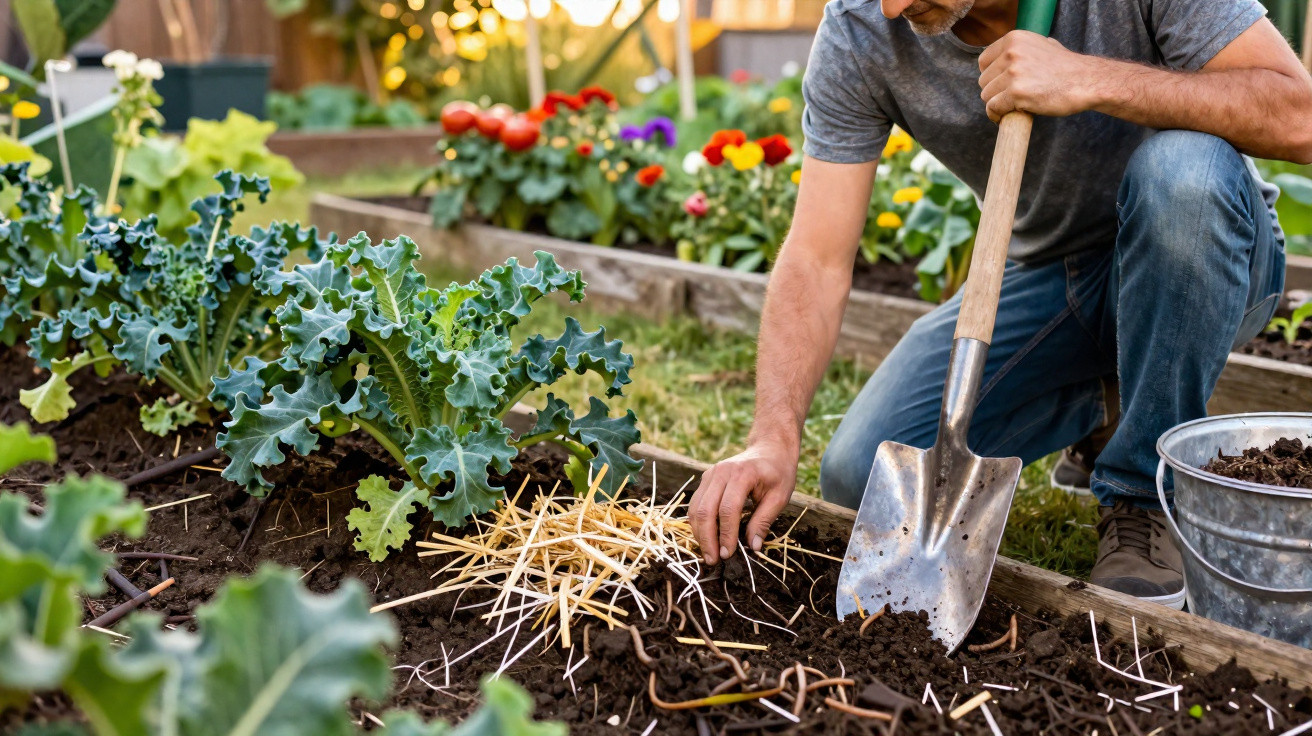
Winter can feel like a pause in the garden: your hands are itching to get started and plans for the new vegetable-growing year are already taking shape. For many people, that traditionally means digging everything over, breaking the soil into a fine tilth and turning every root upside down. Yet what looks like diligent care is increasingly proving to be one of the biggest mistakes in the home garden.
Why we assume a “thoroughly dug-over” garden is better
The image of the ideal vegetable garden is deeply ingrained: dark, bare soil that has just been dug, with not a blade of grass or fallen leaf in sight. After a day with a spade, anyone without aching muscles can almost feel guilty.
This approach largely originates in agriculture. For decades, deep ploughing and heavy tractors were held up as the model. Methods that worked reasonably well across large monoculture fields were adopted unquestioningly for home gardens, despite the conditions being entirely different.
A vegetable garden is not a miniature arable field, but a tiny ecosystem that should be treated very differently.
There is also the ideal of the “tidy garden”. Open soil broken down into fine crumbs appears neat and controlled. In nature, however, you rarely find anything like it. Healthy soil is almost always covered, whether by leaves, plant remains or living roots. There, bare soil would be a warning sign; in our gardens, it is still far too often seen as the goal.
Beneath your boots: how spades and hoes damage soil life
When you dig, you see brown earth and perhaps a few earthworms. Beneath the surface, though, a biological landslide is taking place. Soil is not an inert growing medium, but a living system of animals, fungi and bacteria.
Earthworms: the hidden builders
Deep digging destroys the tunnels made by earthworms. These very channels allow water to drain away and air to reach deeper layers. Many worms are highly sensitive to light and drying out, so they die on the surface or become food for birds.
Their numbers decline with every season. The result is denser soil, more frequent waterlogging, and plant roots having to force their way through something more like concrete than loose humus.
The fungal “internet” is cut apart
Even less visible, but equally important, is the delicate web formed by soil fungi. Their threads link roots, move nutrients and water, and even allow plants to “exchange” warning signals when pests attack.
Every cut of the spade severs these connections. Plants then have to painstakingly rebuild them instead of putting their energy into leaves, flowers and fruit.
Anyone who constantly cuts deep furrows repeatedly disconnects their plants from their natural supply network.
When loosening makes soil harder: the problem of surface crusting
Many gardeners loosen soil because it feels too hard. Straight after digging, everything seems wonderfully light and fluffy. After a few weeks of rain, however, the surface suddenly becomes rock-hard, an effect many people interpret as a personal failure.
The cause is a physical process. In intact soil, small aggregates are held together by humus, clay and biological “glues”. Intensive breaking-up destroys these crumbs, causing the structure to collapse into individual particles.
When rain falls, these fine particles block the pores. As the ground dries, a sealed crust develops. Water runs off, very little air can enter, and young seedlings struggle to break through the hard layer.
The more often you make the soil look finely “beautiful”, the faster rain turns it into a concrete slab.
Many amateur gardeners respond by digging even more intensively the following year. This creates a cycle of continual cultivation and increasing compaction.
How using a spade sows most weeds for you
People who dig frequently also spend plenty of time kneeling down to weed. That is no coincidence. Every soil contains a huge reserve of weed seeds, often dormant for years.
As long as these seeds remain deep down in darkness, they stay inactive. Digging brings them up towards the light, which triggers germination in many species.
- deep spade cut → old seeds are brought to the surface
- light and oxygen → the signal to begin germinating
- the bed looks “clean” → a dense carpet of weeds appears a few weeks later
By leaving soil undisturbed and covered, you keep those seeds at depth instead. There, they can often remain inactive for decades. As a result, the number of newly emerging weeds falls noticeably with each season.
Soil as a nutrient addict: why constant digging makes it hungry
One common claim is: “Digging gets nutrients moving.” In the short term, that is indeed true. Strong aeration suddenly sends certain bacteria into overdrive, causing them to break down organic matter at a rapid rate.
This releases a great deal of nutrients in a short period. Plants make a turbo-charged start and grow a rich green, leaving the gardener feeling vindicated. What remains unseen is that this boost uses up the store of humus.
Anyone who “wakes up” the soil every year lives off its reserves and empties its humus savings account.
Over time, the soil becomes poorer and less able to retain water and nutrients. It behaves like an addicted patient: without external fertiliser inputs, hardly anything works. The garden then slips into an unwanted dependence on fertiliser instead of remaining stable under its own steam.
Gentle methods: keeping soil loose without destroying it
The good news is that putting the spade aside does not mean letting your garden run wild. On the contrary, it means working more intelligently, alongside soil life rather than against it.
Aerate with a garden fork instead of churning
Tools with several tines that merely lift and gently tip the soil without turning it over are a useful alternative. They relieve compaction and allow air in while leaving the layers largely where they belong.
This keeps microorganisms in their familiar environment. The vertical structure, with both deep and shallow habitats, remains intact. This way of working is also far kinder to your back and shoulders than vigorous shovelling.
Roots, mulch and green manures as natural soil workers
It is even more effective to leave soil bare as rarely as possible. Permanent cover acts both as a protective blanket and as a food source for soil organisms.
Suitable materials include:
- autumn leaves
- straw or hay
- woodchip from pruned shrubs
- unbleached, unprinted cardboard
Earthworms gradually pull these layers downwards, turn them into humus and loosen the soil as they do so. At the same time, you can deliberately grow plants with strong root systems, including green manures such as phacelia, mustard or different clovers. They break through compacted layers and, once they die back, leave fine channels behind in the soil.
| Method | Effect on the soil |
|---|---|
| Deep digging | destroys structure, encourages crusting, speeds up humus breakdown |
| Loosening with tines | improves aeration, largely protects soil life |
| Permanent mulch cover | protects against erosion, feeds earthworms, retains moisture |
| Green manure | roots through and loosens the soil, adds fresh organic matter |
Making the switch: how to change your own garden
No one needs to transform their entire garden overnight. In fact, a gradual approach makes it easier to learn. For the coming season, try this straightforward method:
- Choose one bed where you will experiment with no longer digging.
- Loosen it only roughly where necessary, and remove roots of troublesome perennial weeds.
- Cover the bed with mulch immediately.
- In spring, open up only the planting rows or planting holes you need.
- Continue mulching between the rows rather than hoeing.
This area gives you a direct comparison: how does soil moisture develop? How easily can you push your hand into the earth? How vigorously do weeds grow compared with conventionally cultivated beds?
What common technical terms really mean in everyday gardening
Terms such as “humus”, “soil structure” and “green manure” may sound abstract, but they determine whether gardening brings success or frustration. Humus is ultimately simply the stable remainder left from decomposed plant and animal material. The greater its proportion, the more sponge-like and alive the soil feels.
You can recognise good structure when the soil breaks apart into small crumbs in your hand, rather than dust or large solid lumps. Green manure means deliberately sowing plants primarily to benefit the soil rather than for harvesting: a kind of wellbeing treatment for the bed.
Once you have experienced these relationships in your own garden, you will willingly set the spade aside more often. Instead of spending time on exhausting “soil care”, you can devote it to harvesting, observing and marvelling at how much work earthworms and roots do when they are allowed to.




Comments
No comments yet. Be the first to comment!
Leave a Comment