
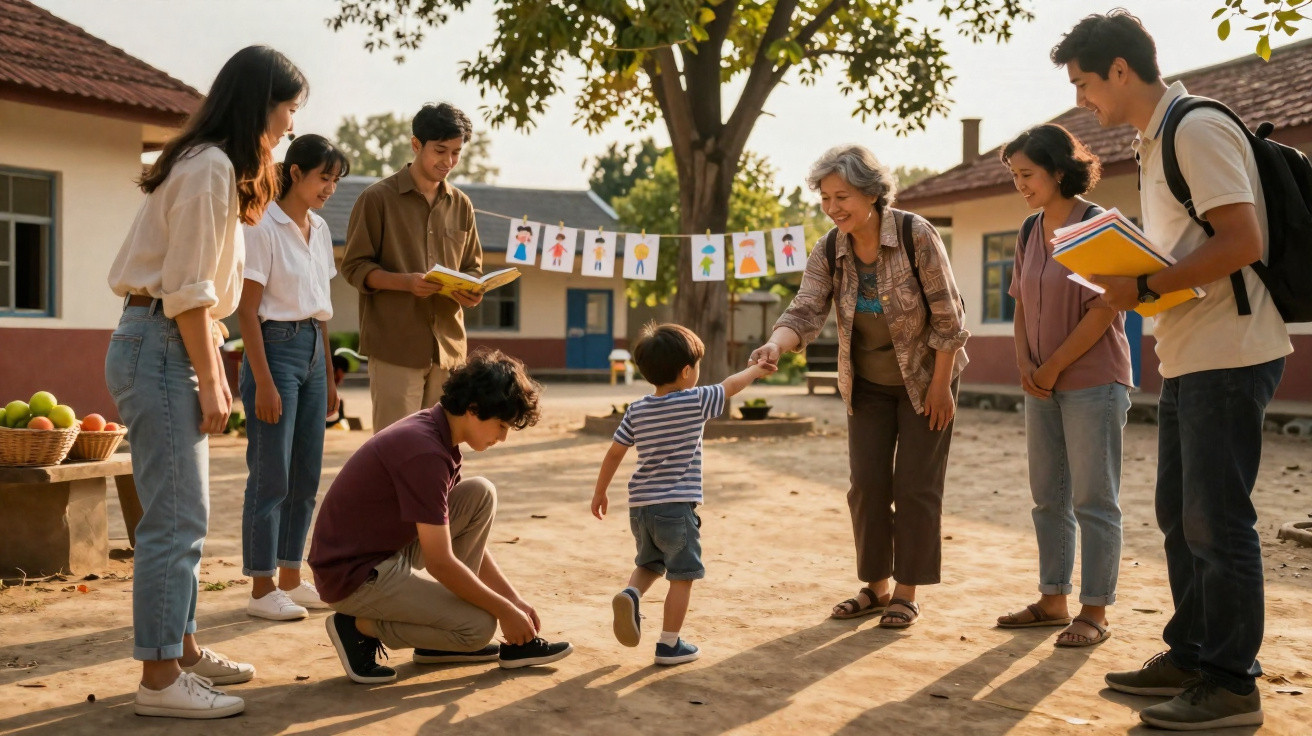
The proverb about an entire village makes sense through the lens of Ubuntu philosophy, which holds that a person exists through their relationships with others. From this perspective, child and community cannot be regarded as separate worlds or as isolated responsibilities.
What does Ubuntu reveal about living in a community?
Ubuntu is commonly understood as a concept found in Bantu languages, particularly Zulu and Xhosa, connected with the idea of humanity towards other people. At its ethical heart, it brings together the individual and the collective, showing that human life finds meaning within community relationships.
The philosophy challenges narcissism and individualism by placing value on compassion, open-mindedness, sharing and trust. Applied to childhood, it indicates that care and development rely on strong social ties rather than solely on a family’s private efforts.
This principle is clearly reflected in values including:
- Brotherhood: each person’s humanity is connected to the humanity of others.
- Compassion: supporting another person is a natural part of shared life.
- Communion: the “I” cannot be entirely detached from the “we”.
- Solidarity: individual actions directly affect the whole social fabric.
- Reconciliation: living together should restore relationships and reinforce social peace.
Why does the proverb place education in the hands of many people?
If people become people through other people, childhood likewise unfolds within this same network of relationships. This is precisely the logic expressed by the proverb: education and belonging emerge from living alongside others, their presence and shared responsibility.
Parents remain essential in shaping values, language and emotional security, but they are not the only people involved. The village represents the network of adults, institutions and relationships that provides guidance and support throughout a child’s development.
How does Ubuntu philosophy shed light on the school’s role?
The concept highlights that Ubuntu encourages strong social connections and peaceful coexistence because the “I” is inseparable from the “we”. It therefore helps us see school as a setting for living together and development, rather than simply a place where content is delivered.
School as a living community
Learning also means belonging
By emphasising the connection between the person and the community, Ubuntu suggests that educational environments should foster respect, sharing and trust, as well as individual achievement.
School work consequently takes on a broader role: teaching subject content remains important, but teaching people how to live together also becomes a central part of human development.
When teachers, classmates and school staff form part of this network, children encounter different examples of cooperation and boundaries. Learning becomes stronger because welcome and discipline no longer operate as opposing forces, but work together in everyday life.
This approach makes it possible to view school as:
- an extension of community life;
- a place for sharing and trust;
- a space for ethical and social development;
- practical support for child development.
What does this idea teach us about family support networks?
Ubuntu maintains that individual actions have collective consequences and that helping others strengthens the entire social fabric. Raising children without a support network therefore places greater pressure on each adult and weakens the protection and continuity of care.
In Brazil, this reflection relates to grandparents, aunts, uncles, neighbours and friends who participate in children’s everyday lives in different ways. A support network does not replace the family; instead, it extends the family’s ability to provide presence and stability during difficult periods.
This collective network can take simple forms:
- sharing care and supervision duties;
- providing a listening ear and guidance in times of tension;
- creating reliable adult role models around the child;
- strengthening connections between home, school and community.
How does this proverb remain relevant to raising children?
The phrase retains its power because it reminds us that no one matures alone, an idea close to the folk wisdom passed down through generations. Rather than isolation, childcare calls for alliance and cooperation among those around the child.
More than an abstract celebration of community, the proverb provides a practical rule for the present day. Raising children well requires recognising that childhood thrives when its path is supported by a network of respect and solidarity.






Comments
No comments yet. Be the first to comment!
Leave a Comment