
One everyday cupboard staple can transform the way you clean floors, helping to tackle dirt and germs without filling your home with harsh chemical fumes.
As more households turn away from aggressive cleaning products, a subtle change is taking place beneath our feet: an approach to floor washing that deals with grime and bacteria while posing fewer concerns for health and indoor air quality.
Why so many people are rethinking floor cleaner
Floors collect almost everything: dust, pet dander, dropped food, pollution carried in from roads and even pesticide residues. Each footstep can send these particles back into the air. Cleaning floors is therefore about much more than appearance; it affects the air inside your home.
For many years, ammonia and bleach have been standard choices in households. They remove grease, destroy a broad range of microbes and create the “disinfected” scent that many people remember growing up with. However, both involve unwelcome compromises, particularly in confined or badly ventilated rooms.
Ammonia may aggravate the eyes, throat and lungs. Bleach gives off fumes that can react with other airborne chemicals. If used improperly or combined with an unsuitable product, they can create toxic gases. Those with asthma or allergies are often among the first to notice the effects.
Floor cleaners do not just touch surfaces. They shape indoor air quality, especially for children and pets close to the ground.
Frequent bleach use also sends wastewater into rivers and coastal waters, adding chemical burdens to ecosystems that are already vulnerable. Increasingly, consumers are looking for products that clean effectively without feeling like they are handling laboratory chemicals.
The pantry ingredient that upgrades your mop bucket
A remarkably useful cleaning helper may be sitting beside your olive oil or pickles: ordinary white vinegar. Combined with water, it can loosen mineral build-up, cut through soap residue, lessen odours and disrupt the growth of many common household microbes.
The acetic acid in vinegar works by breaking down the bonds that allow dirt to adhere to a surface. On sealed tile, vinyl and many laminate floors, a gentle vinegar mixture can remove daily grime without creating a sticky residue.
For most sealed hard floors, a bucket of warm water with a splash of white vinegar is often all you need for regular cleaning.
How to use vinegar safely on floors
- Choose cold or lukewarm water rather than boiling water to safeguard floor finishes.
- Begin with a weak solution: roughly 120 ml of white vinegar for 4 litres of water.
- Wring out the mop thoroughly, particularly on laminate, so the floor is not saturated.
- Try the mixture first in an inconspicuous area, especially where grout is coloured or sealant is old.
This solution can tackle minor marks, routine kitchen spills and the dull grey layer that develops in busy hallways. Since vinegar dries rapidly, it often leaves fewer streaks than heavily fragranced floor products.
When vinegar is not the best choice
Not all materials respond well to acid. On natural stone, including marble, limestone and travertine, as well as unsealed concrete, vinegar’s limescale-cutting action can also etch or dull the finish.
With repeated use, acidic mixtures may make these sensitive surfaces rougher. This increases their porosity and, somewhat ironically, can make them more difficult to clean. This is where another gentler cupboard favourite comes into play: lemon.
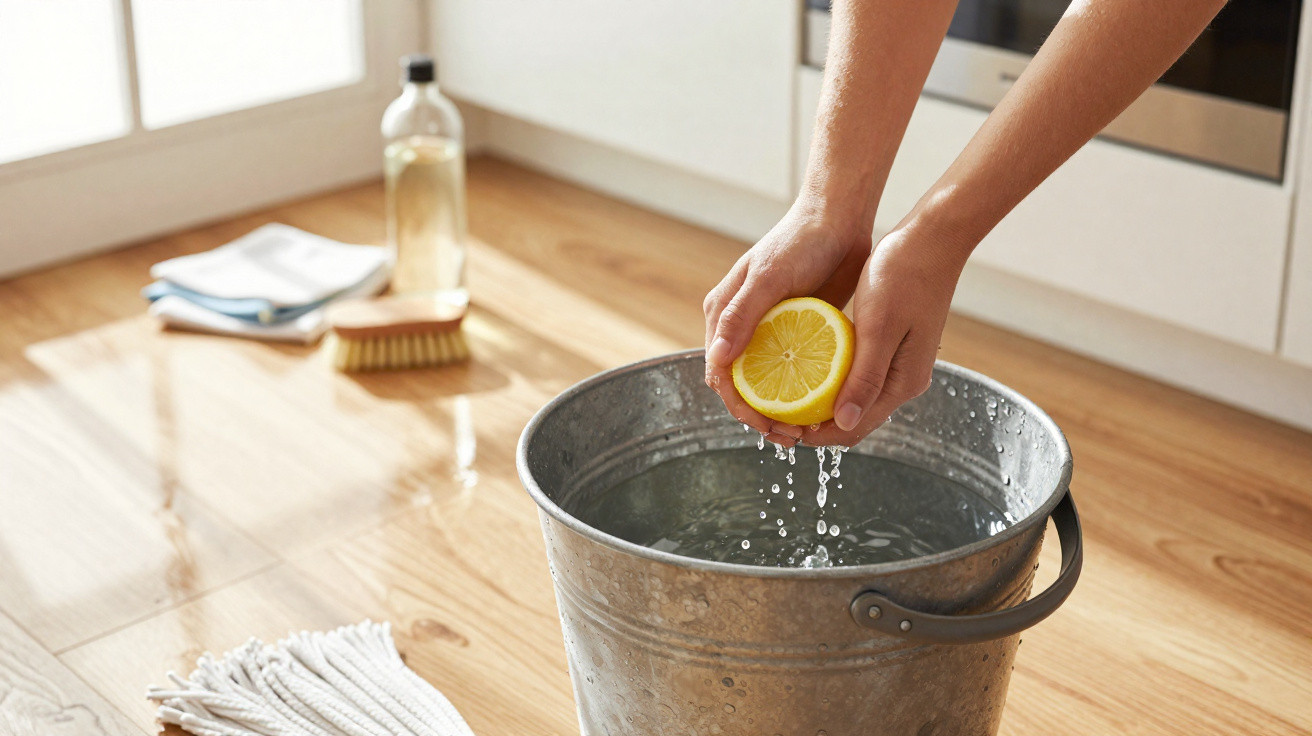
Lemon water, the softer alternative for delicate floors
Fresh lemon juice contains citric acid, which provides both degreasing and deodorising properties. When diluted more generously than vinegar, it makes a very gentle mixture that many householders choose for surfaces where they want to avoid stronger acids and artificial fragrances.
For routine mopping, some cleaning specialists recommend a blend of one tablespoon of lemon juice with 4 litres of water. Its scent is fresher than vinegar, while the mixture can still help lift light grease and food remnants.
Lemon water, used in very small amounts, offers a calmer middle ground between harsh detergents and plain water.
Lemon can also be combined with a very small amount of neutral washing-up liquid for sticky areas in the kitchen. Clear water should then be used to rinse the floor, preventing a residue that could attract dust.
Choosing between vinegar and lemon
| Ingredient | Best suited for | Main benefits | Key cautions |
|---|---|---|---|
| White vinegar | Sealed tiles, vinyl, many laminates | Degreases, deodorises, limits limescale | Avoid on natural stone, terrazzo, waxed wood |
| Lemon water | Light cleaning on sealed floors, quick refresh | Mild, pleasant scent, plant-based | Use highly diluted, can still damage stone if too strong |
Why terrazzo needs special attention
Terrazzo has returned strongly in both new-build properties and renovation projects, appearing everywhere from bathroom floors to streamlined kitchen islands. It combines marble, quartz, granite and other chips with a binding material, before polishing produces its flecked, almost terrazzo-stone appearance.
Because it contains marble fragments, terrazzo reacts poorly to acids. Although it may look hard-wearing, vinegar and lemon can gradually tarnish the material, particularly when spills are allowed to remain on the surface.
Experts generally advise a more straightforward method. For day-to-day upkeep, they recommend a soft brush, microfibre dust mop or vacuum cleaner fitted with a hard-floor attachment. This clears away abrasive grit that could scratch the polished surface.
With terrazzo, mechanical cleaning – sweeping and vacuuming – matters more than strong chemicals. Gentle products help preserve the shine.
For wet cleaning, pH-neutral products clearly marked as suitable for stone or terrazzo are preferred, diluted with water. Once again, minimal use is best: a mop that is only just damp, followed by careful drying, helps prevent water marks and protects the binder holding the chips together.
Matching cleaner to floor type
There is no universal ingredient that suits every type of floor. The wrong cleaner can reduce the lifespan of a costly surface, so checking the manufacturer’s guidance can prevent problems later on.
- Ceramic or porcelain tiles: usually cope well with diluted vinegar, provided the grout remains properly sealed.
- Vinyl and most laminates: can take mild vinegar or lemon water, but should never be left with standing water.
- Engineered and solid wood: are better cleaned with dedicated wood products, as excess water can cause boards to swell.
- Natural stone and terrazzo: require pH-neutral, non-acidic cleaners alongside regular gentle sweeping.
Intense fragrances and brightly coloured cleaning liquids do not usually indicate better hygiene. They are largely marketing decisions. Friction, clean water and consistent cleaning are what do the real work.
Health, cost and environmental angles
Replacing ammonia or bleach with vinegar or lemon water changes more than how your home smells. It lowers the quantity of volatile compounds released during mopping. This is relevant for children who play on the floor and pets that lick their paws after walking through freshly applied cleaning solution.
In budget terms, a bottle of white vinegar generally costs less than a branded disinfectant and can be used for dozens of mop buckets. The same is true of a bag of lemons, especially if you use fruit left over from cooking.
Environmentally, these cupboard acids break down quickly after dilution in wastewater. They should still be used responsibly – tipping pure acid down a drain benefits no one – but their longer-term effect appears lighter than that of many chlorine-based products.
When you still need something stronger
Some circumstances may still call for a hospital-grade disinfectant: following a sewage backup, during outbreaks of particular infections or in professional environments with strict procedures. For typical household floors, that degree of strength rarely offers a clear advantage.
Many public health bodies now stress that detergent and water should come first. Disinfection should be targeted and follow afterwards, rather than preceding it. Mopping at the right time with a mild solution, alongside frequent sweeping, can remove a substantial proportion of the microbial load before a disinfectant bottle is even needed.
Going a step further: building a low-tox cleaning routine
Changing your floor cleaner can prompt a broader review of household cleaning products. Some homes adopt a compact selection of essentials – including baking soda, vinegar, citric acid and neutral soap – and base most of their cleaning routines on these items.
This method reduces plastic packaging, creates more room in cupboards and lowers the risk of accidentally combining incompatible chemicals. It also encourages closer label reading. Once you look at the ingredients in conventional floor cleaners, the list can seem unexpectedly long beside a bottle of diluted vinegar.
For people who are sensitive to scents, this transition may provide genuine comfort. The smell of vinegar usually fades once it has dried, while lemon’s fragrance comes from real fruit instead of synthetic perfume mixtures. One modest adjustment to the mop bucket can discreetly alter the whole atmosphere of your home.

Comments
No comments yet. Be the first to comment!
Leave a Comment