
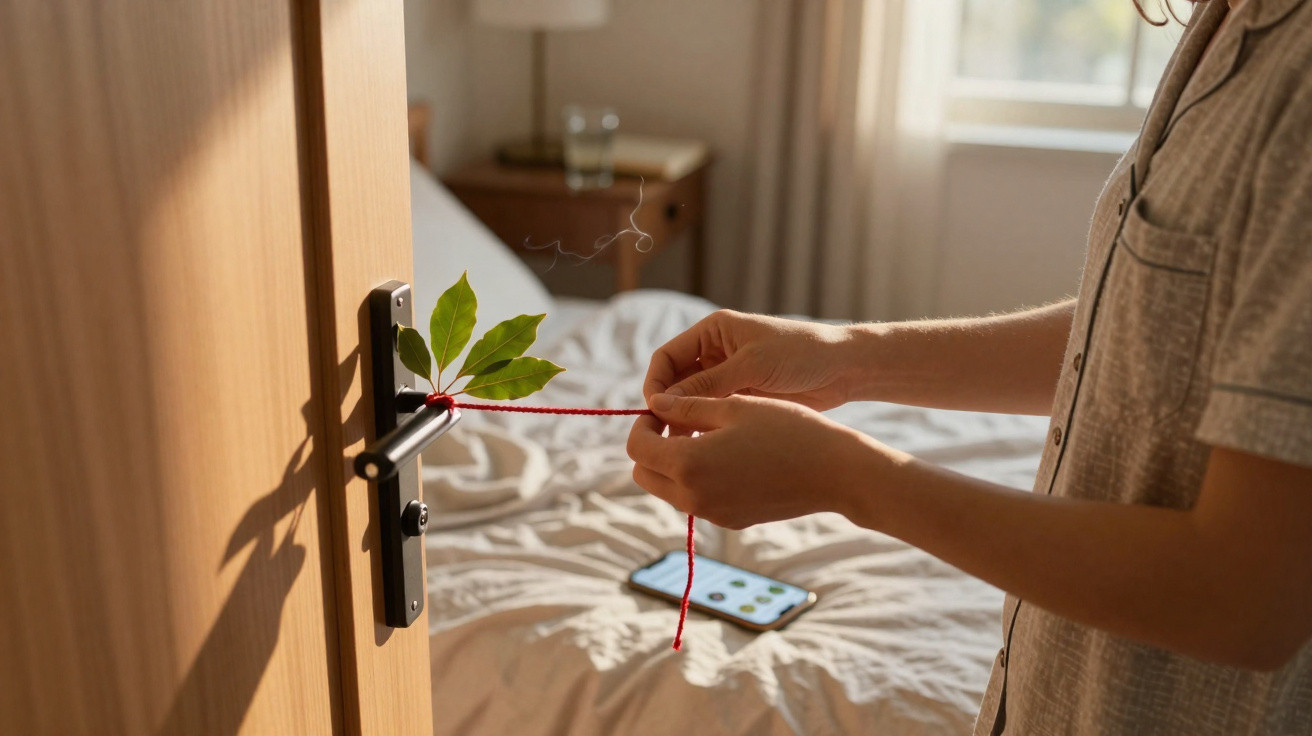
In a London flat, a young woman tapes three bay leaves above her door handle. In a Greek village, a grandmother hangs seven from red thread, her hands steady as though she has repeated the ritual a thousand times. Two continents, one small green talisman.
On TikTok, some people swear these dried leaves keep nightmares, bad energy and sometimes even bad luck at bay. Others openly ridicule the idea, calling it recycled superstition with a boho décor twist. Between them sits a quiet audience, watching videos, reading comments and wondering who is right.
Between a protection ritual and a simple placebo
The first time you spot bay leaves on a bedroom door, they can seem like a DIY attempt that has gone slightly wrong: a small cluster of dried green leaves, secured with kitchen string or tape, shifting gently as the door shuts. There is nothing showy about it. No crystals, clouds of incense or elaborate ceremony. Only a discreet, determined gesture.
Still, people attach enormous meaning to those leaves. They are said to offer protection from “negative energy”, improve sleep and encourage calmer dreams. To some, they create an unseen barrier between their most vulnerable space and the wider world. To others, they are simply a reason to roll their eyes and keep scrolling. One object, one doorframe, two very different interpretations.
Bay has a remarkably extensive history across cultures. The ancient Greeks burned it in temples devoted to Apollo. In some Mediterranean communities, it has been used to bless homes and repel gossip or “bad mouth”. Nineteenth-century folklore books refer to bay leaves hung near beds to guard sleeping people and “brighten visions”. Scientifically, there is plainly no connection between a leaf on a door and a person’s luck. The psychological relationship between a small ritual and a more settled mind, however, is genuine. People have always needed somewhere to place their anxieties.
Spend long enough on social media and the trend soon appears: a brief video, gentle music and a promise that bay leaves hung by a bedroom door can transform your energy. One New York creator tells viewers that she did it before an important job interview. She says she slept properly for the first time in weeks and arrived “feeling protected”. She got the job, and the bay leaves have become inseparable from that moment in her mind.
Another video takes a very different approach. A man in a hoodie laughs while taping a bay leaf above his flatmate’s door “for science”. A week later, he reports no miracles, only one issue: “It smells like pizza seasoning every time I walk in.” The comments are divided. Some accuse him of making fun of “old magic”, while others point out that at least the home smells pleasant. The statistics are difficult to establish. A quick search for “bay leaves protection bedroom” produces millions of views in multiple languages. That does not demonstrate that it works; it demonstrates that people want it to.
Viewed rationally, a leaf cannot create a force field. No peer-reviewed study shows that bay leaves prevent misfortune or nightmares. There is, though, research into belief and ritual. When someone carries out a straightforward, repeatable action before bed, the brain can read it as a signal of safety. The heart rate may ease slightly, thoughts can slow, and sleep may come more readily. Is it a placebo? Yes. Yet a placebo still produces a real bodily effect. The online disagreement is therefore not truly about bay leaves, but about what qualifies as “real”: only outcomes that can be measured, or personal experience too.
How people hang bay leaves on bedroom doors
A closer look reveals an informal method behind the trend. Most people choose dried bay leaves rather than the fresh, flexible leaves from a newly bought plant. Three, five or seven leaves are the usual quantities, depending on the tradition - or TikTok video - someone has followed. They are commonly tied with fine red or white thread, then placed on the inside of the bedroom door at eye level or just above it.
Some people add another step, writing a word on each leaf with a pen: “Protection”. “Peace”. “Clarity”. They hang the small bundle, close the door and take one slow breath. The whole ritual takes perhaps 30 seconds. There is no chanting or dramatic soundtrack, just an ordinary action that quietly communicates: beyond this threshold, I want to feel safer. Even if it’s only in my head.
The usual errors are practical rather than mystical. Bay leaves are still leaves, after all: they gather dust, fade and can crumble, leaving small fragments on the floor or bed. Let’s be honest: nobody really performs a meticulous daily clean of the talisman above the door. Others place them too near lights or candles, turning a spiritual shortcut into a fire hazard.
There is also an interpersonal element. Flatmates or partners may consider the ritual “weird” and quietly remove it. Parents may feel concerned when teenagers begin creating bedroom altars without saying why. Usually, the kindest response is the most straightforward one: have a conversation. “This makes me feel calmer” is difficult to dispute, provided no one is claiming miracles or rejecting medical support because of a leaf. The ritual should complement wellbeing, never take the place of proper care.
One herbalist I spoke to expressed it bluntly:
“The bay leaf doesn’t protect you. The story you tell yourself while you hang it does. The leaf is just the bookmark in that story.”
This is where the practice can become quietly meaningful rather than merely decorative. You set an intention, move your body and touch something natural before bed instead of reaching for your phone. The bay leaf then becomes a cue to stop, breathe and decide what you will allow to cross your threshold that night.
- Put the leaves somewhere you will notice every day, rather than concealing them behind the doorframe.
- Replace them every 4–6 weeks to prevent crumbling and excessive dust build-up.
- Pair the ritual with one practical safety measure: lock the door, switch off notifications or begin a short journalling habit.
Is it magic, superstition or simply a gentle bedtime habit?
A neuroscientist may discuss conditioned responses and bedtime signals. A grandmother from southern Italy may speak of “the evil eye” and explain why her own mother always placed laurel near the bedroom. A stressed person in their twenties who tried it last week might simply say, “I don’t know why, but I sleep better with it there.” Three ways of speaking, three explanations, one little bundle of leaves.
What is really being challenged is the notion of invisible help. Some people find anything that cannot be measured or charted deeply uncomfortable. Others believe that traditions surviving for centuries contain a quiet form of intelligence. Most people sit somewhere between the two: they use weather apps yet still cross their fingers before an exam. Hanging bay leaves on a bedroom door belongs precisely in that grey area. It is neither complete nonsense nor hard science, but a symbolic act that may work through the nervous system rather than the air.
That is why the comments sections become so divided. One side shares studies; the other shares stories. Both, however, are addressing the same need: feeling less exposed when the lights go out. Whether that comes from a herbal ritual, therapy, prayer or a strong lock on the door, the purpose is the same. Perhaps the more truthful question is not “Does the bay leaf protect you?” but “What does protection even mean in your life right now?” That is worth discussing, with or without the leaves.
| Key point | Details | Why it matters to readers |
|---|---|---|
| Where to hang bay leaves | Most people position a small bundle on the inside of the bedroom door, approximately at eye level, either taped flat or suspended from a hook or handle. | The position affects how often you see the leaves, allowing them to become a nightly prompt to slow down instead of fading into the background as decoration. |
| Fresh versus dried bay leaves | Dried supermarket bay leaves retain their form and fragrance for longer. Fresh leaves from a plant may initially look more attractive, but they wilt and quickly go mouldy in enclosed rooms. | Selecting the suitable type means the ritual will not quietly decay above your head or require constant replacement when life is already busy. |
| Combining ritual with real safety | Some people combine hanging bay leaves with checking the door lock, lowering the lights or silencing notifications as part of a brief evening routine. | Connecting the symbol with practical actions grounds the ritual, helping you feel calmer emotionally and physically before sleep. |
FAQ
- Does hanging bay leaves on my bedroom door actually work? There is no evidence that bay leaves literally stop bad luck or “negative energy”, but many people say that putting them up helps them feel safer and sleep more easily. The effect is psychological rather than magical, closer to a comforting bedtime habit than a protective shield.
- How long should I leave bay leaves on the door? Most practitioners replace them about once a month, or once they begin to fade, split or collect dust. Changing them keeps the space looking cared for and refreshes the intention behind the ritual, rather than allowing it to become unnoticed clutter.
- Is there a “right” number of bay leaves to hang? Traditions recommend different quantities, although three, five and seven leaves occur most often. In reality, choosing a number that feels meaningful to you is sufficient, since the ritual is about your focus and feelings rather than a hidden numerical code.
- Can I write wishes or words on the bay leaves? Yes. Many people use an ordinary pen or fine marker to write one word on each leaf, such as “calm”, “protection” or “clarity”. The writing does not alter the leaf itself, but it gives your mind something specific to focus on as you pass through the doorway.
- Is this safe from a health and fire perspective? Dried bay leaves are flammable, so do not hang them near candles, exposed bulbs or incense burners, and dust them occasionally. Treat them as you would any small dried plant decoration: keep them away from direct heat, clean them lightly and replace them when they become too brittle.






Comments
No comments yet. Be the first to comment!
Leave a Comment