
The wardrobe doors no longer shut properly. A stack of jumpers tilts towards you, poised to topple onto the first person bold enough to pull out a hanger. Down at the bottom sits a muddle of shoes, one missing sock, and the dress you were sure had vanished from your life. The bedroom seems tighter and more oppressive, as though every centimetre has been claimed by belongings you rarely use but still cannot bring yourself to part with.
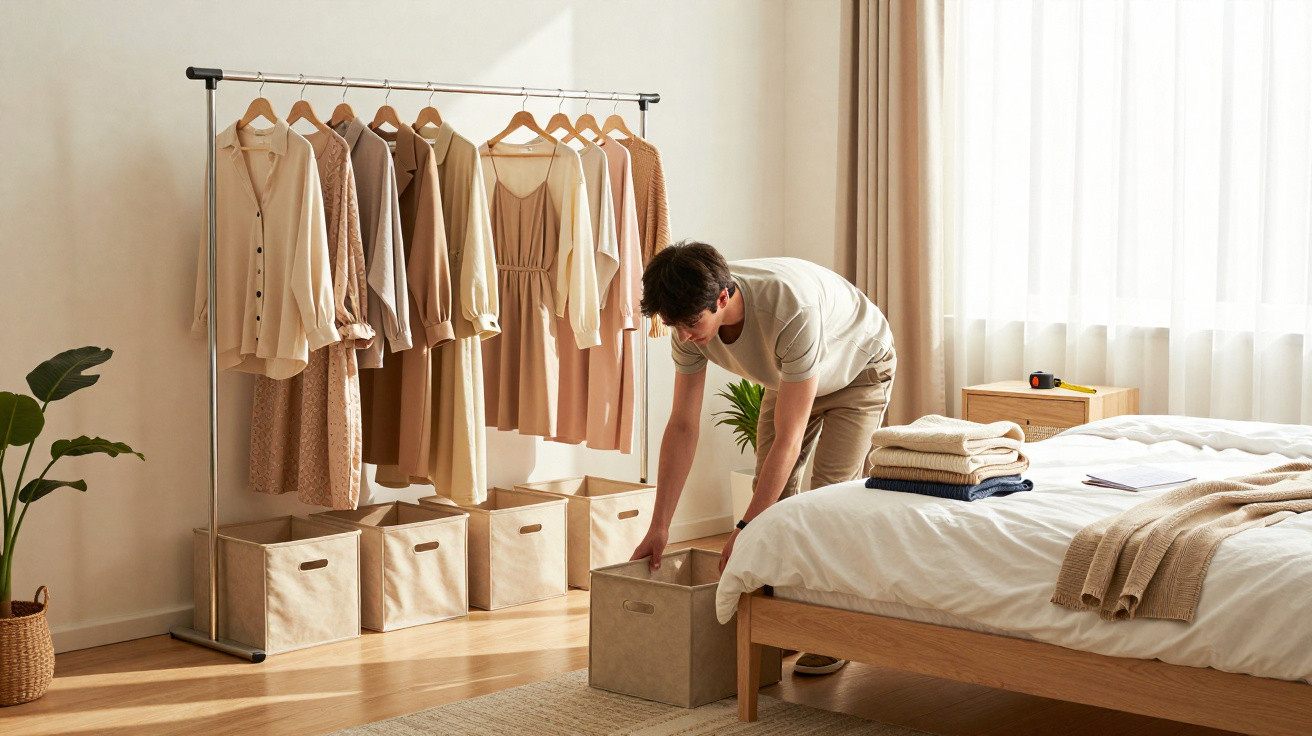
Then, one day, you call at a friend’s flat. There is no conventional wardrobe and no weighty furniture cutting off the light. Instead, there is a low clothes rail, a tidy fabric chest, baskets beneath the bed, and a corner that feels both comfortably used and unexpectedly serene.
You return home, and your large wardrobe suddenly appears… old-fashioned.
The quiet move away from the classic bedroom wardrobe
For generations, a tall, commanding wardrobe was treated as almost essential. You bought a bed, mattress, bedside tables and a wardrobe that you expected to keep for 20 years. It was “serious” furniture: difficult to shift and irritating whenever you had to clean the space behind it.
But homes have evolved, and so have daily routines. Bedrooms are more compact, rents cost more, and lifestyles are less fixed. People relocate, change careers and cities, and sometimes divide their time between two homes. In that context, a vast wardrobe can begin to resemble a courteous prison for clothing, rather than an intelligent way to store it.
Gradually, a different solution has found its way into our homes.
Look around a new-build studio flat, or browse interiors accounts on social media, and the trend is hard to miss. Open rails are replacing substantial cupboards. Storage beneath the bed is taking the place of deep drawers. Modular shelving can be fixed to the wall, then enlarged or reduced as circumstances change.
A recent survey by a European furniture retailer reported that bedroom open-storage system sales had risen by more than 40% over three years, while sales of traditional wardrobes with doors had remained stagnant. The retailer did not even present it as a revolution. Shoppers simply began choosing different products.
The signal, hidden between social-media scrolls, was straightforward: fewer solid blocks and more room to breathe.
There is a clear rationale behind this change. Traditional wardrobes were created for capacity and permanence, rather than adaptability. They presume a permanent home, a stable amount of clothing and an unchanging lifestyle. For many people today, that assumption no longer applies.
Open storage and modular options can be extended, reduced, transferred to another room or even taken with you to your next flat. They respond to shifts in seasons, bodies and personal style. Their visual lightness is important as well: less bulk against a wall creates a greater impression of space, while allowing more daylight rather than letting a dark item of furniture absorb it.
Space is not measured only in square metres. It is also about the feeling a room gives you when you wake up there.
The space-saving alternative everyone is quietly choosing
At the moment, the favoured replacement is remarkably straightforward: combine a clothes rail, a low dresser and under-bed storage. Rather than relying on one large unit, storage is split into smaller modules that are easy to move. Use a metal rail for clothes you genuinely wear, a fabric or compact chest for folded garments, and slim wheeled boxes under the bed for off-season or infrequently used items.
You free up wall space, and the room can immediately appear larger. Your clothing is visible at a glance. Choosing an outfit starts to feel more like browsing a small, carefully selected boutique than battling with a stuck sliding door.
That single change can alter the way you begin each morning.
Consider Lina, 32, who shares a 20 m² studio flat with her partner and cat. Until last year, an enormous second-hand wardrobe consumed a whole wall. It was sturdy and dark, making the room resemble a corridor. She sold it through a classifieds app and bought a basic rail, two robust lidded boxes and a fabric column with zipped compartments.
The cost was lower than the amount she received for the wardrobe. The time involved was one Sunday afternoon.
“ We suddenly had space for a small desk,” she laughs. “Before, the wardrobe felt like a guest we didn’t dare ask to leave.” Today, her clothes are organised by use: everyday pieces hang on the rail, sportswear goes into the fabric column, and seldom-worn outfits are kept in labelled boxes beneath the bed. Nothing glamorous, simply more room to breathe.
The appeal of this arrangement lies not only in the space it saves, but also in the flexibility it provides. A large furniture item fixes a room in place: the bed goes here, the wardrobe goes there, and that is that. Smaller components let you alter the layout when required. You can make a corner into a small office, or move storage aside to create room for a yoga mat, baby cot or guest air bed.
It can also transform how you feel about your possessions. If clothing is easier to see, you are more likely to wear it. You spot the items that have sat untouched for months. You sort, donate and sell. The storage system no longer acts as a black hole where possessions disappear.
Rather than owning a wardrobe, you create your own ecosystem.
How to replace a bulky wardrobe with flexible bedroom storage
Begin with one simple task: take everything out of the wardrobe. For a while, the floor may indeed vanish. Lay your clothes over the bed, a chair and perhaps even the hallway. This is not an exercise in drastic decluttering; it is simply a way to see what you truly own.
Next, sketch your bedroom on a scrap of paper. Record the position of the window, how the door opens and where you definitely want the bed to sit. Identify the unused corners, low walls beneath windows, and areas under the bed or eaves. These overlooked spots are now your allies.
Then select two or three compact types of storage to work together, rather than ten. Think in layers, not as one oversized block.
Most people fall into the same traps. They purchase attractive boxes before taking measurements. They load a rail so heavily that it bows. Or they attempt to reproduce the layout of a conventional wardrobe… without actually having the wardrobe.
Go easy on yourself. You are not styling a showroom; you are reconsidering how you manage clothing in everyday life. Distinguish reality from fantasy: the “ideal” version of yourself with 12 cocktail dresses, and the actual person who generally wears jeans, two favourite shirts and one good blazer.
In truth, nobody perfectly rotates every item by colour, season and material each day. Build a system that still works on a weary Tuesday evening, rather than only on an exceptionally motivated Sunday.
“Once I split my storage into rails, baskets, and under-bed boxes, I stopped fighting my own room,” says Marc, 41. “I gained half a metre of space and lost that weird guilt every time I opened the old wardrobe.”
- One open rail for clothes worn every week, including shirts, jackets and dresses.
- One low dresser or fabric column for folded essentials, such as T-shirts, underwear and pyjamas.
- Flat under-bed boxes for seasonal or occasionwear, including coats, ski equipment and formal outfits.
- A small basket beside the door or bed for “in-between” clothes: yesterday’s jeans or the hoodie you plan to wear again.
- Hooks or a wall-mounted peg rail for bags, scarves or tomorrow’s outfit.
A bedroom that adapts to your life, rather than resisting it
The traditional wardrobe will not vanish overnight. It still suits some homes, families and lifestyles. However, the understated growth of flexible storage reveals something about how bedrooms are now viewed. They are less like static display rooms and more like adaptable spaces for work calls, sleeping, stretching, late-night scrolling and the occasional heap of washing.
Beneath the trend is a more personal issue: how much room do we let our belongings occupy in our minds? Removing a heavy piece of furniture does not only create floor space. It changes your relationship with your possessions, your mornings and the way you enter and leave your day.
Perhaps the true luxury is not a giant wardrobe, but a room that can alter its shape when life changes.
| Key point | Detail | Value for the reader |
|---|---|---|
| Divide up the large wardrobe | Swap one bulky unit for rails, low dressers and under-bed storage | An immediate feeling of space and simpler room layouts |
| Store according to use, rather than category | Leave weekly-worn items visible, keep rarely used pieces in boxes, and give “in-between” clothes their own place | Quicker mornings and fewer “I have nothing to wear” moments |
| Select modular, movable pieces | Lightweight furniture that can be moved, stacked or taken to a new home | A longer-lasting system that adjusts to moves, children or new routines |
FAQ:
- Question 1 What is the best alternative to a classic wardrobe in a very small bedroom?
Answer 1 A straightforward combination is effective: a slim open rail, a small chest or fabric column, plus under-bed boxes. This trio will usually replace a full wardrobe while releasing wall space.
Question 2 Will open storage make my room appear untidy?
Answer 2 It can do if everything is packed together. Display only your everyday clothing, select matching-style hangers, and keep the rest in closed boxes or drawers. A calm appearance comes from rhythm, rather than concealing everything.
Question 3 How can I manage dust on open rails and shelves?
Answer 3 Put regularly worn items on the rail, and keep less-used clothes in boxes or fabric covers. A quick weekly pass with a duster is usually sufficient when garments are moved and worn frequently.
Question 4 Is it worthwhile if I may be moving soon?
Answer 4 This is precisely when it is most practical. Lightweight, modular storage is simpler to carry and rearrange in a new home than a huge wardrobe that may not even fit through the next doorway.
Question 5 What if I genuinely like the appearance of a large wardrobe?
Answer 5 You can preserve that visual effect by selecting sliding-door or fitted systems with a shallower depth, or by placing curtains around a rail and dresser. The aim is not to prohibit wardrobes, but to select storage that genuinely suits your room and life.





Comments
No comments yet. Be the first to comment!
Leave a Comment