
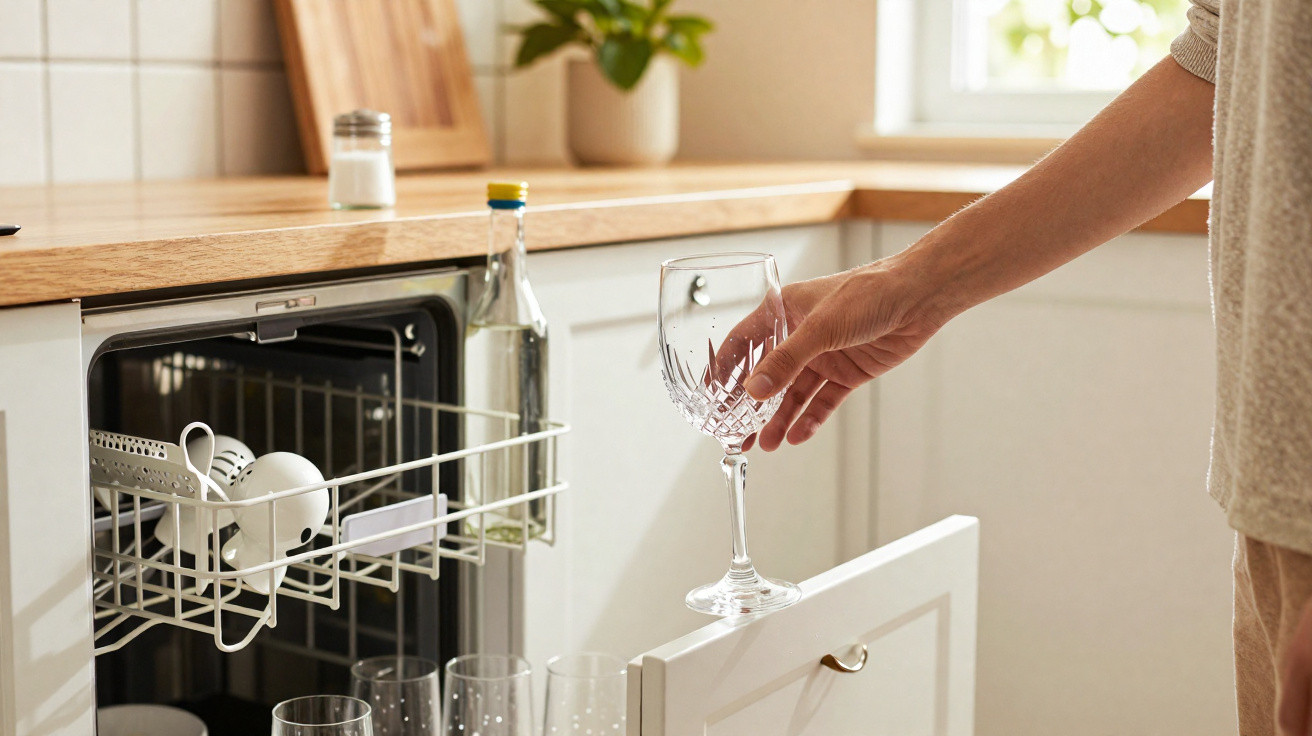
The dishwasher beeps, the door opens, and a gentle puff of steam escapes.
You reach for your favourite wine glasses, expecting a flawless, transparent sparkle. What you find instead are cloudy bowls, lifeless stems and a whitish film that makes even tap water look miserable inside them. You rub one with your thumb. No change. You put them through another cycle. It is still there.
Soon, you are wondering whether the glasses are beyond saving, whether the detergent is too harsh or whether the machine is somehow waging a private war on your glassware. Perhaps you blame hard water, or silently regret buying that expensive set last Christmas. It is a small annoyance, yet it plays on your mind whenever you have people round.
Then somebody mentions an easy tip in passing. It takes one small adjustment and an item you already keep in the kitchen, and the next load emerges crystal clear. It almost feels unfairly simple.
The puzzling “fog” on clean glasses
Cloudy residue initially seems like evidence of a poor wash. It looks as though the dishwasher has failed to complete the job. Your plates are shining, but the glasses appear to be covered by a delicate white coating. They may be hygienic, but they certainly do not look clean. So you carry one to the sink, rinse it under hot water and perhaps scrub it with washing-up liquid.
Yet the cloudiness remains. The film tends to linger around the rim and base in particular. In strong light, it can resemble a layer of frost. This is when many people search for “dishwasher ruined my glasses”, half-prepared to learn that the appliance has gradually wrecked every glass in the cupboard. It seems remarkably unfair for something intended to hold a drink.
One Tuesday evening in a compact London flat, Emma watched a clear pint glass become a milky-looking cylinder after another wash. She had owned the glasses for only six months. “I thought it was cheap glass,” she said, raising one against her kitchen window. Her flatmate joked that the beer would taste no different. She was not amused.
They tested different detergent brands, swapped tablets for gel and ran both eco and intensive programmes. Nothing made a difference. Emma then did what most people would do: she uploaded a photo to Instagram with the caption, “Anyone else’s dishwasher doing THIS to their glasses?” Her inbox quickly filled with responses, including stories about water softeners and admissions from people who had surrendered to hand-washing “the nice ones”. However, one small, useful suggestion appeared again and again, often in almost identical words.
Beneath that innocent-looking white film, two entirely separate issues may be at work. The first is mineral residue: fine deposits of calcium and magnesium from hard water that adhere to glass, creating a chalky appearance. This type of cloudiness can be removed. The second is glass corrosion, in which tough dishwasher conditions physically etch tiny scratches into the surface. That damage cannot be reversed.
Most reports of cloudy glasses belong to the first group. Hard water combined with hot programmes creates ideal conditions for limescale. Problems become more pronounced when dishwasher salt or rinse-aid levels are incorrect. The important question, then, is not simply “Why are my glasses cloudy?” but “Can this residue still be removed, or is the damage permanent?” The tip so many people recommend works precisely at that dividing line.
The dishwasher vinegar trick for cloudy glasses
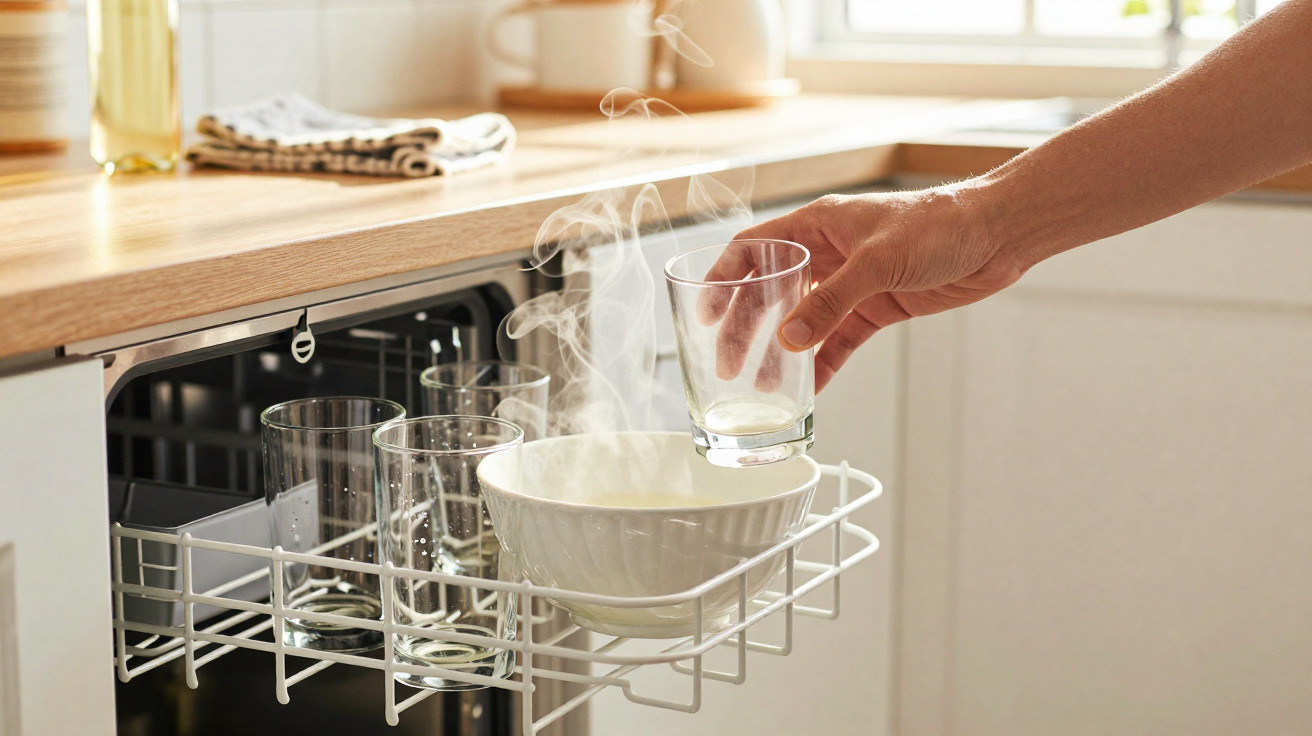
The method is straightforward: put a small dishwasher-safe bowl containing white vinegar on your dishwasher’s top rack, with the cloudy glasses inside, and run an ordinary cycle. There is no need for a special setting. Use your usual programme and let the bowl of vinegar do its work quietly in the background.
During the wash, the vinegar warms, evaporates a little and circulates around the appliance. Its gentle acidity works through mineral deposits, loosening the bonds holding that cloudy coating to the glass. When the door opens, many people report the same experience: they take out a glass, wipe away the remaining droplets and discover that the haze has gone. It is as if the glass has remembered its former clarity.
This trick can fail in a few ways, usually for very human reasons. Some people tip vinegar directly into the detergent dispenser, then wonder why there is no result. Others leave glasses in cold vinegar for two minutes, abandon the attempt and decide the method is “overrated”. Let’s be honest: nobody really does that every day.
Timing, heat and moderation are what matter. A small cup or bowl filled about halfway with ordinary white vinegar will do the job. There is no need to flood the dishwasher. Test it first with your cloudiest glasses and judge the result. Should the film lessen without disappearing completely, repeat the process or gently rub the glasses by hand after the cycle using a cloth soaked in vinegar. If there is absolutely no difference, you are likely dealing with etching rather than mineral residue. That is disappointing, but it means you can stop wasting electricity in search of a miracle.
An appliance technician I spoke to put it this way:
“People blame the dishwasher, but nine times out of ten it’s just hard water quietly leaving fingerprints all over their glasses. Vinegar is like a reset button.”
This easy technique is even more effective when it forms part of a wider dishwasher-care routine:
- Do the vinegar-bowl “deep clean” monthly rather than with every wash.
- Check the dishwasher salt and rinse-aid levels before deciding your glasses are beyond rescue.
- Put especially delicate or vintage glasses on gentle cycles, or wash them by hand.
- Reduce the temperature if glass etching has been a problem before.
- Leave a little more room between glasses so that water and vinegar vapour can circulate freely.
Why this small routine means more than clean glasses
At face value, this is simply a way to make glassware clearer: a bowl of vinegar, a dishwasher programme and the pleasing sight of that misty white coating disappearing. Yet there is an unexpectedly emotional side to it. On a hectic weekday evening, your dishwasher should be the unobtrusive helper in the corner, not the thing that makes you feel self-conscious about pouring wine for guests.
More deeply, the trick offers a sense of control over a machine that often seems inscrutable. Most of us press the same button every time and hope for the best. We do not consult the manual, adjust the settings or give much thought to water hardness. Then a simple vinegar-bowl ritual can make years of cloudy-glass frustration understandable within a few hours. It makes the appliance feel like something you can actually “tune” to suit your home, rather than merely put up with.
There is also a subtle pleasure in seeing an ordinary object look new once more. You notice the room reflected in the glass, the crisp line of its rim and the way a cold drink seems almost to glitter. It is a small improvement to the day, one that nobody beyond your kitchen may ever fully appreciate. We’ve all had that moment when a small domestic victory changes the mood of the whole evening. This is one of those wins worth passing on, if only so those close to you can see their foggy glasses regain their shine.
| Key point | Detail | Benefit for the reader |
|---|---|---|
| Vinegar in the dishwasher | A small bowl of white vinegar on the top rack during a normal cycle | Helps remove the limescale film from glasses quickly |
| Difference between film and corrosion | Reversible mineral deposits versus permanent micro-scratches | Helps establish whether a glass can be saved… or not |
| Regular maintenance | Dishwasher salt level, rinse aid, temperature and spacing between glasses | Lowers the chance of the issue returning and extends the life of tableware |
FAQ:
Is it safe to put vinegar in the dishwasher with glasses? Yes, placing a small dishwasher-safe bowl of white vinegar on the top rack is generally safe for most dishwashers and glassware. Do not regularly pour vinegar directly onto rubber components or seals, because repeated exposure can wear them down over time.
How often should I do the vinegar trick? For most households, once a month works well as a “reset” for cloudy residue. For heavily hazed glasses, you can repeat it once more in the same week, but vinegar is not needed in every wash.
What if the cloudy film doesn’t disappear at all? If vinegar and a hot programme do not alter the appearance or texture of your glasses, their surface may be etched. This damage is permanent, and no method can restore the original shine. Instead, focus on preventing the same problem with new glasses.
Can I use apple cider vinegar or other types instead of white vinegar? White vinegar is the best option because it is clear, inexpensive and leaves behind neither colour nor odour. Other vinegars might work in theory, but could stain, create a smell or leave additional residue, defeating the point.
Will rinse aid and dishwasher salt alone stop cloudy glasses? They make a significant difference. The correct dishwasher salt level helps manage hard water, while rinse aid improves drying and reduces spots. However, in places with very hard water, mineral deposits can still accumulate over time, which is why an occasional vinegar cycle is such a useful additional measure.


Comments
No comments yet. Be the first to comment!
Leave a Comment