
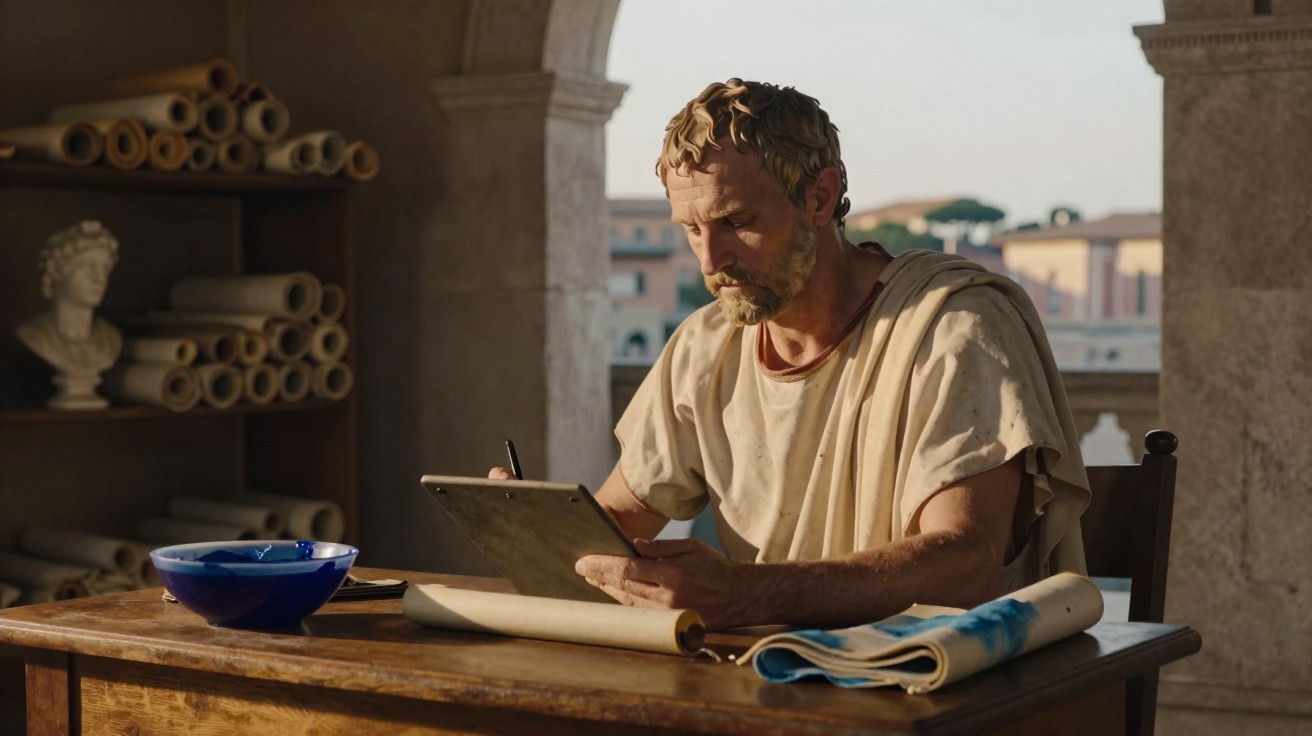
Marcus Aurelius recorded an idea in Meditations that has endured for almost two millennia: the thoughts we revisit shape the mind itself. The familiar saying, “the soul is dyed by the colour of its thoughts”, comes from Book 5, section 16. It takes on added significance when we consider its author: a Roman emperor writing privately about how he ought to think, act and endure hardship.
What does “the soul is dyed by the colour of its thoughts” mean?
The image likens the mind to fabric that slowly takes in dye. A single thought does not define an individual, but ideas repeatedly entertained each day can affect judgements, emotions and behaviour. In the full passage, Marcus Aurelius explicitly connects the mind’s character with its customary thoughts, making clear that he was concerned with repetition rather than fleeting thoughts.
- Recurrent thoughts establish patterns of interpretation.
- Continual attention to particular problems alters how they are perceived.
- Mental habits influence the way people respond to events.
- The dye metaphor indicates gradual rather than immediate change.
Where did Marcus Aurelius write this reflection?
This idea appears in Book 5 of Meditations, specifically section 16. In George Long’s well-known nineteenth-century English translation, the passage states that the mind will take on the character of its habitual thoughts, “for the soul is dyed by the thoughts”. Modern translations use alternatives such as “the soul takes on the colour of its thoughts”, which is why several versions of the quotation now circulate.
The original text was written in Greek, even though Marcus Aurelius was emperor of Rome. Consequently, the familiar wording should not be treated as a word-for-word rendering of something he wrote in precisely that form. It is a concise expression of an authentic passage from Meditations, whose central point remains consistent between translations: whatever regularly occupies the mind changes its disposition.
Why is it so striking that an emperor wrote this for himself?
Meditations was not written as a guide for the public. It consists of private notes in which Marcus Aurelius recalls Stoic principles, challenges his own conduct and seeks to retain perspective amid power, conflict, loss and responsibility. This changes how the quotation is read: rather than distant advice from a philosopher instructing others, it is a warning one of the most powerful men of his era addressed to himself.
- He had to manage political and military decisions.
- His reign was defined by wars along the Empire’s borders.
- A major epidemic affected the Roman world during this period.
- His notes reveal concerns about irritation, fear, fame and mortality.
Is the quotation directly connected to Stoicism?
Yes. For the Stoics, external events are not always within our control, but judgements, choices and responses demand continual attention. Marcus Aurelius’s focus on habitual thoughts follows this reasoning: even when it is impossible to control everything that occurs, it remains possible to work on how the mind interprets it.
This does not mean assuming that positive thoughts remove genuine difficulties. Marcus Aurelius’s Stoicism is far removed from the modern notion of simply “thinking positively”. His approach involves examining impressions, distinguishing facts from judgements, and preventing fear, resentment or the desire for recognition from continually governing the mind.
Why does this quotation still resonate nearly two thousand years later?
The image has force because it captures something readily recognised in everyday life. Anyone who spends hours feeding the same irritation begins to view new events through it; anyone who focuses only on threats starts to see them everywhere. The colour of thoughts is a metaphor for this accumulation: the mind gradually adopts the tone of what it receives repeatedly.
This is also what makes the passage in Meditations so human. Marcus Aurelius did not write as someone who had achieved perfect command of his mind, but as someone who needed continually to remind himself of the path he wished to follow. Behind the figure of the Roman emperor lies a concern that remains familiar: to choose carefully what occupies our thoughts, because repetition ultimately leaves its mark on how we see the world.






Comments
No comments yet. Be the first to comment!
Leave a Comment