
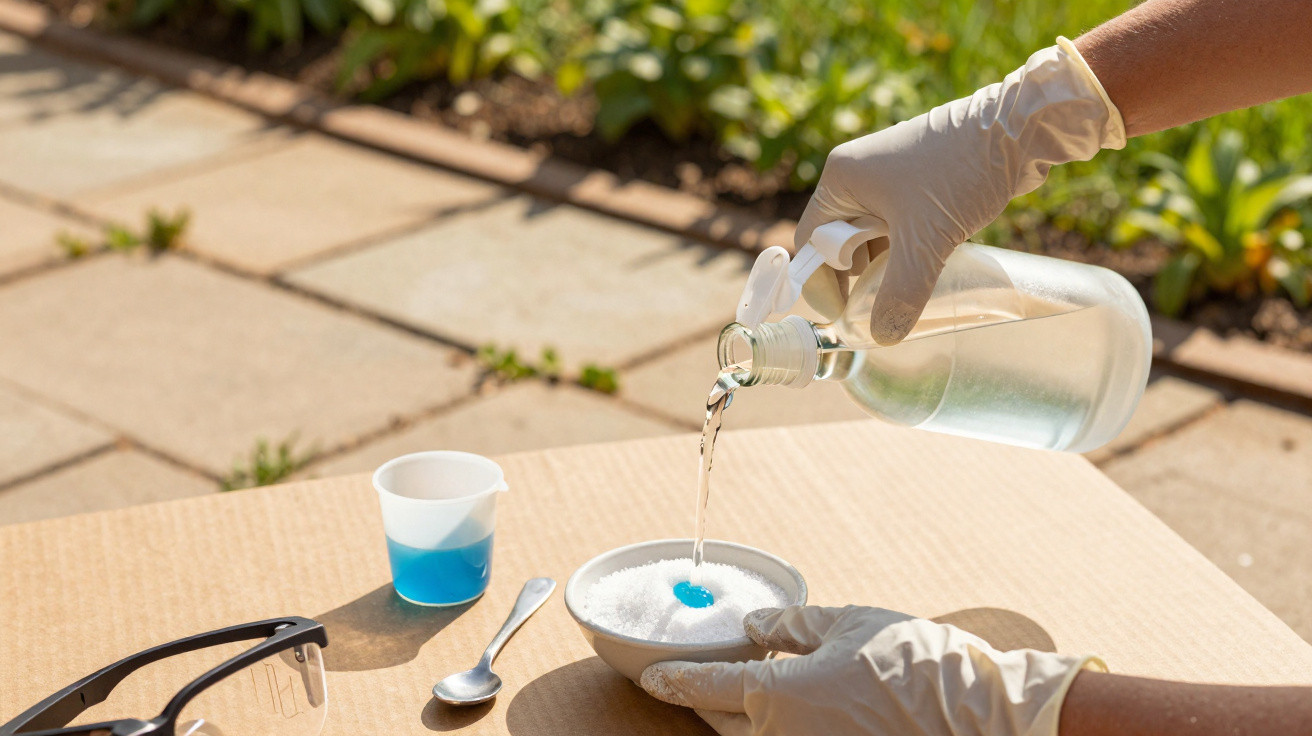
For householders fed up with unknown chemicals, an unassuming three-ingredient combination from the kitchen cupboard is being presented as a quick, inexpensive answer to unwanted plant growth.
Why a homemade weed killer is back in the spotlight
With more towns and cities considering limits on standard herbicides, many gardeners feel caught between spreading weeds and concerns about what may enter their soil. Supermarket aisles are still stocked with branded weedkillers, but their packaging can feature unfamiliar chemical terms, hazard symbols and safety instructions in very small print.
This concern has brought a straightforward query into wider discussion: can everyday household items deal with weeds on driveways and patios without requiring a laboratory-style formula?
From US gardens to British allotments, social media users repeatedly promote one response: a potent, uncomplicated blend of vinegar, salt and blue washing-up liquid, commonly called “Sunny Day Spray”. The idea is not new, but it has become increasingly popular as users post before-and-after images showing shrivelled dandelions and clear paving within under 24 hours.
“Sunny Day Spray” relies on three cheap ingredients, no specialist equipment, and direct sunlight to scorch weeds fast.
How “Sunny Day Spray” works in practice
The formula seems almost self-evident: household vinegar, ordinary salt and a squeeze of Dawn or comparable washing-up liquid. However, each ingredient has its own purpose once the mixture reaches a leaf in strong sunshine.
The science in plain language
- Vinegar supplies acetic acid, which damages and dries out tender plant tissue on contact.
- Salt (sodium chloride) places plants under stress by disrupting the water balance within their cells.
- Dawn or washing-up liquid works as a surfactant, reducing surface tension so that the solution spreads and adheres to foliage.
In bright sun, foliage treated with the solution sheds moisture quickly. Its surface dries, cells break down and the leaves droop. This is still a non-selective treatment, so it affects virtually any plant it reaches. Even so, it can act remarkably fast on young weeds with shallow roots growing between paving slabs, in gravel or through cracks in a driveway.
Think of the spray as a short, sharp “sun amplifier” on the leaf surface rather than a deep, systemic poison.
The basic “Sunny Day Spray” recipe
Although gardeners alter the proportions, a commonly circulated version uses the following approximate formula, designed for rapid results rather than restraint.
| Ingredient | Typical amount | Role in the mix |
|---|---|---|
| White vinegar (5% acetic acid) | 1 gallon (around 3.8 litres) | Main leaf-burn agent |
| Table salt or rock salt | 1 cup (around 300 g) | Draws moisture, stresses cells |
| Dawn or similar washing-up liquid | 1 tablespoon | Helps spray cling and spread |
People usually dissolve the salt in the vinegar, stir in the washing-up liquid last and transfer the mixture to a hand sprayer. It requires no water dilution, specialist face mask or additional chemicals.
Gardeners warn: “Sun on the leaves is half the product.” Cloudy or rainy days blunt the effect dramatically.
Where this spray works – and where it does not
For all the online excitement, “Sunny Day Spray” is not a universal solution. It functions more like a surface scorch than a herbicide that travels deep into a plant, which determines the situations in which it is useful.
Best uses reported by gardeners
- Weeds appearing in gaps between paving slabs, bricks or gravel.
- Annual seedlings and young plants with tender foliage.
- The margins of paths, driveways and hardstanding areas, provided no wanted roots lie below.
- Compact urban courtyards used by children and pets, if treatment is applied carefully to individual spots.
When conditions are dry and sunny, users often see leaves wilt within hours, followed by brown, apparently dead foliage the following day. Hardier weeds frequently need repeated treatments.
Risks and blind spots people often miss
Calling the mixture “natural” may imply that it is harmless, but horticultural discussions continue to highlight several real drawbacks.
- Soil damage from salt: Frequent use may cause salt to accumulate, damaging nearby plants, soil structure and soil micro-life.
- No root kill on deep perennials: Docks, bindweed, brambles and couch grass commonly return from stored reserves below ground.
- Collateral damage: Drifting droplets can burn lawns, bedding plants and vegetable seedlings as soon as they make contact.
- Eye and skin irritation: Vinegar splashed into eyes, or prolonged exposure to a strong mixture, can sting and cause inflammation.
“Natural” does not automatically mean “gentle”. Salt stays in the soil long after the weed withers.
Applying “Sunny Day Spray” with fewer regrets
Gardeners who use this blend while keeping the rest of their garden healthy tend to follow a group of principles based on common sense and, often, difficult experience.
Timing and weather
- Apply it on a dry, sunny day when several hours of clear weather are expected.
- Do not spray in windy weather, to reduce the chance of drift reaching lawns or valued perennials.
- Avoid using it shortly before heavy rain, which may carry the solution into beds and borders.
Practical safety steps
- Put on simple gloves and eye protection, as vinegar spray can irritate skin and eyes.
- Keep children and pets away until the treated foliage has dried completely.
- Choose a hand sprayer or narrow nozzle to target individual weeds accurately.
- Never combine it with bleach or other cleaning products, as reactions can produce dangerous fumes.
Aim only at the green tissue you want gone. Every stray droplet is a vote against something else in the garden.
How it compares with other weed control options
Despite the attention surrounding the recipe, gardeners continue to assess it alongside established weed-control methods.
- Hand weeding: A slow but accurate option, particularly suited to flowerbeds and vegetable plots where protecting roots is important.
- Boiling water: Useful for young weeds on paths and leaves no salt behind, although its range is limited and it can be awkward to use.
- Mulch and ground covers: Bark, woodchips and living covers such as clover cut the need for spraying by preventing light from reaching the soil.
- Commercial “organic” herbicides: These are often made with stronger acetic acid or fatty acids, and generally provide clearer labelling and safety information.
Some professional groundskeepers now view the vinegar-and-salt blend as a temporary measure: convenient for swiftly clearing hard surfaces, but much less appropriate as a weekly practice across a whole property.
Environmental questions surrounding the trend
As the recipe spreads through TikTok, Facebook groups and gardening forums, ecologists repeat a familiar caution: salt does not disappear simply because a social media post has moved on.
Salt accumulation beside driveways may gradually weaken neighbouring hedges and shrubs. Extensive, repeated applications close to surface-water drains could raise salinity in small watercourses. Aquatic plants and invertebrates are downstream from every “natural” experiment conducted on a patio.
Small, scattered sprays rarely cause a crisis. Routine saturation of long strips and car parks might, over time.
Regulators in the US and UK view these DIY methods with unease. Approved herbicides are required to undergo rigorous testing and display unambiguous hazard statements. Homemade mixtures avoid those safeguards, even if every ingredient was bought in a supermarket.
Looking beyond the quick fix
The appeal of “Sunny Day Spray” reflects a wider change in gardening. People may worry about chemical cocktails while still wanting immediate, Instagram-ready outcomes. A bottle mixed at home and given an approachable name can feel like a middle ground: clear visible results without a laboratory-style label.
However, the most durable weed-management plans generally combine several methods: closer planting to shade the soil, thoughtful mulching, occasional hand weeding and carefully targeted treatments where necessary. The vinegar–salt–soap mixture can have a place within that toolkit, provided it is handled as a powerful implement rather than a harmless toy.
For anyone taking a longer-term view, soil health is the central issue. Healthy, biologically active soil is better at resisting invasion, encourages stronger turf and recovers from the occasional dandelion. Regular soil tests, additions of organic matter and sensible watering practices influence this unseen foundation far more than any individual spray, whether homemade or commercial.
Ultimately, weeds reveal underlying conditions. A patio overrun with growth, a border packed with opportunistic seedlings or a gravel drive gradually becoming green can each point to compacted soil, breaks in ground cover or light reaching areas where it could be excluded. “Sunny Day Spray” provides a rapid visual clear-up. The more demanding task is understanding what returns afterwards and deciding whether the answer is another bottle-or managing the entire space differently.





Comments
No comments yet. Be the first to comment!
Leave a Comment