
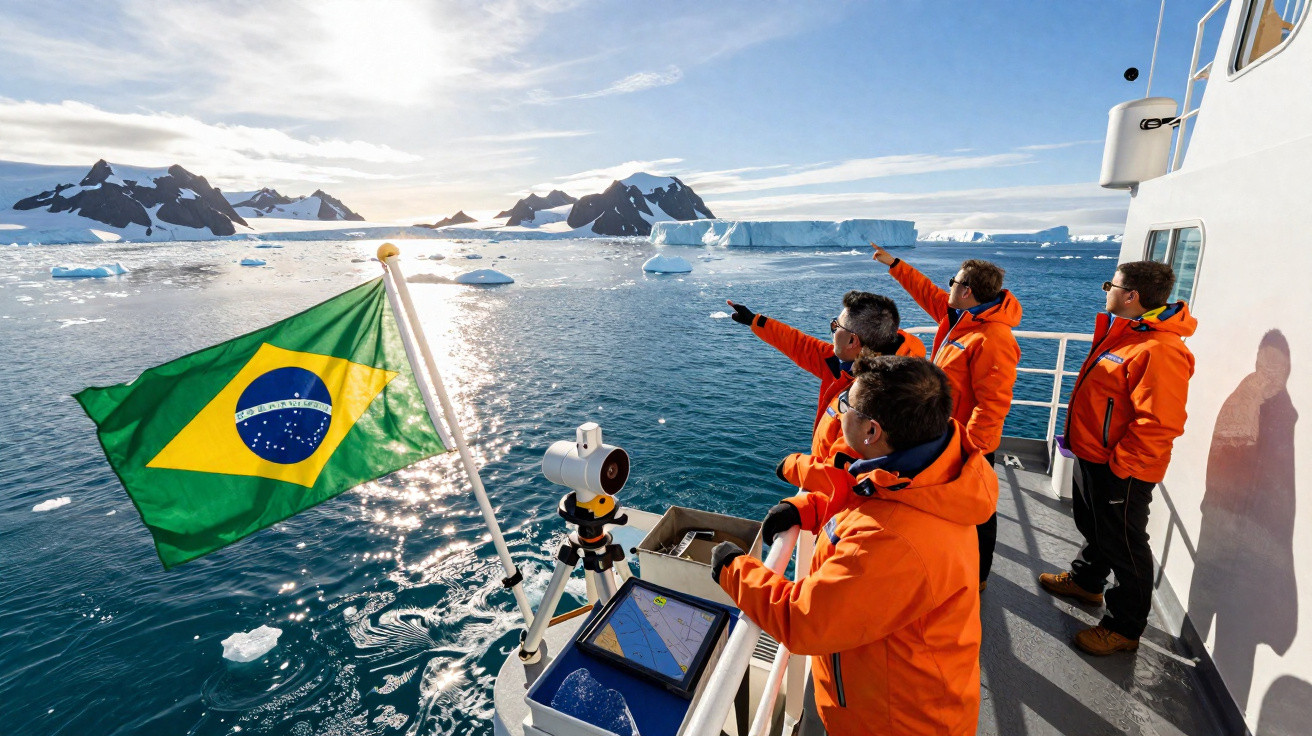
With a new milestone in its Antarctic operational record, the Brazilian Navy’s Polar Ship Almirante Maximiano has completed its second voyage beyond the Antarctic Circle, reinforcing the country’s presence in one of the planet’s most demanding environments. The passage, undertaken on 27 January as part of the Antarctic Operation (OPERANTAR), coincided with the 150th anniversary of the Directorate of Hydrography and Navigation (DHN), an organisation central to producing maritime knowledge and providing the logistical and scientific support that underpins Brazil’s presence on the white continent.
The Almirante Maximiano beyond the Antarctic Circle
Situated at 66°33′ south latitude, the Antarctic Circle represents a boundary at which natural conditions create exacting technical and operational demands. In this extreme setting, defined by sub-zero temperatures, persistent ice and unpredictable weather, navigation requires accuracy, meticulous planning and continuous environmental monitoring. Under such circumstances, the Almirante Maximiano-the DHN’s flagship in the Southern Ocean-once again proved its worth as a scientific platform, an instrument of strategic projection and a symbol of the continuity of Brazil’s Antarctic effort.
During its route through Antarctic waters, the ship sailed close to the Cruls Islands, Admiral Alexandrino de Alencar Peak and Mount Rio Branco, three geographical landmarks embodying part of Brazil’s scientific and diplomatic history. This approach meant that the Almirante Maximiano’s passage carried not only operational significance but also symbolic weight, bringing together tradition, knowledge and sovereignty in a single voyage.
In this regard, the ship’s commanding officer, Captain Carlos Eduardo Navazio de Oliveira da Silva, said that Brazilian Hydrography “exemplifies the convergence of science, technology and geopolitical positioning”, highlighting Brazil’s strategic role in the governance of the South Atlantic and Antarctica. Meanwhile, Lieutenant Commander Julio César de Castro Rocha, hydrographer and meteorologist for the 44th OPERANTAR, explained that one of the principal tasks on board is producing accurate weather forecasts. These are essential for anticipating sudden changes in conditions and ensuring the safety of air, scientific and logistical operations conducted within limited time windows.
Almirante Saldanha programme and Antarctic capabilities
Although the Almirante Maximiano, launched in 1974 and commissioned by the Brazilian Navy in 2009, remains Brazil’s principal means of Antarctic projection, the project intended to complement it is progressing slowly. The future Polar Ship Almirante Saldanha, designed to replace the NApOc Ary Rongel in this role in the coming years, was announced in 2019. It is due to be built at the Jurong-Aracruz Shipyard (EJA), with technical support from SembCorp Marine Specialized Shipbuilding.
Developed under the Hydro-oceanographic Resources and Antarctic Support Procurement Programme (PROHIDRO), the project was initially expected to be delivered by 2025. However, no official updates have been reported recently, leaving on hold a development that is key to safeguarding the continuity of Brazil’s scientific and strategic presence in the polar region.
The Almirante Saldanha will have a length of 103 metres, a hangar for two medium helicopters and an endurance of 70 days. It will accommodate 95 personnel, including 26 researchers. Its entry into service will enable the replacement of the veteran Almirante Maximiano, expanding the operational and scientific capabilities accumulated by the Brazilian Navy over more than four decades of Antarctic presence. In the meantime, the Almirante Maximiano will remain the standard-bearer of Brazilian Hydrography in the southern seas, reaffirming the country’s determination to sustain an active, scientific and strategic presence on the planet’s most inhospitable continent.





Comments
No comments yet. Be the first to comment!
Leave a Comment