
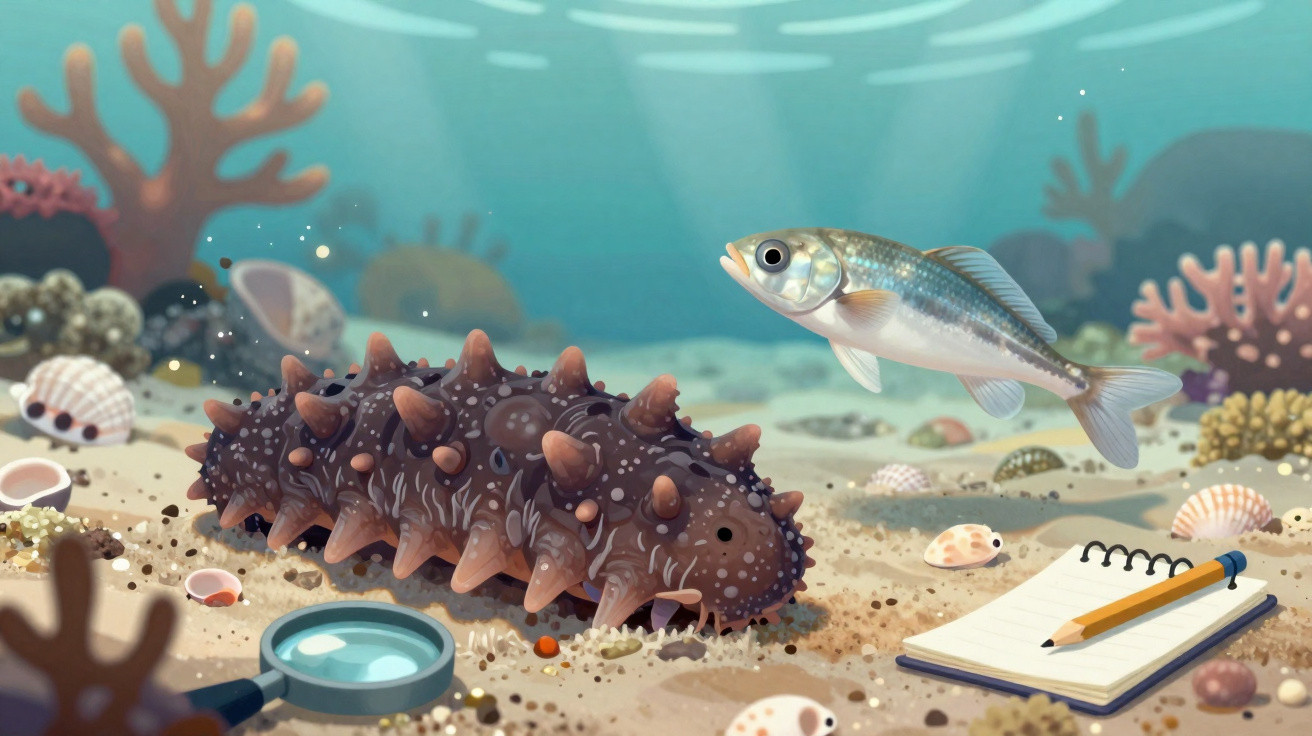
When a sea cucumber pumps water through its cloaca to exchange gases, it may also create an opening for a slender, determined visitor. A pearlfish waits for this movement, approaches head- or tail-first, and passes through the anus, using the invertebrate’s body cavity as shelter from predators.
How does a sea cucumber breathe?
In many species, water is drawn in through the cloacal opening and channelled to internal structures known as respiratory trees. This flow enables gas exchange before the water is released back into the sea, creating a rhythm that indicates when the passage is open.
For the pearlfish, the current is a useful signal. It circles its host, identifies the opening and waits until it can enter. Some species go in head-first, whereas others enter tail-first so that their head remains facing outwards. The name pearlfish covers species in the Carapidae family: marine animals that may live freely, hide inside invertebrates, or form more damaging parasitic relationships.
How can a fish fit through there?
Pearlfish have long, narrow, flexible bodies suited to confined spaces. Their rapid movements and ribbon-like shape allow them to pass through the cloaca and reach internal areas without creating a new opening.
- The sea cucumber draws water through its cloaca towards its respiratory structures.
- The fish senses the current and waits for the opening to become accessible.
- Its long, flexible body moves quickly through the channel.
- The internal cavity provides darkness and protection from predators outside.
The host may contract the opening or deploy defensive structures, but these measures do not always stop the intrusion. Reports describe several fish occupying one sea cucumber, turning what might be an individual refuge into a shared hiding place. The fish uses chemical cues as well as water flow to find the cloaca, and observations have recorded repeated attempts when the host contracts the opening.
Does the sea cucumber suffer from this arrangement?
That depends on the species involved. Some fish use the interior as a refuge and leave it to feed, an association regarded as close to commensalism when the fish gains an advantage without significantly harming the sea cucumber. However, this coexistence is not invariably neutral.
Other species may feed on internal tissues, including reproductive structures, which makes the relationship parasitic. Since the same common name includes different behaviours, it is inaccurate to describe every pearlfish either as a harmless tenant or as a host-destroyer. In certain associations, the fish remains protected inside during the day and emerges to hunt at night; in others, it stays within the host and feeds directly on its tissues.
Watch the video shared by the Rodrigo Plei YouTube channel showing the interaction between a pearlfish and a sea cucumber.
Does the pearlfish stay inside forever?
Species that feed outside the host generally leave their shelter at night and return later. The interior protects them while they rest, while the surrounding sea offers small crustaceans and other prey.
Sea cucumbers have remarkable defences, including the expulsion of internal structures in some species. Even so, the fish’s persistent attempts to enter can overcome some of these barriers.
What does this partnership reveal about the ocean?
An opening used for breathing can also become a doorway, a hiding place and a food source. Biological functions do not operate in isolation: other organisms notice rhythms, exploit vulnerabilities and turn another animal’s body into part of their own habitat.
The sight is startling because it challenges the idea of where a fish ought to live. On the seabed, even the inside of another animal can become an address. Determining whether the occupant is a guest or a parasite requires looking beyond its unusual entrance.





Comments
No comments yet. Be the first to comment!
Leave a Comment