
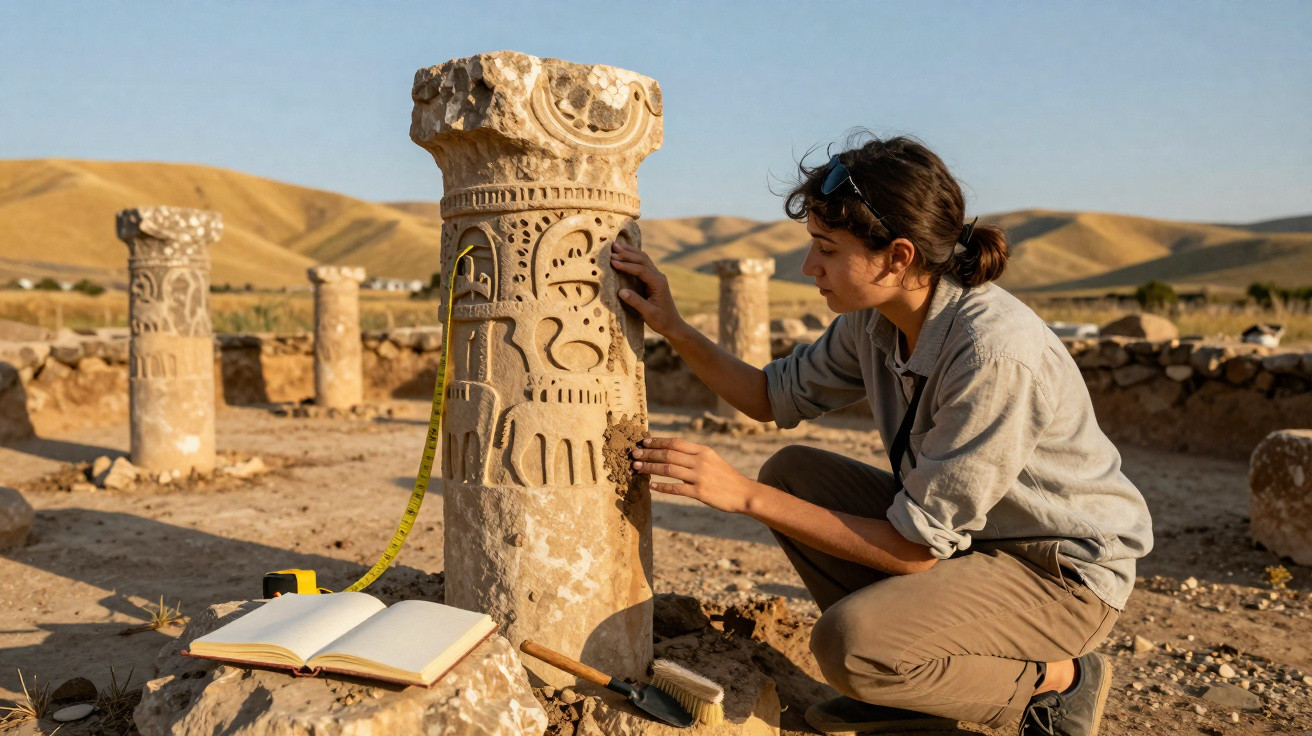
Across the exposed hills above Türkiye's broad south-eastern plains, fresh archaeological finds are shedding light on what life may have been like 11,000 years ago, as the world's first communities started to take shape.
Recent discoveries – including a stone figurine whose lips appear stitched shut, sculpted stone heads and a black serpentinite bead bearing expressive faces on each side – are providing insights into Neolithic rituals and beliefs.
"The growing number of human sculptures can be read as a direct outcome of settled life," Necmi Karul, the archaeologist heading excavations at Karahan Tepe, told AFP.
"As communities became more sedentary, people gradually distanced themselves from nature and placed the human figure and the human experience at the centre of the universe," he said, gesturing towards a human face carved into a T-shaped pillar.
Türkiye's Stone Hills project
The dig forms part of Türkiye's Stone Hills project, a state-supported scheme begun in 2020 at 12 locations in Şanlıurfa province. Culture Minister Nuri Ersoy has called the province "the world's Neolithic capital".
Among the project's sites is UNESCO-listed Göbekli Tepe – known in Turkish as "Potbelly Hill" – containing Upper Mesopotamia's oldest known megalithic structures. Excavations there were first launched in 1995 by the late German archaeologist Klaus Schmidt.
'A glimpse into someone's life'
Discussing several new objects displayed at Karahan Tepe's visitor centre, Lee Clare of the German Archaeological Institute said they call into question established accounts of humanity's move from nomadic hunter-gathering to the first settled communities.
"Every building we study gives us a small glimpse into someone's life. Every layer we excavate brings us closer to an individual – we can almost touch that person, through their bones. We're gaining insights into their belief systems," he said.
Over the past five years, "a wonderful amount of data coming out of all these new sites," has been gathered, the archaeologist told AFP.
Yet complete certainty remained out of reach. "We don't have any written records, obviously, because it's prehistory," said Clare, who has worked at Göbekli Tepe since 2013.
Determining whom the statues and figurines portrayed was likely impossible because they came from "a period before writing, around 10,000 years ago", said Karul, who also heads the Göbekli Tepe excavation and coordinates the Stone Hills project.
"But as the number of such finds increases and as we learn more about the contexts in which they appear, we gain the opportunity to conduct statistical analyses and make meaningful comparisons."
'Highly organised society'
According to Karul, settlements began to develop after the end of the last Ice Age.
"The changing environment created fertile conditions, allowing people to feed themselves without constantly going hunting. This, in turn, supported population growth and encouraged the development and expansion of permanent settlements in the area."
New forms of social interaction appeared as these communities put down roots, Clare said.
"Once people produced surplus, they got rich and poor," he said, pointing to the earliest indications of social hierarchy.
"What we see here is the beginning of that process. In many ways, we are on a slippery slope that leads toward the modern world."
Karahan Tepe and distinct Neolithic cultures
As work continues, the excavations will reshape perceptions of the Neolithic, while every site secures a separate role in scientific history, said Emre Güldoğan of Istanbul University, the lead archaeologist at nearby Sefer Tepe.
"Karahan Tepe and the wider Stone Hills project show a highly organised society with its own symbolic world and belief structures" that challenges previous portrayals of a "primitive" Neolithic world, he said.
"These communities shared traits but also developed clear cultural differences," he said.
Human symbolism is particularly prevalent at Karahan Tepe, while animal images are more prominent at Göbekli Tepe.
Archaeologists say discoveries from the two sites reveal communities representing their surrounding environments in distinct ways.
"Each new discovery raises fresh questions aimed at understanding the people behind these creations," Güldoğan said.
The latest archaeological finds have also expanded the appeal of an area chiefly known as the place where Abraham is said to have settled, a figure venerated by Judaism, Christianity and Islam.
"Before the excavations began at Karahan Tepe and other sites, the area mainly attracted religious tour groups, drawn largely by its association with the prophet Abraham," tourist guide Yakup Bedlek said.
"With the emergence of new archaeological zones, a more varied mix of tourists are visiting the region."
© Agence France-Presse





Comments
No comments yet. Be the first to comment!
Leave a Comment