
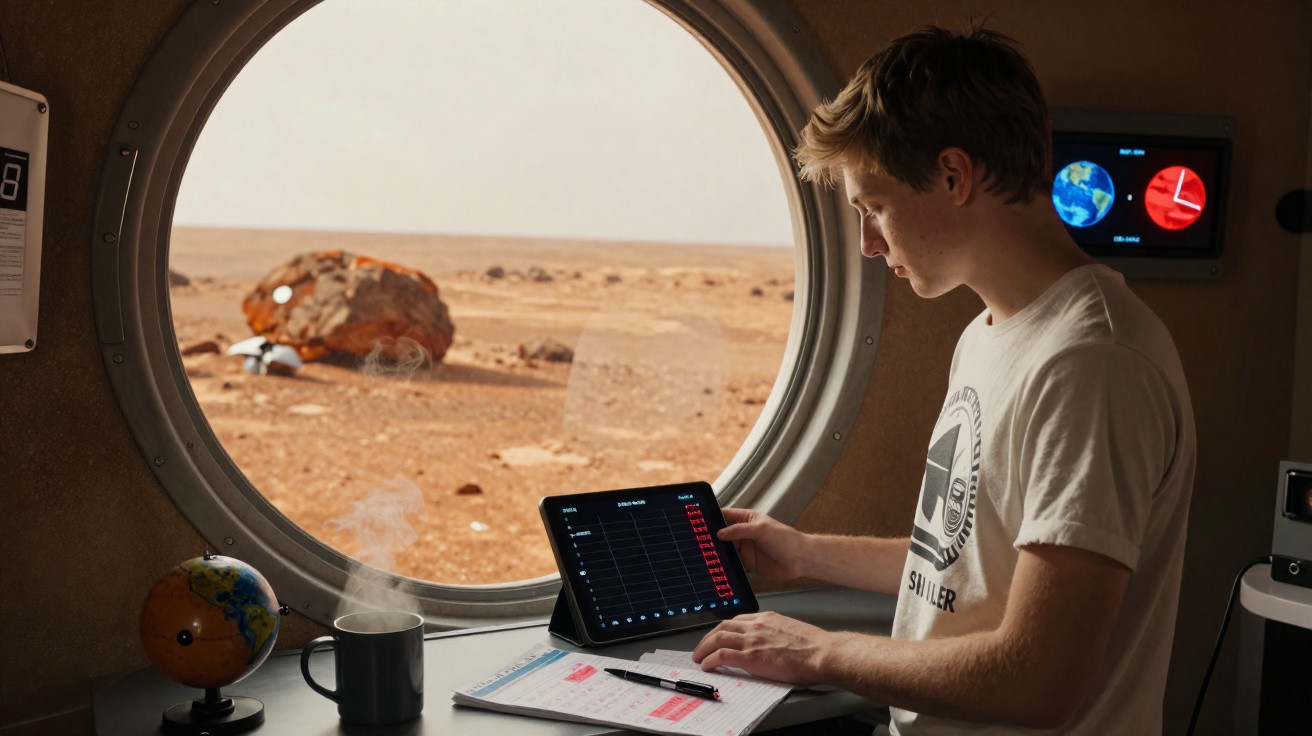
The astronaut checks his wrist, then glances towards the pale orange horizon. His watch reads 07:14. Yet the Martian sunrise suggests it is nearer to 07:30 on Earth. The mission clock on the habitat wall, synchronised with Houston, tells another story altogether. There are three times for one instant, and none quite matches.
Beyond the habitat, a dust devil curls across the plain like a storm played in slow motion. Within, a laptop chimes: “Sol 89, 12:00 LMST. Begin experiment.” That is local Mars time: neither Earth time nor the astronaut’s own internal clock.
Einstein would probably grin at the mess.
On Mars, time is no longer merely a figure displayed on a screen.
Einstein’s weird time is now a daily problem on Mars
The rule appears straightforward on paper: a Martian day lasts 24 hours, 39 minutes, 35 seconds. That is only slightly longer than a day on Earth. In practice, however, that “just a bit” disrupts timetables, sleep patterns and ground-control routines. Each sol - the name for a Martian day - moves a little further from the bodily rhythm humans recognise.
Engineers in Pasadena and Darmstadt work by wall clocks that shift by 40 minutes each day. Coffee breaks creep into the night, while family dinners disappear into the early hours. Mars time does not simply move onwards for them; it seems to slide sideways.
During NASA’s Curiosity rover mission, some of the operations team committed to living entirely according to Mars time for months. One engineer recalled that sunrise beyond his California window no longer corresponded with his “day”. At times, he drove to work at 3 a.m. beneath streetlights, beginning his “morning meeting” while everybody else was going to bed.
Their phones ran custom applications displaying “Local True Solar Time” on Mars. Calendar entries advanced by 40 minutes every day. Initially, it resembled an entertaining science-fiction experiment. Gradually, though, it became like jet lag with no end point. Sleep studies from those missions almost read as wartime diaries, documenting chronic fatigue, confusion and strained relationships at home.
Underlying this peculiar daily shift is the theory we all learned in school and quickly forgot: Einstein’s relativity. Mars is not merely another rocky world covered in red dust. It has weaker gravity, a different orbit and a marginally slower “heartbeat” in the time it takes to turn once on its axis.
Einstein demonstrated that time is intertwined with space and gravity. More powerful gravity makes time pass more slowly, while faster movement alters it as well. Because Mars is less massive and more distant from the Sun, it bends spacetime less than Earth. This produces minute differences in clock rates when clocks on the two planets are compared. The gaps may be tiny, but for billion-dollar landings, tiny differences cannot be ignored.
From Einstein’s equations to mission alarms on the wall
On an operational mission, there is no spare time for philosophical reflections on spacetime. Teams need alarms to sound at precisely the correct second. Space agencies therefore organise work around two concurrent clocks: one based on Earth and another on Mars. The challenge is to prevent their separation becoming so great that people lose any clear sense of what “now” means.
Mission planners first choose the version of “Mars time” that will apply. A frequent option is Local Mean Solar Time at the landing location. In effect, it means: “We’ll pretend Mars rotates smoothly, and noon is when the Sun is highest above the rover.” Every activity, whether drilling into a rock or communicating with home, is attached to that shifting Martian schedule.
Ground teams must then fit their lives around this unfamiliar timetable. During the opening months of the Perseverance rover mission in Jezero Crater, controllers in California wore specialist watches and used displays showing both Earth and Mars time. Alongside the Martian clock sat the sol number, making clear that what appeared to be midnight outdoors could be “lunchtime” for the rover.
They absorbed several small but difficult practical lessons. Essential operations should not be arranged for the periods when staff will be most deprived of sleep. Shifts need rotating so that nobody spends weeks living in reverse. Alerts must be filtered, separating those that genuinely demand a middle-of-the-night response from those able to wait until the next Martian “morning”. This has become more than physics; it is about survival.
The mathematics beneath it offers no flexibility. A Martian day cannot simply be split into 24 standard Earth hours and treated as complete. A few early Mars missions experimented with unusual solutions, including “Mars seconds” stretched slightly so that a Mars clock would still display 24:00 at the close of a sol. It seemed neat, but it bewildered people.
Teams consequently shifted towards hybrid arrangements: retain seconds and minutes consistent with Earth’s definition, while accepting that local time and the day number will gradually drift. GPS-style adjustments account for relativity, as they already do for satellites orbiting Earth. The same equations that keep your phone’s navigation accurate also keep a Mars lander from missing its touchdown by kilometers. Every mission introduces further refinement, calibration and methods of carefully adapting human time to Einstein’s rules.
How future Mars crews will actually live with elastic time
Should people live on Mars for months or years, they will not merely “check” Mars time - they will inhabit it. One developing proposal divides time in the habitat into three layers: local Mars time for outdoor work, Earth time for communicating with home, and a separate “crew rhythm” time designed around health. Three clocks, three realities and one exhausted mind.
Useful techniques already exist. Light-therapy panels can create reliable dawn and dusk, whatever the Sun is doing beyond the window. A stable sleep and wake routine, tied to a selected Martian hour, enables the body to settle into one timeline. Vital work, including EVAs and landing support, can be grouped into the crew’s natural “day”, even when that leaves Houston working overnight.
The greatest difficulty is not the equipment. It is the human sensation of being slightly out of step with everyone you love. Once time no longer aligns with your emotional world, small tensions begin to develop. Messages from Earth can arrive “late”, not due to radio lag but because a cheerful birthday video from your sister appears when it is 3 a.m. in the habitat.
We have all experienced the moment when the body insists it is bedtime while a laptop demands a deadline. Extend that feeling across months and add another planet, and the emotional calculation becomes weighty. Astronaut trainers increasingly discuss forgiveness: forgiving your own slow-thinking brain, forgiving a teammate who loses their temper at 4 a.m. Mars time, and forgiving the gradual loneliness of living through a day that no one else shares. Let’s be honest: nobody really does this every single day without cracks.
Future Mars explorers may become the first humans to feel, in their bones, that Einstein was right: time is not a single river, it’s a braided delta, and each of us walks along a different branch.
- Adopt one “anchor clock” for your body
Select a regular local Martian time for waking, sleeping and meals, then protect it rigorously. - Use tech as a translator, not a master
Allow apps to convert Earth time into Mars time, but do not let every alert pull you between timelines. - Schedule emotions as much as operations
Arrange regular “Earth windows” for messages and calls so that relationships do not turn into permanent jet lag. - Expect drift and talk about it
Make it normal within the crew to say, “My brain is on a different day right now,”. - Remember the story you’re living
You are not simply following a timetable; you are testing how far human time can extend before it breaks.
The quiet shock of realizing your day isn’t universal anymore
Once the thought takes hold, it does not truly go away: your “today” may not be another person’s. On Mars, this is no metaphor. One person’s Monday-morning catch-up becomes someone else’s emergency call in the middle of the night. The divide involves more than physical separation and radio delay; it is Einstein’s geometry quietly angling the clocks apart.
Some mission psychologists believe this could alter the way crews speak about home. Rather than saying “See you next week,” they may say “See you in five sols,” with that word carrying a new emotional force. Earth’s time zones already divide our days, yet people still behave as though they share one planet, one calendar and one rotating world of routines. Mars will quietly tear open that assumption.
There is something exposed and unexpectedly beautiful in this. A rover log marked Sol 472 can be stored on a server while it remains Tuesday in California. Decades from now, a child may ask a parent who worked on Mars: “What did your days feel like?” The truthful reply may be: “Longer. Sharper around the edges. Slightly detached from everyone else’s.”
As missions reach further afield - to Jupiter’s moons and deep-space stations orbiting far from any sunrise - the notion of one shared human time will diminish. New routines, language and perhaps rituals will be needed to connect these drifting days. The physics is unchanged from when Einstein wrote down his equations. What is changing is humanity’s recognition that its sense of “now” was always more delicate than it seemed.
| Key point | Detail | Value for the reader |
|---|---|---|
| Einstein’s theory shapes real missions | Relativity and Mars’ weaker gravity influence how clocks are synchronised between planets | Provides a tangible understanding of how abstract physics affects everyday life and technology |
| Mars has its own daily rhythm | Every sol is ~39 minutes longer, forcing teams to follow shifting timetables | Helps readers picture the physical and emotional consequences of living on Mars time |
| Humans will juggle multiple “nows” | Future crews may balance Mars time, Earth time and an internal health-based schedule | Encourages reflection on how conflicting times are already managed in our own lives |
FAQ:
- Does time really pass differently on Mars? Yes, in both practical and relativistic terms. In practical terms, a Martian sol lasts longer than an Earth day. Relativistically, Mars’ weaker gravity and different orbit produce tiny differences in the way precise clocks tick compared with clocks on Earth.
- Is this just about longer days, or true Einstein-style time dilation? It is both. The extra 39 minutes in each sol result from Mars’ slower rotation. In addition, there are extremely small relativistic effects, comparable to those experienced by GPS satellites, which missions must include in exact navigation and timing.
- Will future astronauts feel this time difference physically? They will primarily experience the longer day as chronic jet lag if timetables are not managed carefully. The purely relativistic effect is too slight to perceive directly, but its effects emerge in navigation, communication timing and clock synchronisation.
- Why don’t we just use Earth time on Mars to keep things simple? Because everyday life and operations depend on the local Sun. Outdoor activity, solar-panel power and temperature cycles all follow the Martian day. Disregarding local time would make planning and safety far more difficult for both crews and robots.
- Could this change how we think about time on Earth? Very likely. As more missions operate on planetary timetables that differ from Earth’s, people may become more conscious that time is not universal. This could reshape everything from planning calls with astronauts to teaching physics and even considering our own hurried days.






Comments
No comments yet. Be the first to comment!
Leave a Comment