
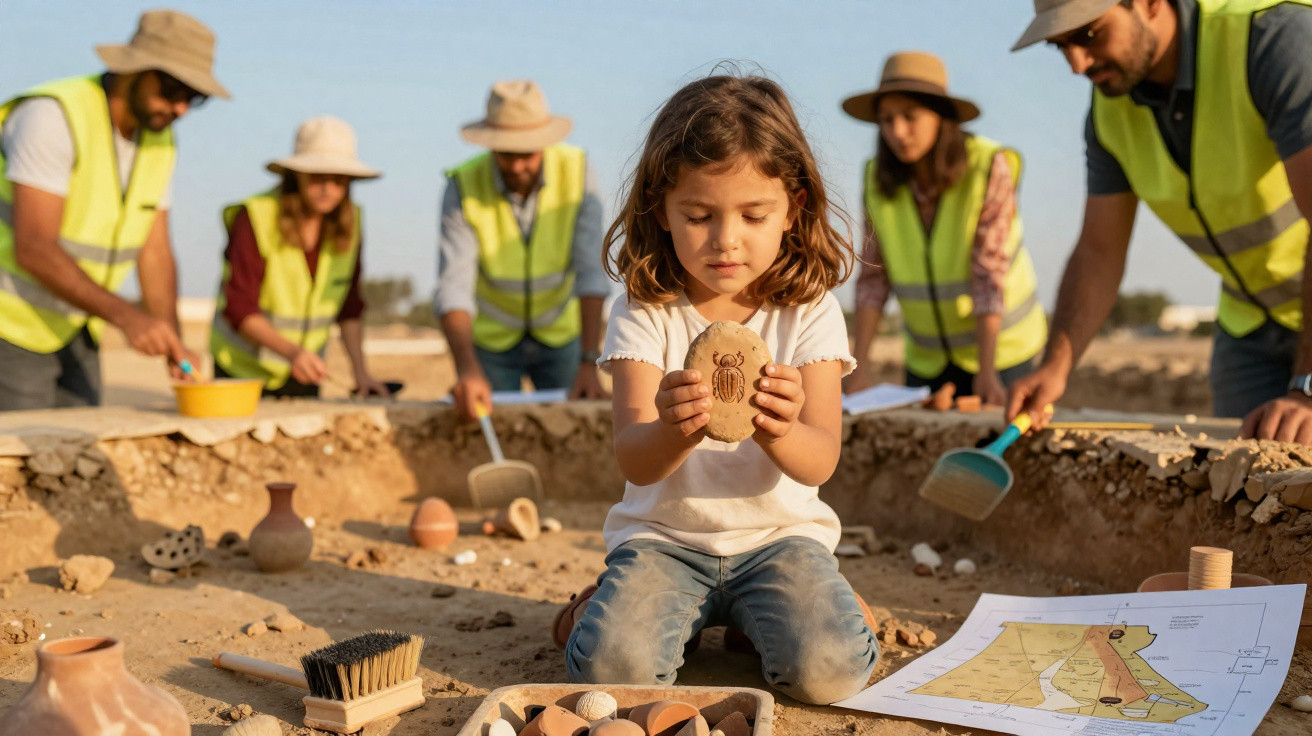
Among thousands of stones scattered across the ground at Tel Azekah, Israel, Ziv Nitzan picked out a small dark fragment while walking with her family. The three-year-old brushed away the soil and uncovered engraved motifs. Archaeologists identified it as a Canaanite scarab dating back about 3,800 years, which may have served as a seal, amulet or emblem of authority.
How did a child find the object?
Ziv was walking through the archaeological site when she crouched down to pick up what initially looked like an ordinary stone. Children do this constantly, but its surface soon revealed a regular shape and details unlikely to have formed naturally.
After inspecting the piece closely, her family contacted those responsible for the site. By handing the find over for examination, they safeguarded not only the artefact itself but also information about where it had been found, which is crucial for connecting it with the region's ancient occupation. Tel Azekah overlooks the Elah Valley and contains layers from several periods of settlement, explaining why ancient materials can lie near the surface following erosion and activity on the land.
What was inside the small “stone”?
The item was a scarab: an object carved in the form of the beetle linked with rebirth in Egyptian culture. Its underside could feature signs, images or inscriptions, allowing it to be pressed into clay.
- The beetle shape refers to a symbolic tradition of Egyptian origin.
- Its engraved underside could be used to stamp clay like a small seal.
- The object might also have been worn or carried as a personal amulet.
- Its material and imagery could communicate identity, protection or social status.
The artefact has been linked to the Middle Bronze Age, around 3,800 years ago. Although small enough to fit in a child's hand, it connects the hill with far wider cultural and political networks spanning the Levant. The scarab bears a figure associated with power and protection, though a definitive interpretation of the markings requires detailed study of the engraved surface.
Why was an Egyptian symbol in Canaan?
Egypt exerted substantial economic, political and religious influence over Canaanite cities during different periods. Scarab-inspired objects moved through trade, diplomacy and local imitation, taking on their own meanings beyond the Nile Valley.
Not every scarab discovered in Canaan was made in Egypt. Local workshops also recreated the form and its symbols, demonstrating that influence was not simply copying. Examining the material and engraving can help establish where each artefact originated. The Israel Antiquities Authority awarded the girl a certificate of recognition, using the incident to highlight the importance of responsibly reporting chance finds.
Watch the video shared by the YouTube channel Israel Antiquities Authority Official Channel showing the discovery of the ring.
What might the Tel Azekah amulet have been used for?
Scarab amulets could be used to seal containers and documents, identify their owners, or accompany a person as protection. Some were set into rings or worn against the body, combining an administrative purpose with symbolic value and decorative appeal.
A small archaeological artefact can reshape understanding of a site when its form, symbols and context are preserved. Its size does not determine its historical significance.
What makes the discovery so unlikely?
Archaeologists are trained to observe carefully, work within grids and document layers. Ziv merely selected one stone from innumerable possibilities. Chance cannot replace method, but it can occasionally deliver to that method an object lying at the surface, waiting to be recognised.
The episode offers an important lesson for every visitor. “Finding does not mean keeping.” By surrendering the piece, the family enabled a child's choice to become shared knowledge about a history stretching back 3,800 years.






Comments
No comments yet. Be the first to comment!
Leave a Comment