
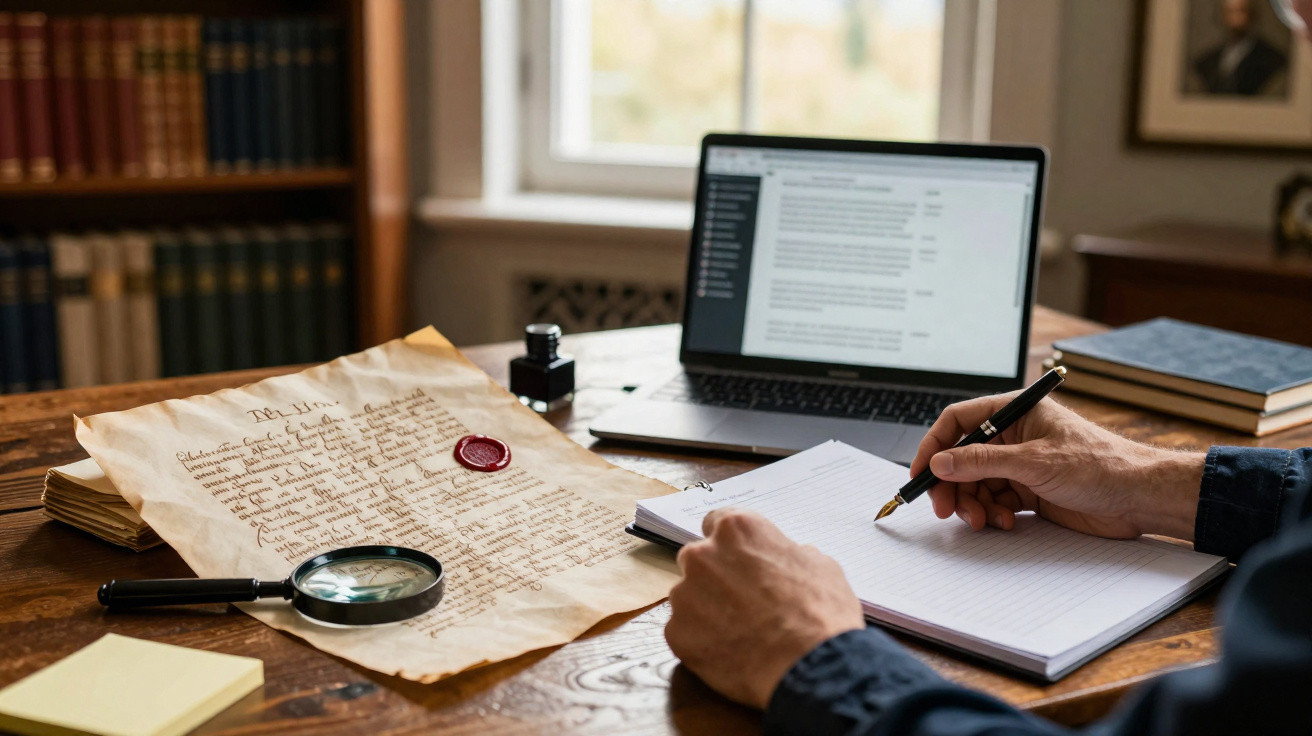
For centuries, a single document has stood as a symbol of human bravery and political brilliance.
Today, a software tool classifies it as machine-produced filler.
The US Declaration of Independence, widely regarded as a high point of human rhetoric, has failed a contemporary test: an AI detector judged it to be almost wholly machine-written. This outcome reveals nothing about 1776, but it exposes how muddled our understanding of authorship has already become in the era of artificial intelligence.
When a 1776 manifesto is labelled machine-written
The dispute started after SEO specialist Dianna Mason entered the complete Declaration of Independence into a widely used AI-detection service. Having assessed its wording, cadence and construction, the tool returned an uncompromising conclusion: the document was “98.51% likely” to have been created by artificial intelligence.
The software that brands college essays as “AI-written” now does the same to the founding text of the United States.
Of course, no AI model was available when Thomas Jefferson wrote the Declaration in 1776. Historically, the finding is plainly a categorical mistake, but it reflects the automated suspicion increasingly experienced by students, journalists and researchers.
Mason did not test only one historical document. Comparable tools have marked 1990s legal judgments and extracts from the Bible as probable AI-generated material too. Such examples spread rapidly across social media, commonly presented as evidence that “AI detectors don’t work” or that they penalise sophisticated, formal prose.
The episode arrives at a fraught time. Universities, news organisations and public bodies around the world rely on AI detectors to identify possible cheating. A rising number of complaints indicates that these systems can fail in precisely the manner seen with the Declaration: by mistaking orderly, polished writing for algorithmically produced text.
Why AI detectors struggle with the past – and the present
AI detectors infer whether a text was written by AI through statistical patterns. They do not interpret meaning; instead, they calculate likelihood. Scores increase when they identify features closely linked with machine-generated output.
- Very consistent sentence lengths can appear “too smooth” to be human.
- Expected word selections can prompt suspicion.
- A formal or archaic voice can resemble model training material.
- Repeated constructions, such as “We hold…”, can activate AI-like indicators.
The Declaration of Independence contains several of these characteristics. Its repeated openings, strict parallel phrasing and logical, near-mechanical order of argument can look suspiciously familiar to an algorithm trained on current AI writing.
Historic texts often follow strict rhetorical rules. Modern detectors mistake this discipline for the “flatness” of AI prose.
There is a further complication. Many AI-detection models learn from material collected from the web, including public-domain classics and religious writing. When a detector encounters the Declaration again, it may be unable to separate “well-known canonical text” from “output that looks like my AI training examples.” The resulting signal is confused.
The issue extends into classrooms. A number of recorded cases involve students being accused of using AI solely because of high detector scores, despite having written the work themselves. Some schools have withdrawn penalties following human assessment, although the damage to trust persists.
Can human and AI writing be reliably separated?
Before the computer age, authorship was frequently established through physical evidence, including handwriting, ink and the source of the paper. Early printed works also bore recognisable traces of particular presses and typesetters. A document could be traced to an individual or workshop.
Those signals disappear in digital text. A paragraph composed in a café in 2025 appears exactly the same on screen as one produced in a server farm. There are no marginal annotations, ink impressions or crossed-out revisions - only characters.
Researchers generally divide AI-authorship methods into two principal categories:
| Approach | How it works | Main weakness |
|---|---|---|
| Text-only detection | Examines style, repetition, word choice and structure for patterns associated with AI. | Creates false positives for human writing and false negatives for polished AI text. |
| Watermarking & cryptographic tags | Places concealed signals or metadata into text as AI produces it. | Depends on cooperation from model providers; fails when text is copied or altered. |
As models such as GPT-4 and later systems improve, the divide between human and machine-produced writing becomes smaller. Developers adjust systems to reproduce human irregularities, change sentence lengths and add moments of personality. Many detectors, designed for older AI generations, cannot keep pace.
Does a text’s origin still matter?
For Dianna Mason, the central issue concerns our response to the tool more than its accuracy. In her Forbes interview, she argues that readers remain uncomfortable upon discovering that AI created content. Some instinctively reject it, presuming that the writing has no depth, care or accountability.
The stigma around AI writing shapes behaviour: the label “generated” often matters more than the words themselves.
Entrepreneur Benjamin Morrison, also cited by Forbes, adopts a more practical position. He sees opposition to AI writing as part of a familiar cycle: society resists each new technology before eventually incorporating it. From classroom calculators to digital photography, tools initially viewed as cheating later became everyday equipment.
The discussion therefore moves from provenance to consequences. Who gains from the text? Who is accountable for mistakes or bias? How open should creators be about AI assistance? These matters carry more weight than any unprocessed detection score.
High stakes for students, journalists and courts
False positives involving the Declaration and the Bible produce straightforward headlines. However, comparable errors affect lives less visibly. If a teacher submits an essay to a detector and receives a “99% AI” result, the student could face a failed grade or disciplinary proceedings. Some pupils report having no opportunity to contest the finding.
Academic lawyers have already cautioned that these tools must not be treated as primary proof of cheating. At most, they argue, a score should trigger a discussion rather than establish guilt. Newsrooms need the same restraint, as editors may question freelance submissions on the basis of one automated assessment.
Legal systems are also under pressure. Judges and clerks are increasingly asking whether submissions contain AI-generated arguments, particularly where fabricated cases are cited. If detectors can identify 1990s case law itself as AI-written, using them uncritically could weaken justice instead of safeguarding it.
New norms for a mixed human–AI writing world
Rather than pursuing a flawless lie detector, some specialists advocate new standards centred on disclosure and accountability. Under this approach, AI is treated as another tool - like spell-checking or translation software - rather than an illicit ghostwriter.
Possible standards taking shape
- Explicit school policies setting out when and how AI support is permitted.
- News-article labels stating whether AI assisted with drafting, translation or summarising.
- Contracts requiring writers to disclose whether AI generated substantial sections of a text.
- Public-sector rules for AI use in official documents to preserve trust.
These measures move the responsibility away from probability-based detection and towards people. Rather than attempting to determine who wrote each text, institutions require individuals to explain their methods and impose consequences when they lie.
Beyond detection: tracing style, intent and risk
The Declaration episode also revives a more fundamental debate about authorship. Many canonical works already arose through collaboration, editing and influence. Jefferson did not write in isolation: he drew on philosophers, pamphlets and political arguments.
AI tools represent another form of collaborator: rapid, tireless and shaped by patterns across billions of words. They can accelerate research, create first drafts and offer alternative wording. They also create several practical concerns:
- Excessive dependence on AI can dilute personal style and voice.
- Biased training data may reinforce stereotypes in policy documents or reports.
- AI-generated legal or medical material can sound authoritative despite being incorrect.
- Ghostwriting at scale can overwhelm public debate with synthetic yet convincing arguments.
Greater detector accuracy would not eliminate these dangers. Addressing them requires literacy about how language models operate, why they fail and where they are useful. Students taught to employ AI critically, instead of covertly, may develop stronger judgement than those completely prohibited from using it.
The wrongly labelled Declaration of Independence is an unusual but valuable prompt. If a founding document can be confused with synthetic prose, style alone cannot support our idea of human writing. Readers, educators and lawmakers must now undertake a more difficult task: creating rules and expectations for a world in which human and machine sentences appear side by side, often impossible to distinguish, yet not morally equivalent.





Comments
No comments yet. Be the first to comment!
Leave a Comment