
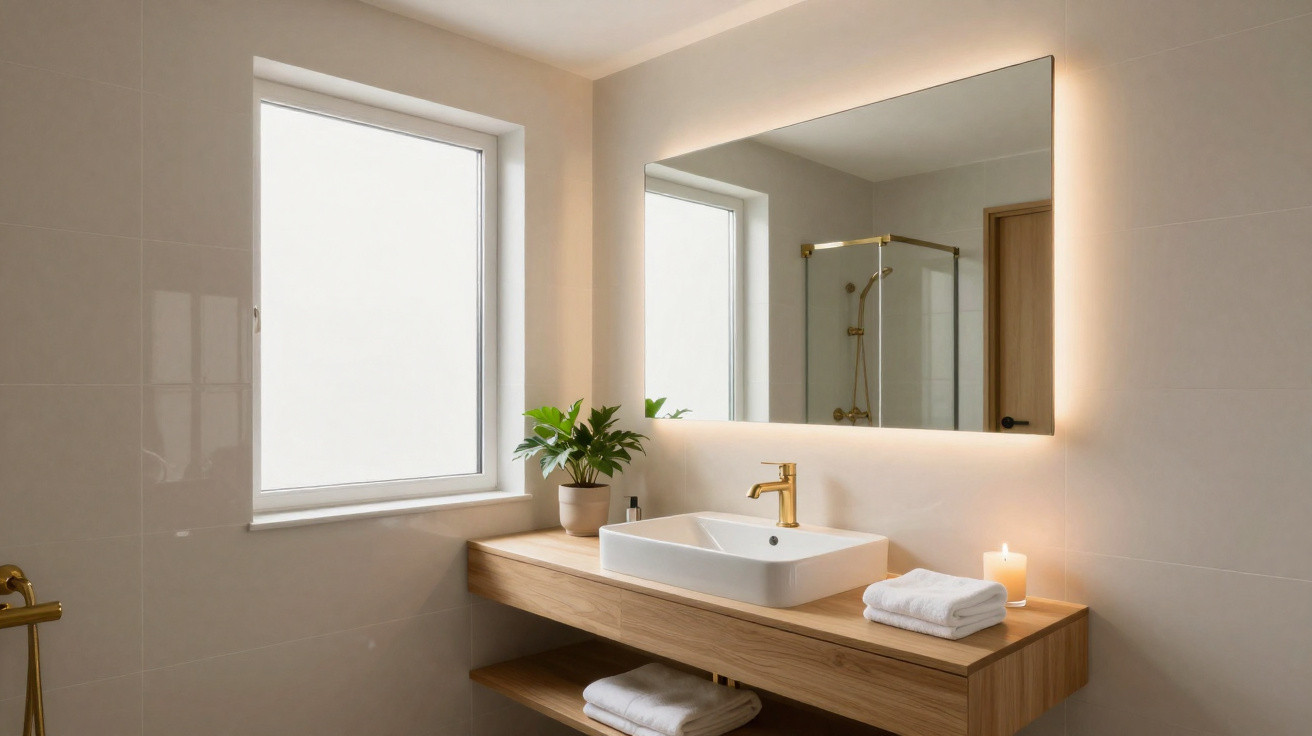
In compact city flats and suburban houses alike, thousands of “blind” bathrooms rely on one miserable ceiling bulb. They end up resembling a cupboard rather than somewhere you would want to begin the day. Interior designers, however, say it is possible to simulate daylight and make the room appear larger without removing any walls.
The real issue with tiny, windowless bathrooms
A bathroom with no window does not simply seem small; it can feel enclosed, as though the walls are gradually closing in.
White tiles paired with a powerful overhead fitting are commonly treated as the obvious answer. Yet this approach can leave the space stark, two-dimensional and oddly clinical, particularly during winter. Everything may be visible, but the room does not feel pleasant.
Designers increasingly focus not on “lighting to see”, but on “lighting to breathe”. In a restricted room, the mind needs two simultaneous visual effects: walls that appear more distant and light that seems to arrive from a genuine natural source.
The goal is not more light, but better light that tricks your eye into seeing space where there is none.
This is where an unexpectedly straightforward pairing proves effective: an enormous mirror and carefully positioned daylight-mimicking LEDs.
The high-end hack: using an oversized mirror as a fake window
In a small space, many homeowners instinctively choose a compact vanity, small fittings and a modest mirror. That very impulse is what makes the bathroom continue to feel confined.
The first element of this technique may seem counterintuitive: select a mirror that is very large, perhaps even seemingly excessive.
Why scale makes such a difference
An ordinary mirror reflects only your face, whereas an oversized version changes the perceived shape of the room.
- It makes the wall on which it hangs appear twice as deep.
- It seemingly moves the edge of the room further away.
- It reflects fittings, tiles and light sources, suggesting a second space that cannot actually be seen.
At a minimum, the mirror should match the width of the vanity unit and extend above eye level. Where feasible, it may cover almost the entire wall from side to side and from the basin towards the ceiling, creating a full-height panel effect.
Think of the mirror as a window you can place wherever you like, not just a grooming aid above the sink.
In design-led bathrooms, this one change can immediately create a “boutique hotel” atmosphere, even where the floor space is scarcely bigger than a cupboard.
The secret ingredient: “daylight” LEDs between 4000K and 5000K
The other half of the approach is selecting the proper type of illumination-not the most intense light, but the most suitable one.
Lighting specialists look closely at colour temperature, which is measured in Kelvins (K). It indicates whether a bulb appears warm and yellow-toned, cool and blue-toned, or similar to daylight at noon.
| Colour temperature | Effect in a bathroom |
|---|---|
| 2700–3000K (warm white) | Cosy, but may appear yellow and dingy, particularly against white tiles. |
| 4000–5000K (neutral/daylight) | Clear, crisp and nearest to natural daylight; flattering for most skin tones. |
| 6000K and above (cool white) | Strongly blue-toned and frequently linked with hospitals and offices. |
For a bathroom without windows, designers consistently return to the central range: 4000–5000K, which is sometimes labelled “neutral white” or “daylight”. It recreates the clarity and brightness of a sunny day without the icy cast associated with very cool LEDs.
Pair an oversized mirror with 4000K “daylight” lighting and the wall begins to behave like a sunlit window.
Rather than merely reflecting you, the mirror catches and distributes this neutral white illumination throughout the room. This softens shadows and makes everything appear cleaner in colour, including towels, tiles and your complexion.
Placement: why ceiling spots are your worst enemy
Even the ideal bulb will not produce the intended result if it is installed in the wrong place.
One overhead light casts severe shadows from above. It can deepen the look of under-eye circles, hollow out the cheeks and leave the room’s corners in darkness.
Light the face, not only the floor
To make a bathroom feel serene and luxurious, lighting should be positioned around face height near the mirror.
- Vertical wall lights placed on both sides of the mirror provide balanced frontal illumination that is flattering to the face.
- Back-lit mirrors incorporating LED strips produce a gentle halo and lessen severe contrast.
- LED strips concealed along the mirror’s sides or upper edge can softly illuminate the wall, making it seem larger.
Lighting designers also refer to the Colour Rendering Index (CRI), a mark out of 100 that measures how faithfully a source reproduces colour. In bathrooms, a CRI of at least 90 allows skin tones and surfaces to look natural rather than greyish or altered.
Good bathroom lighting should feel invisible: you notice how well you look, not the fittings themselves.
Three quick extras that boost the illusion
After installing the mirror and daylight LEDs, several final details can greatly enhance the “fake window” impression.
- Choose satin or velvet-matt paint for the walls instead of completely flat finishes. It bounces back additional light without making the room glossy.
- Replace a dark shower curtain with glass, or use a pale, semi-transparent fabric at least. Any opaque element that divides the room will interrupt the cycle of light between the mirror and walls.
- Introduce a robust houseplant such as pothos or Zamioculcas zamiifolia. Beneath daylight-style LEDs, green leaves add a calm spa-like quality and soften the abundance of hard surfaces.
None of these changes calls for plumbing alterations or a large budget. Combined, though, they encourage the brain to interpret the bathroom as more spacious, fresher and much less box-like.
What this changes about winter mornings
Light is more than a decorating device: it has a direct effect on the body’s internal clock and state of mind.
Exposure to bright, neutral light in the morning can support regulation of the circadian rhythm-the 24-hour cycle affecting sleep, alertness and hormone levels. In a flat where daylight reaches only the living room, a properly illuminated bathroom may provide the first worthwhile dose of “fake sun”.
Those who replace a yellowish bulb with a daylight LED in a compact bathroom frequently say they feel more alert and less lethargic, especially in January and February. The bathroom also seems cleaner and more welcoming, subtly changing the start of their routine.
How to test the hack before spending big
For tenants and anyone hesitant about substantial purchases, a basic experiment can reveal whether this method suits their bathroom.
- Purchase one or two 4000–4500K bulbs with a high CRI, then fit them close to the existing mirror.
- Lean a larger, low-cost mirror panel against the wall behind the basin to imitate a planned oversized mirror.
- Switch off the main ceiling fitting and rely solely on face-level lights for several days.
Notice how your skin appears, whether the room’s corners become more visible and how you feel while getting ready. If temporary equipment already makes a marked difference, a permanent oversized mirror and suitable fittings should be likely to achieve the desired “high-end” feel.
Related ideas for other cramped rooms
These same principles work well beyond the bathroom. Any compact room with limited light can benefit from a thoughtfully planned mirror-and-daylight combination.
In a narrow hall, a tall mirror opposite a doorway, paired with a 4000K wall light, can create the appearance of additional depth. In an internal home office without windows, positioning a large wall mirror and a high-CRI daylight lamp behind the monitor can ease eye strain and prevent the room from feeling like a bunker.
Once you understand how mirrors and colour temperature work together, every dark corner in your home becomes a design opportunity instead of a lost cause.
The method remains consistent: designate one wall as a “view”, install a generously sized mirror on it, and illuminate it as though sunlight were streaming in from behind it. Your eye completes the illusion.




Comments
No comments yet. Be the first to comment!
Leave a Comment