
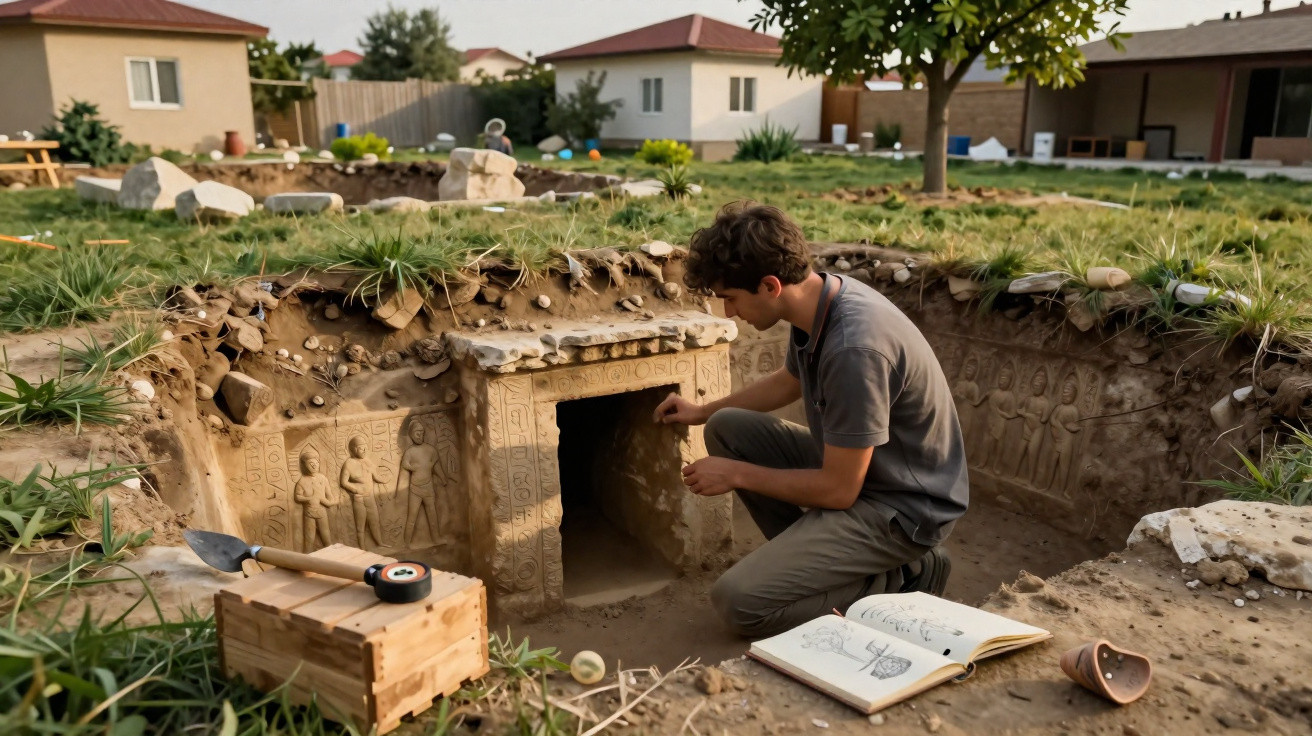
An archaeological survey in the backyard of a home in Şanlıurfa, south-eastern Türkiye, has uncovered a chamber cut straight into the bedrock. Its wall depicts a reclining man beside two winged women. Although regional parallels indicate ancient funerary traditions, the tomb has not yet been conclusively dated.
How was the tomb found beneath the backyard?
The discovery was recorded through the Şanlıurfa Cultural Inventory Project, an initiative established to document incompletely recorded sites across the province. Located beneath a residential plot, the monument comprises a single rock-cut burial chamber concealed below the present ground level.
The find demonstrates why inventories remain valuable even in areas already renowned for archaeology. Rather than beginning with a major excavation, the team was cataloguing heritage scattered among neighbourhoods and private properties. An ordinary domestic space then exposed a funerary structure retaining unusual figurative decoration.
What is carved on the walls?
The principal relief portrays a reclining man, resting on one arm, alongside two winged female figures. The arrangement appears to relate to the deceased and the funerary realm, although the precise identity of the figures has not been determined. One possible reading is that the women served as protective figures.
A painted inscription is also present near the entrance, but part of its text has been damaged and it has not yet been deciphered. This prevents researchers from using it as a quick means of identifying the owner, their social standing or the date of the tomb. Every feature must instead be assessed against other ancient tombs in the region.
Is the structure really around 2,000 years old?
The discovery is often linked with the Roman period because rock-cut tombs are known from Şanlıurfa and the surrounding area. However, the team responsible has stated that the newly documented structure has not yet been dated. The region contains settlements from several different periods, making caution necessary before assigning it a chronology.
The distinction between stylistic comparison and archaeological dating is crucial. Without associated material, a legible inscription or sufficient stratigraphic analysis, calling it “Roman” with certainty may be premature. For now, an age of roughly two thousand years should be regarded as a contextual possibility rather than an established measurement.
- The chamber was cut directly into rock beneath a residential area of Şanlıurfa.
- Its relief depicts a reclining man accompanied by two winged women.
- A painted inscription exists, but it is damaged and has not yet been read reliably.
- Its exact chronology remains unresolved, despite comparisons with ancient funerary traditions in the region.
Who is studying Şanlıurfa’s heritage?
The project brings together specialists from provincial bodies and researchers from Batman and Harran universities. Art historian Gülriz Kozbe of Batman University leads a team of archaeologists, architects and art historians working to compile standardised records for thousands of sites already listed within the province.
The work became even more significant after the 2023 earthquakes, which showed how poorly documented heritage can be vulnerable. Recording plans, photographs and details of ancient structures creates a foundation for conservation and future research, even where there is neither funding nor a need to excavate everything immediately.
What could still reveal who was buried there?
The inscription is among the most promising clues, though reading it will depend on appropriate conservation and recording techniques. The style of the wings, the man’s pose and the chamber’s form can also be compared with dated monuments. Objects recovered in a secure context could help narrow down the chronology.
Until then, the open question is precisely what makes the discovery compelling. An entire tomb remained beneath a modern backyard while its central image continued to be visible in the stone. Establishing when it was created and whom the man represented will be the next stage, rather than an answer archaeology already has ready.






Comments
No comments yet. Be the first to comment!
Leave a Comment