
The first white hair tends to show up on an entirely ordinary Tuesday, when you are not expecting it. In the lift mirror, beneath harsh neon lighting, you spot it: one silver strand glinting as though it belongs there. You flatten it, curl it around a finger, and wonder whether anyone else can see it from that particular angle. All at once, that little hair feels heavier than the laptop in your tote bag.
A few years later, it is no longer a single unwelcome visitor. Instead, a gentle salt-and-pepper halo frames your face. On a good day, it feels chic and French. On a less forgiving day, you glimpse yourself and think, “Since when did I start looking like my old primary school teacher?” You are not trying to look “young at all costs”. You simply do not want every silver strand in the sunlight to trigger an instant “granny” label.
That very tension is where the real transformation can begin.
1. Choose a purposeful cut: the anti-“granny” shortcut
“Gray doesn’t age you. The haircut does,” says Paris-based hairstylist Léa Moretti, drawing a comb through a client’s steel-toned highlights. Sitting in her chair is a 52-year-old lawyer with salt-and-pepper hair skimming her cheekbones and a leather biker jacket. As she checks her emails, nobody in the salon is thinking “granny”. They are wondering who she is and what her story might be.
The reality is that long, unstructured grey hair can pull the face downwards and make signs of tiredness more noticeable. In contrast, clean edges, light layers or a confident bob make each silver strand feel like a deliberate detail. This is the power of a strong cut: it shifts grey hair from a “sign of age” to a deliberate style signal.
Imagine two scenes on the Underground. On one seat sits a woman with chest-length hair that has become thin, yellowed at the ends and grey at the roots, with a centre parting simply because “that’s how it’s always been”. She appears to be apologising for occupying any visual space at all.
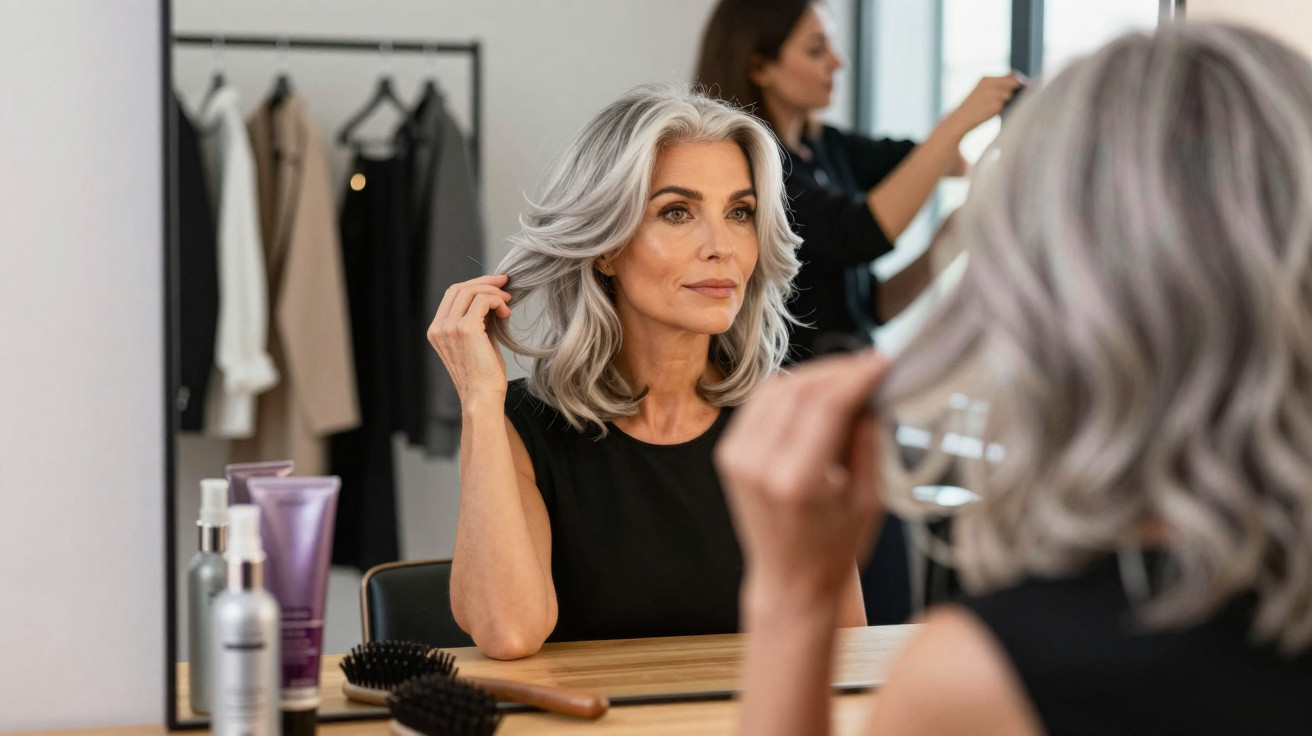
On the seat beside her is someone of exactly the same age, wearing a blunt bob cut to the jawline, with her natural salt and pepper allowed to shine and a little movement through the ends. The colour palette is identical, yet the impression could not be more different. One person fades into the background; the other has the understated impact of a street-style photograph in a magazine. Age is not the difference. Structure is. The cut frames the face, elevates the jawline and makes the brightness in the eyes echo the shine in the hair.
Technically, white and grey hair interact with light in a different way. It is often slightly more porous and coarser, and it reveals every detail of a haircut, whether flattering or unflattering. A weighty, dated shape can look ten times more old-fashioned in silver than it would in brown. For this reason, stylists frequently advise sharper outlines, volume at the crown and necklines that do not droop onto the shoulders.
A contemporary cut makes a straightforward visual statement: this grey is intentional, rather than evidence that you stopped caring. Face-framing layers introduce movement, while a micro-fringe can make glasses look artistic rather than “sensible”. With an up-to-date shape, people see the hair as a style statement, not a clue to your date of birth.
2. Grey hair shine and tone: changing dull grey into silver armour
If the cut provides the frame, shine supplies the filter. Much of the so-called “granny” effect comes from grey hair that appears flat, dull or faintly yellow, rather than the polished silver you admire on Instagram. Fortunately, grey hair responds beautifully to light when it receives the right care.
Hairdressers rely on the same three essentials: moisture, protection and gentle toning. Consider sulphate-free shampoos, nourishing but lightweight conditioners, and purple or blue treatments once a week to counter brassiness. The purpose is not to dye your hair violet, but to maintain a clean, icy dimension. Healthy grey reflects light like a silk scarf; uncared-for grey absorbs it like a cotton sweatshirt.
Léa recalls a 60-year-old client who arrived determined to colour everything brown again. “I’m tired of looking washed out,” she said. Her salt and pepper hair had taken on a beige tint, the ends were straw-like, and she used her hairdryer on its hottest setting “to go faster”.
Rather than colouring it, they detoxed her hair. They used clarifying shampoo to strip away old build-up, a soft gloss for translucent shine and a cool toner to remove the yellow cast. By the end, the very same grey looked like liquid chrome. The client applied red lipstick, took out her phone and whispered: “I can’t believe this is still my hair.” No brown was necessary-only a more considered routine and less harsh treatment.
The explanation is simple. Grey hair contains fewer natural oils, meaning its cuticle can open and frizz more easily. Heat, sunlight and pollution make the surface rougher still, causing light to reflect unevenly. Regular masks, heat protection before styling and a cooler hairdryer setting help smooth it again. A smooth surface reflects light. Reflected light makes hair appear expensive.
Léa has a blunt line that she repeats throughout the day:
“Yellowed gray ages you. Shiny silver lifts you. It’s the same head, just a different care story.”
- Wash and condition with gentle, hydrating products two to three times each week.
- Use a purple mask or conditioner weekly to neutralise yellow tones.
- Apply heat protectant every time before blow-drying or straightening.
- Complete your styling with a tiny drop of serum through the lengths and ends for shine.
- Avoid excessively hot settings: warm air will generally deliver enough smoothness.
3. Use style, clothes and brows to elevate grey hair
The final factor is not your hair at all, but everything that surrounds it. Salt and pepper hair immediately feels editorial when paired with crisp clothing, defined brows and a little facial contrast. This does not require full glamour every morning; a handful of purposeful choices is enough.
Stylists often refer to “visual anchors”: features that draw the eye and communicate “I’m here, present, awake”. With grey hair, this might mean striking glasses frames, a structured blazer, clean-lined white trainers or a bold lip balm that brings colour back to the mouth. Grey loves contrast. A colourful scarf, darker brows or a navy jumper can prevent the faded, beige-from-head-to-toe look that suggests “retirement home” even on a 40-year-old.
We all know the moment when we realise that we have worn the same shapeless cardigan for three winters because “it’s comfy”. Alongside newly grey hair, that cardigan may look like a sign of giving up, even if you feel more alive than ever. Léa says one of the biggest changes occurs when clients give themselves permission to wear bolder, cleaner shapes: straight-leg jeans instead of sagging pairs, a crisp shirt rather than a limp T-shirt, and ankle boots in place of battered flats.
She is equally firm about brows. As the hair becomes lighter, eyebrows often fade as well, leaving the face without definition. A little tint-or simply a quality pencil and brush-restores that framework. The hair may be entirely silver, while the expression remains bright, focused and present.
There is also a psychological element that no shampoo can provide. Women whose grey hair looks especially magnetic usually talk about it in the present tense, not as though it were a remnant of their former selves. They say “my silver” or “my white streak”, rather than “what’s left of my color”. This small change in language alters how they hold their head when entering a room.
Léa captures this idea in a sentence she often gives clients who are unsure about their transition:
“Gray hair tells your story. My job is to cut and style it so the story reads as power, not as permission to dismiss you.”
- Pick one standout element for each outfit: glasses, shoes, a jacket or lipstick.
- Update your brow shape and colour to create balance with lighter hair.
- Choose clothes with clean, defined lines rather than sagging, worn-out pieces.
- Try shades that make silver hair glow, including navy, black, white, fuchsia and emerald.
- Describe your grey hair as a feature rather than a flaw. Your posture will follow.
4. Five everyday habits for grey hair without the “granny” effect
Behind every covetable salt-and-pepper mane lies less magic than you might imagine. More often, it is simply a collection of quiet habits practised consistently. These are the five steps hairstylists return to time and again for clients who want to wear grey hair without the stereotype.
First, schedule a modern haircut every 6 to 10 weeks. This should not be a “trim if you have time”, but a proper appointment to refresh the shape, neaten the neckline and rebalance the length. Overgrown grey hair can quickly start to look “tired”. A precise outline immediately suggests a conscious choice.
The second habit is a manageable care routine that fits real life: a gentle wash, conditioner, a weekly mask and one heat-protective product. Honestly, nobody follows this perfectly every single day. Consistency matters more than perfection. Simply avoiding harsh shampoos and rough towel-drying can noticeably improve texture within a month.
Third, add a fast toning treatment. This might be purple conditioner applied in the shower while you shave your legs, or a salon gloss every couple of months. The intention is to keep the silver cool instead of allowing it to turn nicotine yellow. That adjustment alone removes much of the “granny” feeling.
The fourth habit is a 30-second styling improvement in the mirror before leaving home. You could tuck your hair behind one ear to reveal earrings, switch your parting for extra lift or work a pea-sized amount of volumising mousse into the roots. Messy is acceptable; deliberately messy is chic.
Fifth, pair your grey hair with one visible style choice elsewhere. It may be a bright lipstick, a structured jacket, or a piece of jewelry you actually love. Grey hair makes a strong visual statement. It needs one supporting element on the rest of your body to tell the world, “Yes, I did this on purpose.” These tiny rituals do not demand an hour; they only require a few moments of attention for the person in the mirror.
Grey hair as a style decision, not a surrender
Grey hair once represented a dividing line: before, when you were permitted to be visible, and after, when you were quietly encouraged to tone everything down. That boundary is shifting. Silver buns appear in yoga classes, short white crops at concerts and salt-and-pepper pixie cuts in boardrooms. The more often we see them, the more the old “granny” box begins to break apart.
Everything changes once you view grey as a material rather than a problem. You cut it, gloss it, style it and frame it. You give it contrast and support, and sometimes celebrate it openly. There will still be days when you miss your previous colour, just as you might miss a city where you once lived. But there are also mornings when your reflection seems, unexpectedly, like the most truthful version of yourself. That is when grey hair stops being a deadline and becomes a decision worth sharing.
| Key point | Detail | Value for the reader |
|---|---|---|
| Modern haircut | A structured bob, layers or a short cut that lifts the face | Makes grey hair appear purposeful and stylish rather than neglected |
| Shine and toning | Hydrating care, heat protection and purple products | Turns dull grey into luminous silver that reflects light |
| Style balance | Defined brows, clean clothing and one bold accessory | Removes the “granny” effect and strengthens personal presence |
FAQ:
- Can grey hair really be flattering on everyone? Yes, provided the cut, shine and overall style suit your face and lifestyle. Most people do not suit neglected grey hair, but they can suit grey treated as a design choice.
- Do I have to cut my hair short to avoid the “granny” effect? No. Long grey hair can look striking when the length is healthy, softly layered and not see-through at the ends. Shape, rather than length, is what matters.
- How often should I use purple shampoo or a mask? For natural grey hair, once a week is usually sufficient. If it becomes very yellow, use it up to twice a week, while balancing it with hydrating care to prevent dryness.
- Will grey hair always feel rough? Not always. Regular masks, gentle drying and serums on the lengths can leave grey hair smooth and soft, although its texture may remain slightly stronger than your former pigment-rich hair.
- What if I’m in the middle of growing out dye? Ask your stylist for soft blending with fine highlights, lowlights or a transitional gloss to soften the demarcation line. A current cut and toning products will already make the “in-between” stage seem more intentional.






Comments
Grey hair can look modern and polished with the right cut, healthy shine, and a style that suits your natural texture. Taking care of overall wellness can also support confidence and consistency in your self-care routine: https://wegovypricecompare.com/discount-codes/
Leave a Comment