
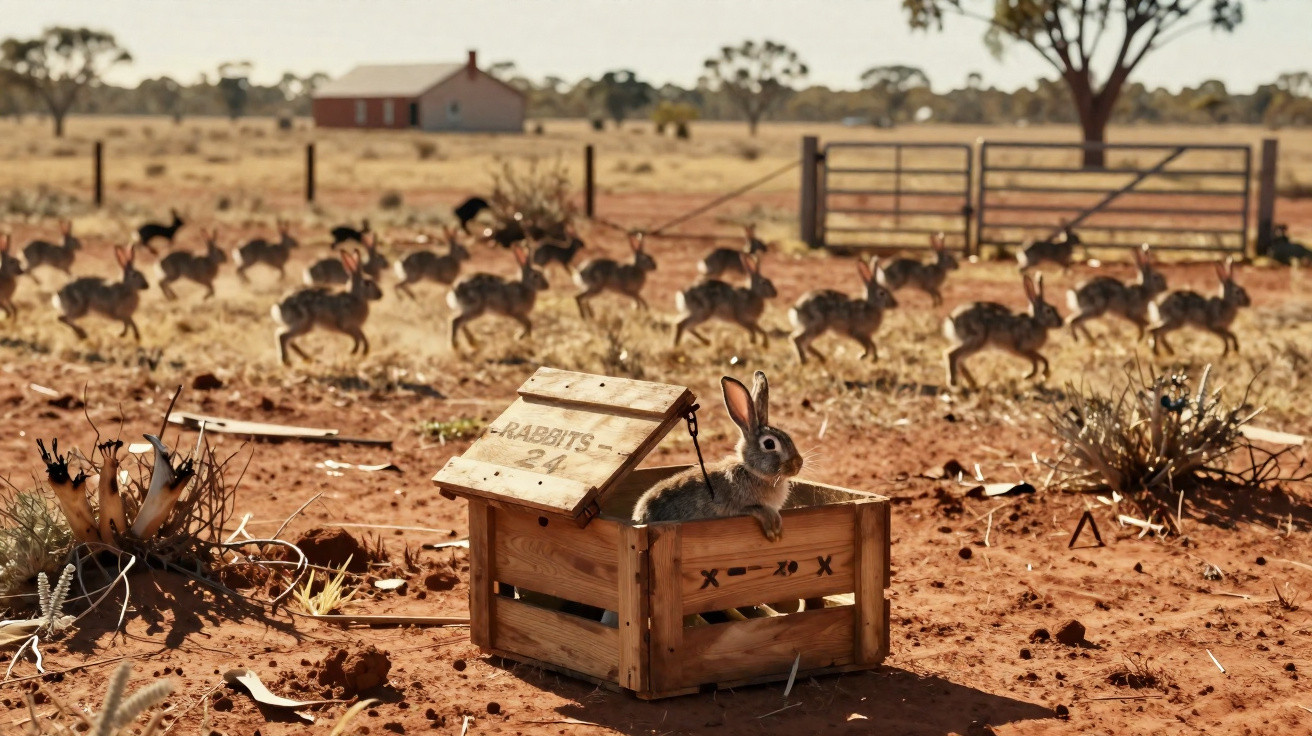
In 1859, British farmer Thomas Austin received a shipment of 24 rabbits at the Barwon Park estate in the Australian state of Victoria, intending to continue his pastime of sport hunting. That introduction helped trigger one of the fastest biological invasions ever documented among mammals: within a few decades, the animals had spread across much of the continent, reaching populations estimated at hundreds of millions and, at certain times, billions.
How did just 24 rabbits lead to a vast invasion?
Rabbits had been brought to Australia before Austin’s arrival, although they were largely kept as domestic animals. The infestation that later spread throughout the continent is closely associated with those released at Barwon Park: historical research indicates that at least 13 wild rabbits from that group contributed to the ancestry of today’s invasive population.
Relatively mild winters, huge expanses of low vegetation created by farming, and the species’ exceptional reproductive capacity all supported its spread. Just seven years after the release, a local newspaper reported that 50,000 rabbits had been killed in the area; roughly a decade later, millions could be killed each year without any noticeable reduction in their numbers.
- Rapid breeding over long periods of the year;
- Vast open areas with readily available food;
- The absence of the same ecological pressures found in Europe;
- The ability to dig burrows and inhabit varied environments;
- Ongoing dispersal across different Australian regions.
Why did rabbits cause such extensive damage to vegetation?
As rabbits spread through Australia, they placed severe pressure on grazing land and native plants. After eating ground cover, they moved on to shrubs, leaves and the bark of young trees, preventing whole areas from regenerating and competing with Australian species for food.
How did the invasion contribute to erosion and species loss?
When thousands of rabbits continually strip away plant cover, the soil surface is left exposed to wind and rain. Erosion then removes the most fertile layers, which may take hundreds of years to recover, making it harder for plants to return even after the invasive population has been reduced.
The effects went beyond farmland. Competition and degradation caused by rabbits are linked to biodiversity loss and affect numerous threatened species. The case follows the same pattern seen in other human introductions, such as beavers brought to Patagonia that later became an invasive species.
- Heavy consumption of native plants and pasture;
- Poor regeneration of young trees and shrubs;
- Competition with native animals for food;
- Soil exposure to wind and rain erosion;
- Continuing harm to agriculture and environmental conservation.
How did Australia try to control billions of rabbits?
Hunting, burrow destruction, traps and enormous fences were employed for decades, but none solved the problem on their own. Between 1901 and 1907, Western Australia built an extensive barrier to halt the animals’ advance, yet rabbits dug beneath it and managed to cross the system; the most significant turning point came in 1950, when the deliberate introduction of the myxomatosis virus cut an estimated population of around 600 million to approximately 100 million, although genetic resistance later enabled a recovery.
Why did the case become a symbol of the risks posed by invasive species?
The rabbit plague in Australia showed how an apparently minor introduction can set off ecological change on a continental scale. The animals colonised around 70% of Australia in under 70 years, an exceptionally rapid expansion for an invasive mammal.
More than a century and a half after the release associated with Thomas Austin, control still relies on fencing, habitat management and biological agents, because continent-wide eradication is no longer regarded as a realistic possibility. The episode turned a handful of animals released for hunting into a classic example of how human decisions can reshape vegetation, soil, agriculture and native populations for many generations.






Comments
No comments yet. Be the first to comment!
Leave a Comment