
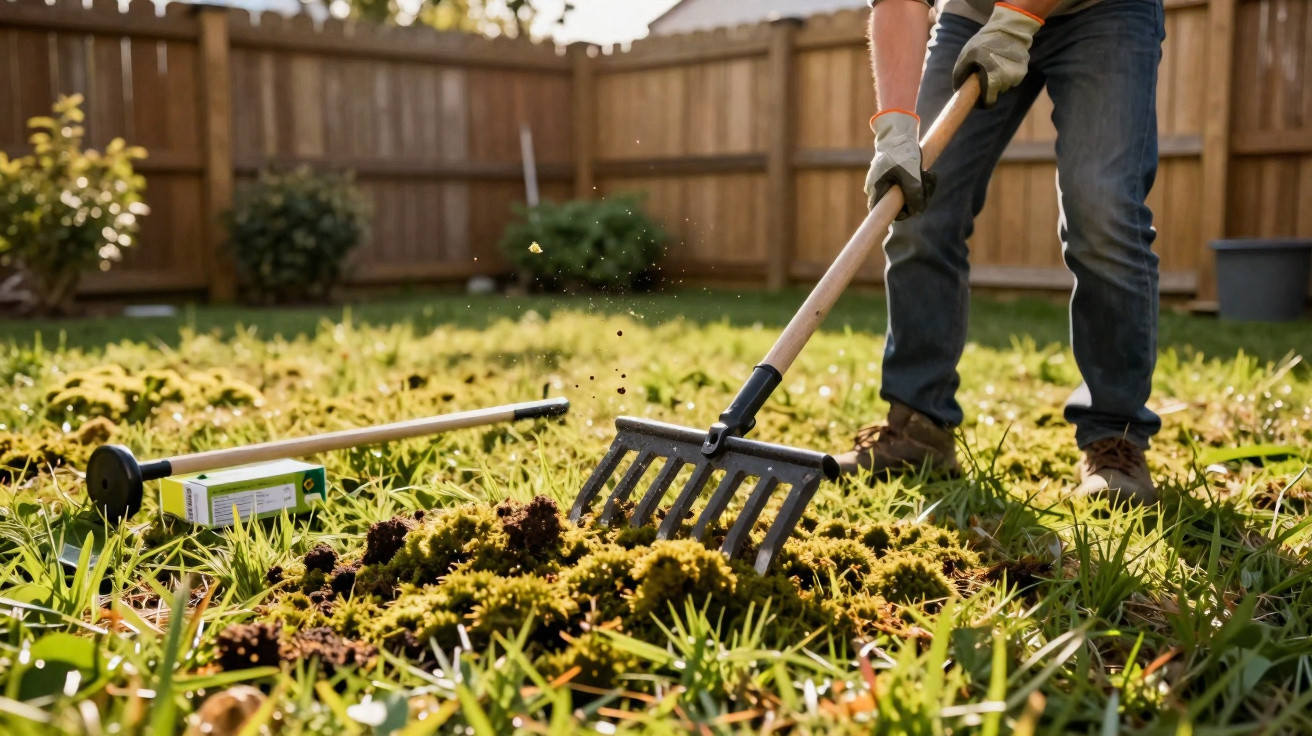
Across the UK and US, homeowners often head outdoors in March hoping to see fresh grass, only to discover moss spreading across the lawn. Fortunately, there is no need for a shed packed with machinery or chemical mixtures. With a straightforward routine and two basic tools, a worn, moss-covered area can become a lawn that looks strong and feels solid beneath your feet.
Why moss suddenly takes over your lawn in spring
Moss is not a conventional weed. It has no deep root system and does not spread in the same way as invasive grasses. Instead, it reproduces through spores and establishes itself where healthy turf is under stress. This is why it can seem to emerge almost overnight, particularly towards the end of winter.
Moss gains an advantage under several conditions:
- Ongoing shade cast by trees, fences or buildings
- Compacted ground caused by regular foot traffic, pets or vehicles
- Inadequate drainage and areas that remain waterlogged
- Acidic soil, which moss tolerates more easily than grass
- Cutting grass too closely, leaving turf weakened and soil exposed
“Where grass is weak or sparse, moss simply fills the gap and forms a soft, green carpet that looks pretty but never feels like a lawn.”
Specialists generally consider late winter and early spring the best time to deal with it. Grass is beginning to grow again and can quickly fill the spaces left after moss is removed. Delaying until summer can slow recovery, as heat and dry weather put the grass under pressure.
Two tools that quietly outperform expensive machines
In most small to medium-sized gardens, there is little need for a powered scarifier or the lawn “renovation” machines promoted during spring sales. An effective anti-moss routine can rely on two affordable tools:
The scarifying rake: where the battle starts
A scarifying rake resembles a sturdy rake fitted with sharp, flexible tines. It pulls through the thatch - the surface layer of dead grass, old clippings and moss. Drawing it firmly over the lawn delivers three benefits at the same time.
| Action | Effect on the lawn |
|---|---|
| Removes moss and thatch | Creates room for new grass shoots to develop |
| Scrapes the soil surface | Allows seeds and nutrients to reach the soil |
| Boosts air movement at the base | Limits the damp conditions moss favours |
Using it once or twice annually can take the place of repeated treatments with harsh moss killers. It is hands-on work, but a single afternoon is often enough to tackle most of the issue in a small garden.
The lawn aerator: the quiet fix for compacted soil
The second tool is simpler still: a lawn aerator. This can be an ordinary garden fork, a manual spiking roller or spike-soled shoes. Whichever option you choose, the principle is identical: make holes in the soil to relieve compaction.
“Regular aeration lets air, water and nutrients travel deeper, which encourages grass roots to head down instead of giving up at the surface.”
After these channels are created, rainwater is less likely to remain on the surface, depriving moss of the still, damp conditions it likes. Grass instead tends to grow denser and feel more resilient underfoot.
Timing your anti-moss routine for real results
When you act matters just as much as which tools you use. Lawn specialists commonly advise treating moss only once grass is capable of growing back into the cleared areas. Early spring is suitable in many places, although cold spells can still pause growth.
A useful guide is to wait until daytime conditions remain steadily mild and the lawn is visibly turning green and growing, rather than merely holding on. Once it reaches that stage, this sequence usually works effectively.
A practical step-by-step schedule
- Mow high. Adjust the mower to roughly 5 cm. Grass weakened by close cutting makes it easier for moss to return.
- Rake thoroughly. Pull the scarifying rake across the lawn to remove moss, dead grass and winter debris.
- Optional moss treatment. At this point, some gardeners use an iron-based moss control product. Such products generally turn moss dark or black and dry it out, making removal easier.
- Wait one to two weeks. Allow any treatment to work, while the grass benefits from the added light and airflow around its base.
- Rake again. Use the scarifying rake once more to lift out the moss that has loosened.
- Aerate the soil. Pierce the ground at regular intervals with a fork or spiked roller, concentrating particularly on high-traffic parts of the lawn.
- Overseed and feed. Sow grass seed over bare areas and use a balanced, slow-release lawn fertiliser.
“A light repeat of raking and aeration in autumn keeps compaction under control and reduces moss pressure the following spring.”
Do moss killers still have a place in home gardens?
Across the UK and in many US states, synthetic pesticide use on domestic lawns is facing closer scrutiny. This is one reason iron-based lawn tonics have grown in popularity. They target moss while feeding the grass, and remain available to home gardeners in many locations.
Products marketed as “moss killer and lawn tonic” commonly contain a combination of seaweed extracts, iron and nitrogen. Their promise is straightforward: rapidly scorch moss while encouraging stronger grass growth. However, they are most effective as a supporting measure rather than the primary solution. If raking and aeration are omitted, moss will usually return once conditions become favourable again.
Why mowing habits make or break a healthy lawn
Moss is frequently a sign of broader lawn stress, with mowing practices among the main causes. In spring, many people cut grass excessively short to create a neat, even finish. Doing so exposes the soil, weakens the turf and leaves open areas where moss spores can settle.
Setting the mower blade higher brings three distinct advantages:
- Grass retains more leaf area, providing additional energy for root development.
- The soil remains shaded and a little cooler, helping reduce stress during dry periods.
- Moss has fewer bare areas in which to establish itself.
For most household lawns, maintaining a height of around 4–5 cm during spring and early summer offers a sensible compromise between a tidy look and healthy grass. Shorter, “bowling green” cuts require specialist maintenance, regular feeding and almost ideal growing conditions.
Understanding your soil: why pH and drainage matter
Ground that remains wet for long periods or is highly acidic usually supports moss more readily than grass. Moss often flourishes in hollows where water gathers, or beneath trees, where decomposing leaves and needles gradually reduce the pH.
A basic soil testing kit can show whether a lawn is strongly acidic. If it is, many lawn-care guides recommend applying garden lime occasionally to move the pH gently towards neutral. Lime will not remove moss by itself, but once raking and aeration begin, it can help shift conditions in favour of grass.
Drainage is equally important. Aeration can improve it, but serious waterlogging may require further action, including topdressing with sandier soil, installing drainage channels or levelling low areas. Otherwise, moss will continue to return in the same damp conditions.
Realistic expectations: what a “strong and healthy” lawn looks like
A lawn labelled strong and healthy does not have to be completely flawless or perfectly even. It should withstand normal use, recover after rainfall and avoid feeling thin, patchy or slippery underfoot. A little moss may still develop in heavily shaded places, particularly beneath dense trees. In these situations, many gardeners accept some moss or use shade-tolerant ground covers instead of trying to overcome the conditions.
Consider a typical small suburban lawn with children and a dog creating heavy traffic, plus uneven shade from a fence. Two spring sessions of scarifying and aerating, along with a higher mowing height and one repeat in autumn, can often reduce moss significantly within a year. Regularly overseeding worn areas then gradually thickens the turf until moss finds it difficult to establish a foothold.
Linked garden habits that support a moss-free lawn
A number of everyday habits can either strengthen or undermine efforts to control moss. Keeping heavy garden furniture in the same position, for instance, compacts the soil and can create sodden areas after rain. Moving furniture regularly and avoiding parking cars on grass help limit compaction.
Grass clippings also need careful management. An occasional thin layer left on the lawn can provide nutrients. Large piles of clippings, however, or mowing when the grass is very wet, create a thick thatch layer that traps moisture at the surface - exactly what moss needs. During rapid growth, collecting clippings or making a second, lighter mowing pass prevents this build-up.
Together, these modest changes and regular use of a scarifying rake and lawn aerator provide an understated but effective method. The lawn is unlikely to transform overnight, but over successive seasons grass begins to reclaim the areas that moss once occupied.




Comments
No comments yet. Be the first to comment!
Leave a Comment