
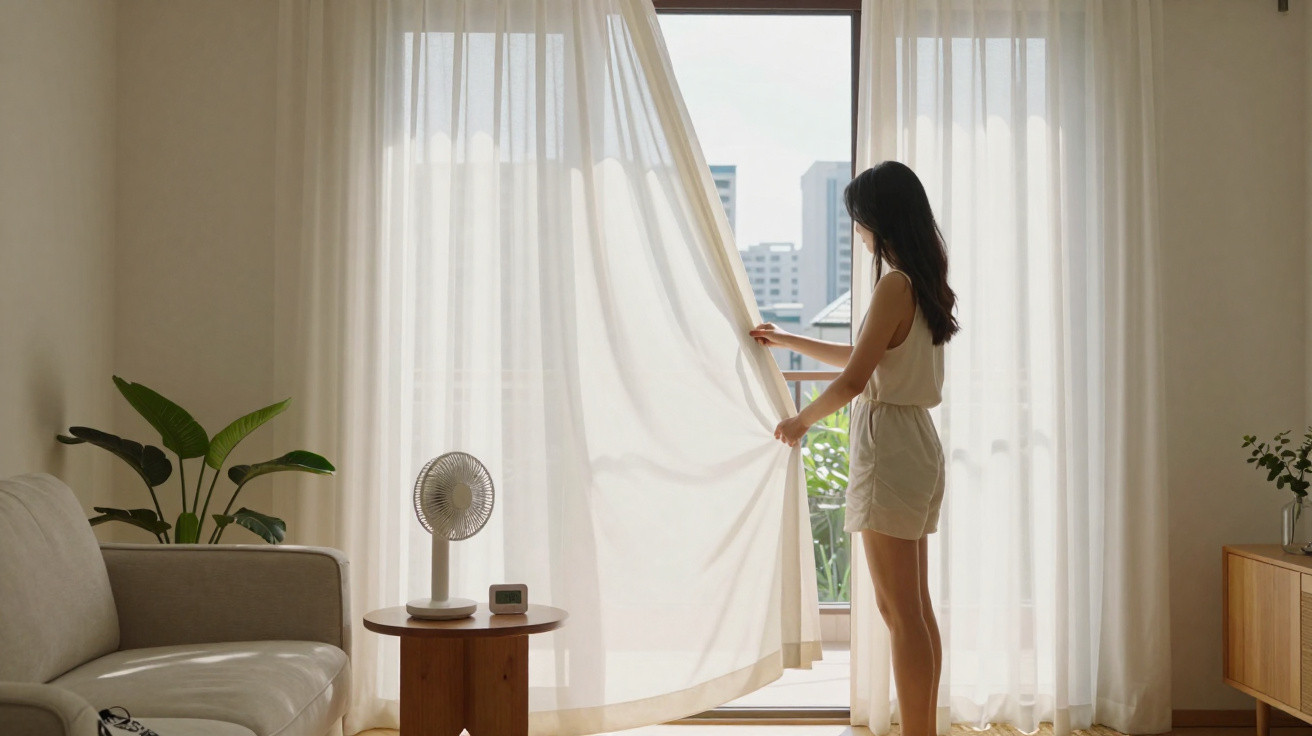
During the warmer months of the year, more people are looking for ways to keep their homes cool without relying solely on air conditioning. As energy bills rise, householders have increasingly turned to straightforward, affordable measures, such as using white curtains to protect against heat, which can lower indoor temperatures without major renovation work.
How do white curtains help block heat at windows?
The principle behind white thermal curtains relates to the way light and heat pass through glass. Windows exposed to sunlight act as entry points for radiation, warming indoor air and nearby surfaces throughout the day.
Placing a pale, heavyweight, tightly woven fabric close to the glass reflects a substantial proportion of that energy back outside. Light shades, and white in particular, reflect more sunlight, forming a simple thermal barrier that limits heat gain without making the room completely dark.
Watch a video on the Almanaque SOS YouTube channel about simple natural cooling techniques and household tips for making rooms feel cooler on very hot days:
https://www.youtube.com/watch?v=M9mF2c5R9U4
Can white curtains completely replace air conditioning?
In areas with hot summers that are not relentlessly extreme all day, white curtains to protect against heat can noticeably reduce the need for mechanical cooling. Rooms facing the sun are less likely to become excessively warm when the entire window is covered with thick, light-coloured fabric.
During severe heatwaves or in very hot cities, combining white curtains with fans and, where possible, air conditioning is generally more effective. Once this barrier is in place, the unit does not need to work as hard, which can help cut energy use and reduce discomfort from temperature peaks during the day.
How should you choose and fit white curtains to improve thermal comfort?
For effective results, choose suitable materials and give some thought to how they will be fitted. Thick, close-weave fabrics in white or another very pale shade typically perform better, including durable cotton, lightweight canvas or light-coloured blackout-style fabric.
A few practical measures can also improve performance and make the curtains easier to use day to day, whether in houses or small flats. The following guidance can help you get more from this approach:
- Fit the fabric as close to the glass as possible to limit the warming of air between the window and curtain;
- Keep curtains closed during the strongest sunshine, particularly in the afternoon;
- Cover the full window area, without gaps at the sides, top or bottom;
- Pair curtains with night-time ventilation by opening windows when outdoor air is cooler.
What are the main benefits and limitations of white curtains against heat?
Using white curtains against heat offers benefits including reduced indoor warming, potential savings on electricity bills and straightforward installation without building work. Their flexibility is another practical advantage: they can be taken down or drawn back on cold days, allowing sunshine to warm the rooms again.
However, during extreme heat, a fabric barrier can moderate the temperature but cannot solve the problem on its own, especially in homes with extensive glazing or limited thermal insulation. In these cases, it is usually more effective to combine this measure with cross-ventilation, external shading, well-insulated roofs and, where practical, air coolers or air conditioning set to operate at moderate temperatures.





Comments
No comments yet. Be the first to comment!
Leave a Comment