
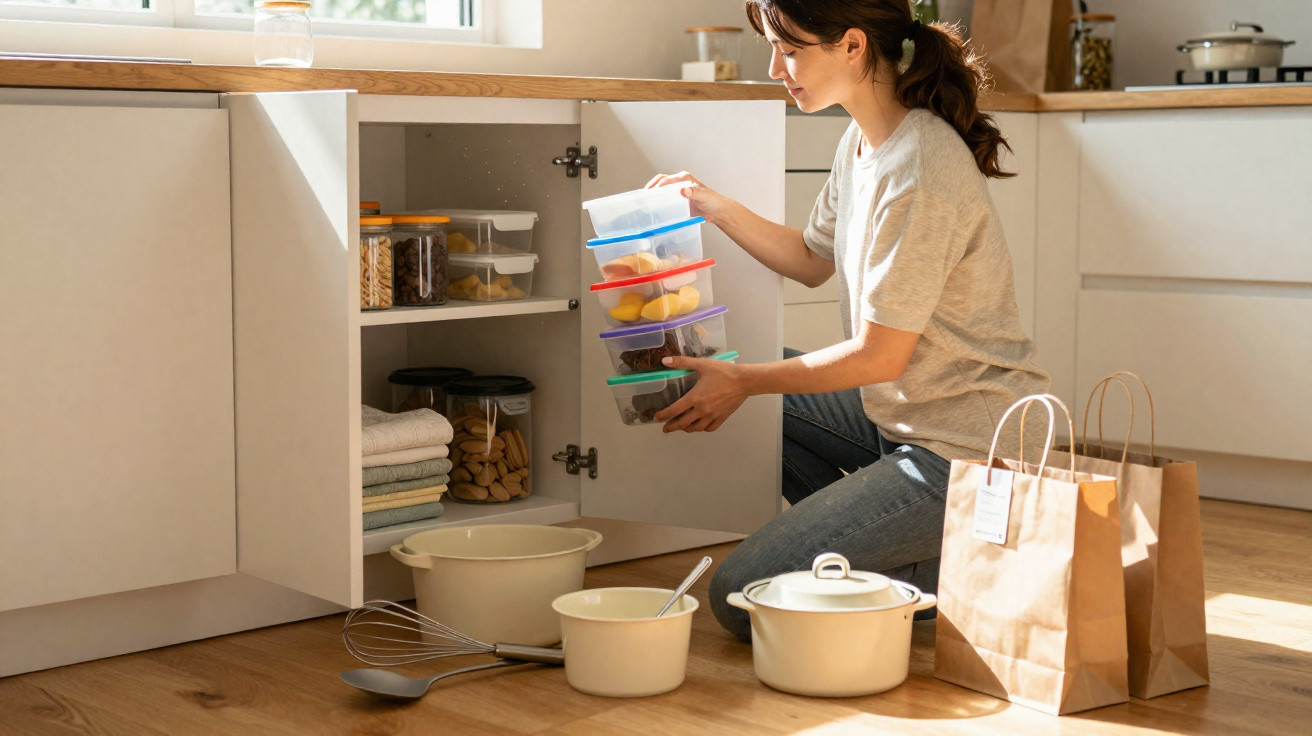
Full cupboards do not necessarily mean that your home lacks storage space. Often, the issue is the number of duplicate objects or items kept without a clear purpose. Extra utensils, containers without lids and bags saved for an occasion that never arrives can take up valuable space for months.
Why does having too many items make organisation harder?
When a single area stores a greater variety of items, it becomes more difficult to see what is actually available. As a result, things may be forgotten at the back of shelves while more visible alternatives are bought again.
Professional organisation is usually based on one straightforward principle: the available space should match what is genuinely used. This does not mean owning as few things as possible, but rather preventing cupboards from being filled with items that have no practical use.
Which duplicate utensils should be reviewed?
Glasses, mugs, storage tubs, serving dishes and other kitchen utensils can build up over time. Some come from sets, gifts or occasional purchases, and remain in the cupboard even when the household already has enough for everyday life.
To assess them, gather every similar item together and consider how many are truly used. Broken or damaged pieces, along with those that rarely leave the cupboard, may be suitable to remove, depending on the needs of the household.
Why do containers without lids take up so much room?
Plastic tubs and containers in assorted shapes often create stacks that are awkward to organise. Once the matching lid has gone missing, a container can continue to occupy space without serving its intended purpose.
One option is to collect all containers and lids, then check which sets are still complete. Any that are no longer useful can be disposed of or recycled according to their material and local rules.
What about bags and objects kept “for someday”?
Reusable bags, packaging and small containers can accumulate because they appear to have possible future value. The problem begins when the quantity greatly exceeds what is actually used.
The same applies to items purchased for a hypothetical occasion. Before putting something away again, it can help to ask when it was last used and whether the item has a specific planned purpose.
Which 5 things in cupboards deserve attention?
A review can begin with these categories:
- Duplicate utensils: similar pieces kept in quantities far beyond the household’s needs.
- Tubs without lids: containers that no longer make up a functional set.
- Accumulated bags: bags taking up more room than the number normally used.
- Empty packaging: boxes and containers retained without a defined purpose.
- Objects “for someday”: items stored for a long time with no realistic expectation of use.
The aim is not to throw away everything that is not used every day. Some possessions are seasonal, sentimental or intended for a particular purpose. The goal of cupboard organisation is to make room for what genuinely belongs in your routine and make it easier to find what is already at home.


Comments
No comments yet. Be the first to comment!
Leave a Comment