
Not the piercing bite of bleach, but the stale, damp blend of shampoo, old limescale and “I’ll deal with this later”. You push open the bathroom door, notice the lifeless mirror, hazy shower glass and tap that never seems properly clean, and feel a familiar little knot in your stomach.
You could grab the standard fluorescent bottle and attack the lot in ten minutes: fast results, overpowering fumes, windows thrown open and children kept away. Or you could choose a gentler, quieter approach that is less punishing for your lungs and the planet.
Somewhere between those choices, many households are gradually changing how they clean. They are trying white vinegar, baking soda, microfibre cloths and better timing. Some attempts disappoint, while others earn glowing praise. A few people find a routine that keeps the bathroom truly clean without a toxic haze lingering around the basin.
At first, that routine looks remarkably unremarkable.
Small daily rituals that prevent the “bathroom disaster” moment
Bathrooms that remain naturally clean seldom belong to people who spend hours scrubbing. They usually belong to those who carry out small, unexciting tasks almost automatically: wiping the basin while the kettle boils, rinsing the shower walls before reaching for the towel, or opening the window whenever steam fills the room.
This simple, low-effort routine prevents dirt from setting hard. Soap scum has no time to stick, and toothpaste splashes cannot become fossilised on the tap. It may seem insignificant, but a few minutes here and there can quietly replace the dreaded monthly deep-clean marathon.
One Tuesday evening in Lyon, a young father matches his “bathroom reset” to his child’s bath time. As the child plays with plastic boats, he wipes down the tiles, mirror and sink. It takes five minutes each night. He says he has not needed to scrub limescale for six months. A study by the American Cleaning Institute once found that people greatly underestimate how much easier fresh dirt is to remove.
That is precisely the principle at work. Rather than holding out for the “weekend operation”, you never allow the mess to take control. There is no heroic cleaning session, only small actions repeated regularly. The bathroom may not be Instagram-perfect, but it rarely reaches the point of “how did it get this bad?”.
Psychologically, micro-routines make it easier to get started. You are not “cleaning the bathroom”; you are “wiping the tap while the water heats”. Your mind is more willing to accept that exchange. In time, the room settles into a sufficiently clean state without demanding extreme effort. Avoiding harsh chemicals also makes a difference. There is no need to put on gloves or fling open every window to escape fumes, so cleaning becomes less dramatic.
There is a health benefit, too. Regular light cleaning with mild products lowers the level of irritants in the air and on surfaces. This is important for people with asthma, sensitive skin or children who want to touch everything. The bathroom becomes less of a battleground and more of a space where care can take place.
Natural ingredients and precise methods: what really works
Households that keep a sparkling bathroom without aggressive products tend to depend on a straightforward trio: white vinegar, baking soda and hot water. None is glamorous, but when used in the right sequence, they deal with most everyday grime. Vinegar tackles limescale and the film left by soap scum; baking soda provides mild abrasion and helps with odours; hot water softens the build-up first.
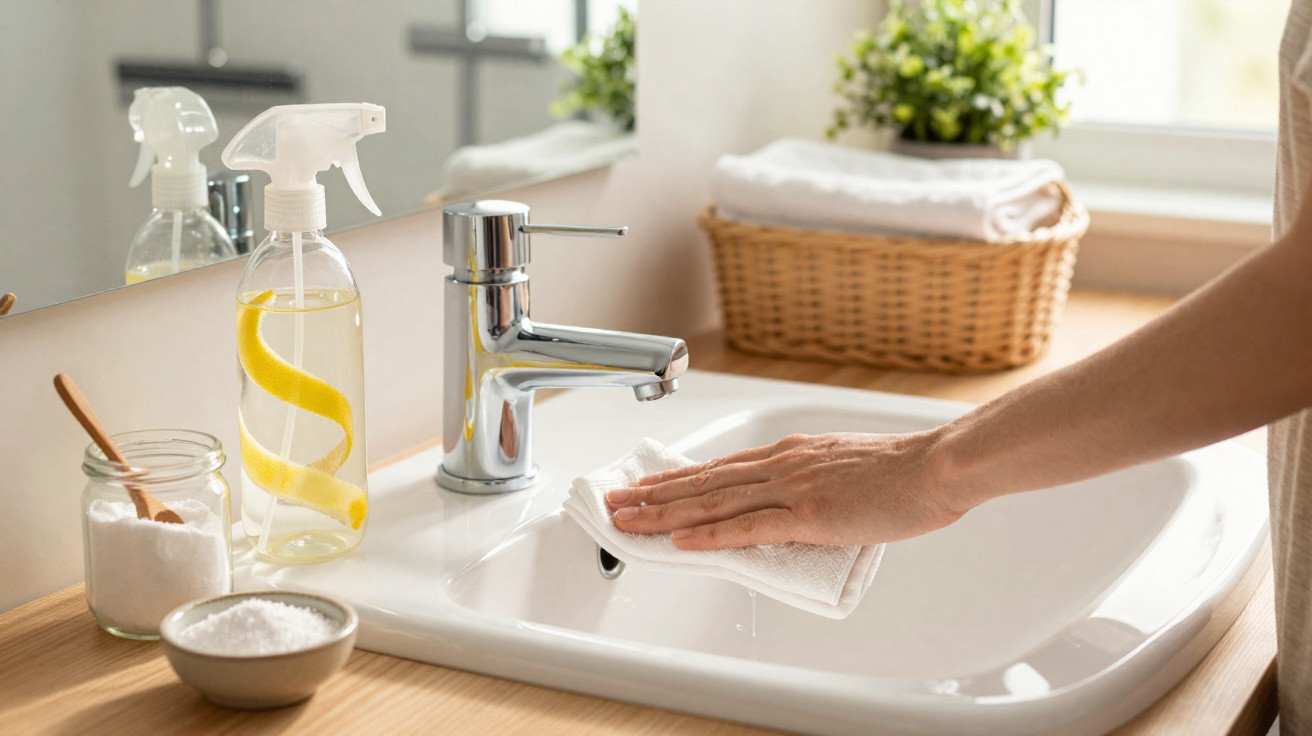
A common routine goes like this. Once you have had a hot shower, while the tiles and glass remain warm and misty, spray the walls and glass with a 50/50 solution of white vinegar and water. Leave it on while you brush your teeth. Next, pull a squeegee from top to bottom, using one smooth pass for each strip. For the sink, scatter a little baking soda, add a dash of vinegar, allow it to fizz, then wipe with a damp microfibre cloth.
Problems tend to arise when people embrace “all natural” cleaning but treat these ingredients as though they were magic. Vinegar left for hours on natural stone can damage the finish. A heavy layer of baking soda can scratch chrome if you scrub excessively. Let’s be honest: nobody really does all of this every day, and that is absolutely fine.
What matters is deciding where to be consistent. Rinse and quickly wipe the shower after every use. Ventilate for at least ten minutes whenever hot water has been running. Even if everything else only happens weekly, these two habits already reduce the need for hard scrubbing and the urge to reach for harsh chemicals.
There is also a very relatable moment. On a Sunday evening, you spot a pinkish coating in the corners of the shower and think, “Too late, I’ll need the strong stuff.” Usually, this is simply biofilm and soap residue, both of which respond well to a warm vinegar spray and a soft brush when caught soon enough.
“The trick isn’t finding the perfect eco-product,” says Claire, who runs a small eco-cleaning service in Bristol. “It’s deciding what you’re going to do in under five minutes, even when you’re tired, and then repeating that boring little thing more often than you think you should.”
- Keep one spray bottle of 50/50 vinegar and water for glass, taps and tiles.
- Hang a dry microfibre cloth behind the door for fast mirror and sink wipes.
- Save baking soda for stubborn marks rather than using it across entire surfaces.
- Open a window or run the extractor fan for ten minutes after showers to combat mould naturally.
Making cleaning a sustainable, human routine
Once the belief that “grimy bathroom = nuclear chemicals” begins to disappear, a gentler approach takes its place. Cleaning feels less like a punishment and more like brushing your teeth: mildly tedious but entirely normal. Instead of waiting to feel motivated, you depend on routine.
Some families place a small checklist inside a cupboard: wipe the sink each evening, quickly squeegee the shower, spray the shower head with vinegar weekly, and scrub grout more thoroughly each month with a baking soda paste. It is not military discipline. It is simply a visible prompt that bathrooms do not remain clean by chance; they stay clean because small jobs happen at regular intervals.
This also leaves room for modest pleasures: a humidity-loving plant by the window, a better soap bar that leaves less residue, or a mirror bright enough to reflect your morning smile without bleach fumes stinging your eyes. Avoiding harsh products is not only an environmental decision. It changes the atmosphere of the whole room.
It can also subtly alter the conversation at home. Children learn that “clean” does not have to mean “smells like chlorine”. Partners argue less about the mythical “deep clean” for which nobody ever seems to have time. The bathroom will still become messy, and life will still happen. But beneath towels left on the floor and toys scattered about, the surfaces remain easy to restore with a few natural, understated habits.
| Key point | Details | Why it matters to readers |
|---|---|---|
| Daily 2-minute sink reset | After brushing your teeth in the evening, run hot water, add a pinch of baking soda to the basin, rub with a damp cloth, then rinse and dry the tap and surrounding edges. | Stops toothpaste crust and soap rings from accumulating, helping you avoid heavy scrubbing sessions and the temptation to use aggressive cleaners. |
| Post-shower vinegar spray | Fill a spray bottle with equal quantities of white vinegar and water. After showering, mist the tiles and glass, wait a few minutes, then draw a squeegee from top to bottom. | Loosens limescale before it hardens, keeping glass clearer and tiles less dull without strong descalers that irritate skin and lungs. |
| Weekly grout focus | Once a week, apply a thick paste of baking soda and a little water to discoloured grout, mist lightly with vinegar, let it fizz, then scrub using a soft brush. | Deals with the visibly dirtiest areas, making the whole bathroom look cleaner and extending the period between professional or chemical-intensive treatments. |
FAQ
- Can natural products really kill bathroom germs? White vinegar has mild disinfecting properties and can help lower bacterial levels, particularly when it is used warm and left for a few minutes. For most homes, frequent cleaning with vinegar, soap and thorough rinsing is sufficient to keep bathrooms hygienic, provided visible dirt is not left untouched for weeks.
- Is vinegar safe on every bathroom surface? No. Do not use vinegar on natural stone such as marble, travertine and certain limestones, because its acidity can etch and dull them. Use a pH-neutral cleaner on these materials, reserving vinegar for glass, ceramic tiles and chrome fittings.
- How often should I deep clean if I follow these routines? When you maintain quick daily and weekly habits, a more comprehensive deep clean every one to two months is generally enough. This may involve cleaning behind the toilet, washing the shower curtain, and cleaning extractor fans and vents.
- What’s the best way to prevent mould without harsh sprays? Ventilation is your best defence: open windows or run the fan during and after showers, and leave doors slightly open where possible. Remove condensation from tiles and windows, then tackle early mould marks with a vinegar-and-water mixture before they spread.
- Are microfibre cloths really better than regular sponges? Microfibre captures fine particles and soap film more effectively, often working with water alone or a mild solution. It also dries more quickly than thick sponges, helping to reduce musty odours and bacterial growth between uses.



Comments
No comments yet. Be the first to comment!
Leave a Comment