
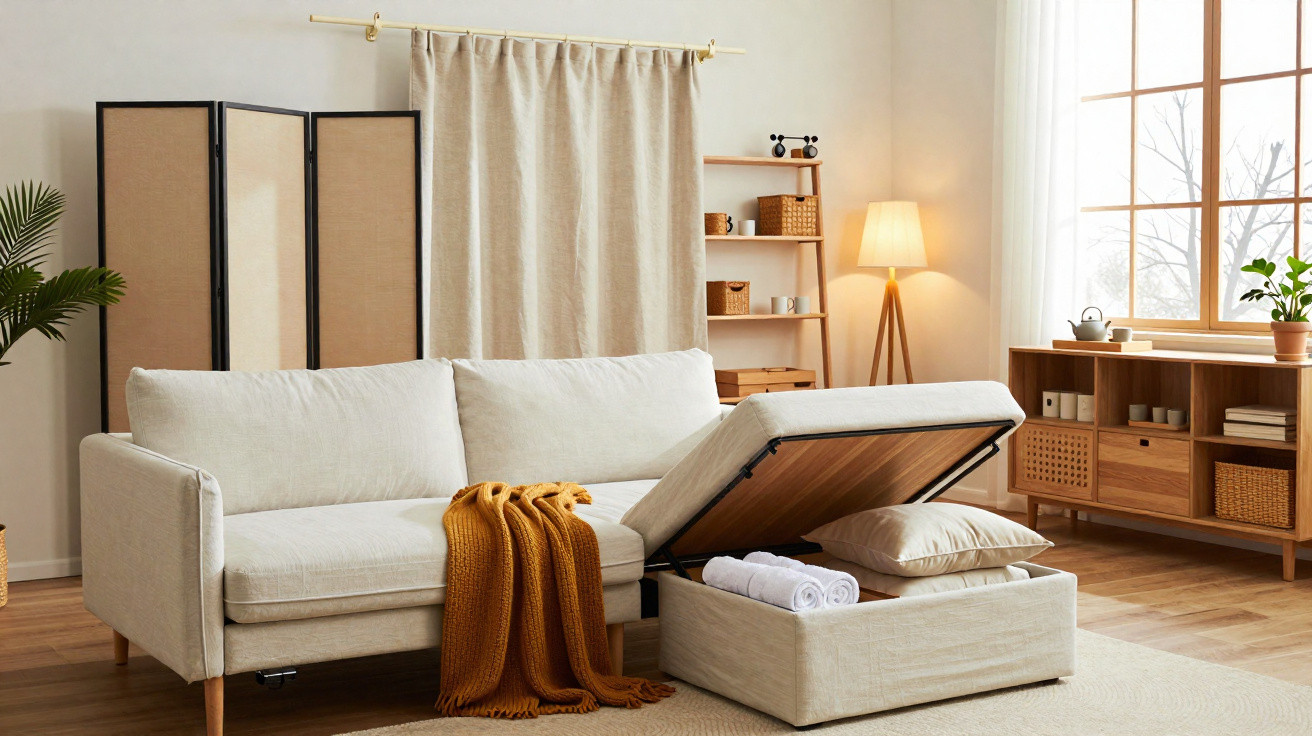
As family members reserve rail tickets and friends arrange overnight visits, plenty of households face the same problem: there is no proper guest room, yet they do not want to give up an entire bedroom for people who stay only a few nights each year.
Why the traditional guest room no longer works in 2025
For decades, a separate guest bedroom was seen as a sign of comfort and security. You had supposedly “made it” once you could provide a proper bed behind a closed door. In reality, however, that room commonly stands unused, gradually collecting boxes, seasonal clothing and perhaps an unused exercise bike.
In crowded cities, underused space can begin to seem less like an indulgence and more like a levy. As rents rise, energy costs increase and every square metre carries a monthly price, the expense is felt with each direct debit. It becomes difficult to defend a room used for only three weekends annually when the living room must also function as a study, playroom and dining space.
Across major European capitals, architects now treat the “static guest room” as a relic of a housing model where space felt cheap, and life more predictable.
Working from home changes the equation once more. Many homes require:
- a peaceful desk area several days each week,
- a place for homework in the evening,
- a play space during wet afternoons,
- and a comfortable bed when relatives stay overnight.
A room with one permanent role seldom meets all those needs. Interior designers instead advocate adaptable arrangements that let a space change purpose in fewer than five minutes. The objective remains simple: accommodate visitors without leaving an entire room in “hotel mode” for the rest of the year.
The living room that becomes a bedroom overnight
The living room is now central to this change. It already brings together everyday activity, natural light and social life. Using it as a temporary bedroom after dark is no longer viewed as an inferior solution, but as an intentional design decision.
The key item in this approach is the contemporary sofa bed. Put aside the bulky, noisy designs that many still associate with the 1990s. Models for 2025 prioritise three essentials: comfortable seating, genuinely restful sleep and styling that resembles an ordinary sofa in daytime.
The strongest options provide:
- a one- or two-step opening mechanism that does not mean shifting a weighty coffee table,
- a substantial mattress that feels closer to a conventional bed than a folding futon,
- supportive slats rather than a metal rail across the back,
- armrests and cushions that remain where they belong when the bed is unfolded.
The shift is subtle but clear: the sofa bed is no longer a compromise. It becomes the main bed for guests and a primary seat for daily life, not a last-minute fallback.
Brands on either side of the Atlantic now position convertible sofas as key pieces within their winter ranges. Silhouettes are softer, textiles are more textured and earthy shades sit easily alongside seasonal décor. This is important because the furniture needs to perform convincingly for 350 days of the year as the living room’s focal point, rather than looking like a hidden bed awaiting Christmas guests.
Storage ideas that keep your living room from resembling a hostel
Adaptable sleeping layouts succeed only when the room can be restored swiftly each morning. That makes storage planning essential before purchasing the first furniture item.
Concealed storage beneath benches, ottomans and sideboards can hold pillows, duvets and spare blankets. Closed units reduce visual clutter. Rather than leaving bedding piled on a chair in the corner, it can all disappear in a few motions once a guest has finished their coffee.
Some households even plan their “night mode” on paper: the location of the bedding, the place for a suitcase and the lamp that will serve as a bedside light. It may appear overly particular in writing, but it reduces pressure when somebody arrives late carrying a heavy bag and everyone simply wants the room to function.
| Need | Day arrangement | Night arrangement |
|---|---|---|
| Bedside surface | Side table holding a plant | Move the plant to a shelf and place the table beside the sofa bed |
| Light | Floor lamp in the reading area | Move the floor lamp to the guest side of the room |
| Bedding storage | Concealed drawer beneath a bench | Opens in 10 seconds, allowing bedding to go directly onto the mattress |
| Privacy | Open-plan area | Unfold a curtain or screen along a pre-planned line |
Soft boundaries: giving guests privacy without constructing walls
Privacy often determines whether a living-room bedroom feels comfortable or embarrassing. Few people enjoy sleeping visibly in the centre of a home. Yet fixed plasterboard walls reduce both daylight and adaptability in compact homes.
This is where soft dividers prove useful. Designers now make extensive use of:
- heavy curtains fitted to unobtrusive ceiling tracks,
- folding screens made from cane, timber or fabric,
- open shelving that screens views while allowing daylight to pass through.
A substantial linen curtain in a muted shade, paired with velvet or wool cushions, can form an immediate cocoon around the bed. In a narrow flat, a woven-cane screen can gently soften the edges of the sleeping space without entirely obstructing sightlines.
The trick is not total isolation, but a sense of “my corner” for the guest and “our home still works” for the host.
Small details complete the effect: a thick rug beneath the bed area to soften footfall, a lightweight bedside stool for a glass of water and an accessible socket for charging a phone. Such additions make visitors feel that the space has been adjusted for them, rather than that they are merely being put up on the sofa.
Materials and atmosphere: keeping winter stays calm rather than cramped
As this switch mainly takes place in the coldest part of the year, the choice of materials is significant. Homes are increasingly choosing warm, hard-wearing textiles that cope with regular use.
Washed linen and cotton mixes withstand repeated laundering. Pale woods prevent the room feeling too weighty when the bed is open. Unfinished ceramics and wool throws introduce visual warmth without dominating the arrangement. The living room should still feel like a living room first and a guest area second.
For renters or those keeping a close eye on spending, modest accessories can create a seasonal change with little risk: loose covers, cushion covers, heavier curtains that retain heat and one striking rug to visually define the “night zone” when the bed is unfolded.
Budget timing and regional trends: when to improve your arrangement
Throughout France and much of Europe, modular furniture typically receives more attention in December, when retailers promote collections for smaller homes and open-plan living rooms. Retailers in the UK and US follow a comparable pattern, connecting launches and reductions with Black Friday, Boxing Day and January sales.
People hoping to reshape a living room before the busiest guest period commonly look for:
- mid-priced sofa beds with improved mattresses,
- storage benches and ottomans that conceal bedding,
- curtain track systems that can later be used as room dividers,
- folding desks or wall-mounted tables for a home-working corner.
Concept shops and online retailers now assemble complete “day-to-night living room” packages: a convertible sofa, adaptable divider and practical side tables offered as one solution. The proposition is designed for busy urban residents who want a ready-made plan rather than months of DIY trial and error.
What this change means for living together
This move away from the fixed guest room reveals something about contemporary hosting. Rather than making a hotel-like enclosure at the end of a corridor, many urban homes now bring visitors into the centre of domestic life. Guests sleep where the household spends the rest of the week talking, working and watching films.
Some families see this as a benefit, particularly when grandparents or close friends visit. Children watch the living area change for someone’s arrival and return to normal the following morning. The home appears to breathe, instead of separating every activity behind its own door.
There are compromises involved. People who stay up late may need to alter their evening scrolling or television habits. Light sleepers can be disturbed by creaking floors or an early coffee machine. Before spending money, households often stage a trial “guest night” to see how the space works when someone is genuinely sleeping there.
Looking ahead: from guest room to multi-use micro-hub
If present trends continue, the “guest room” of the coming decade may no longer exist as a dedicated room. Designers instead discuss multi-use hubs: areas that operate as a home office, hobby space, exercise corner and spare bedroom, supported by furniture that changes quickly.
For those preparing a renovation, the message is straightforward: prioritise pieces that can rapidly take on a different purpose. Choose a sofa that becomes a bed, a curtain that can move from window treatment to room divider and a sideboard that conceals linen and technology equipment. Such decisions serve guests now while also adapting to a new job, a baby or a flatmate later in life.
Homeowners sometimes assess their layout using a simple test: can the room shift from “morning work” to “evening guests” in under ten minutes, without heavy lifting or visual disorder? When the answer is yes, the traditional guest room has truly reached the end of the road.






Comments
No comments yet. Be the first to comment!
Leave a Comment