
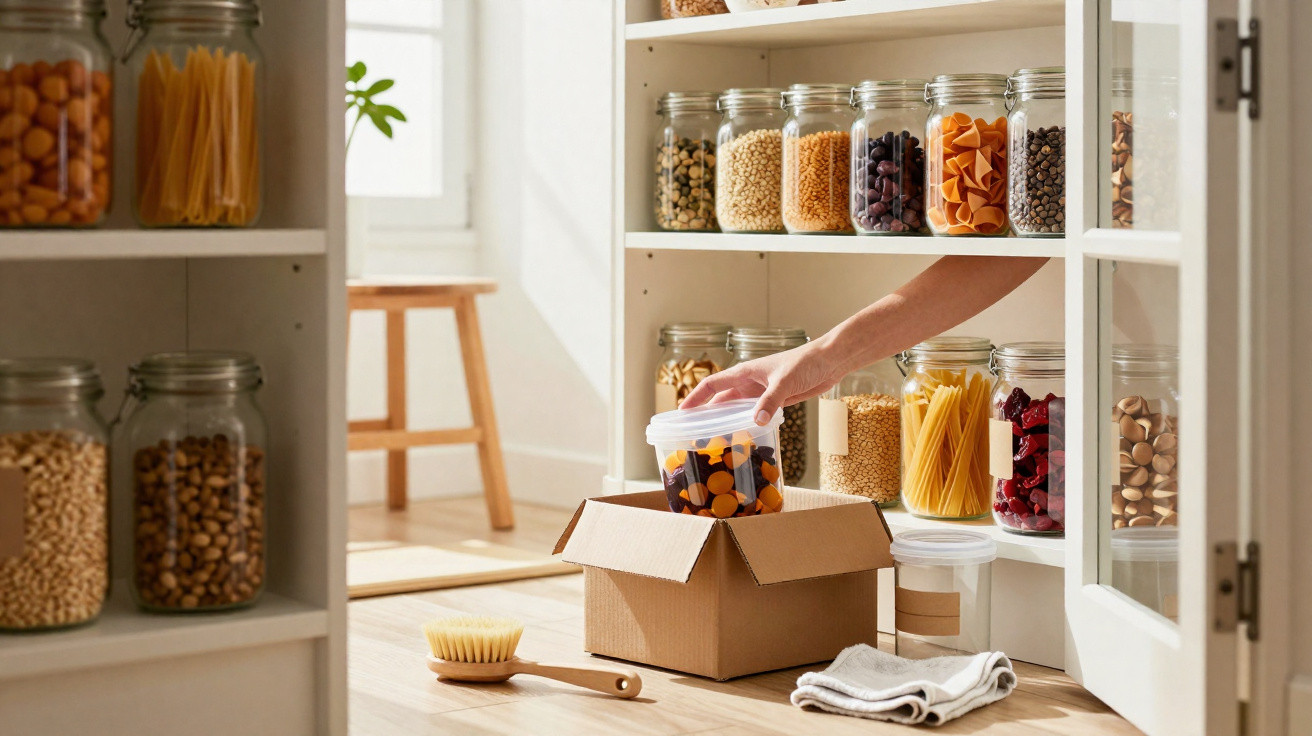
The first time you open a pantry lined with glass jars, it can feel a little like entering a hushed library.
Each ingredient is on display, neatly in place. Nothing clatters when you slide out a shelf. There are no crumpled plastic packets or unidentified tubs with marked lids. Instead, clear cylinders catch the light in orderly rows, showing exactly what you have. Usually, that scene follows a less tidy one: flour spilled from a torn bag, stale cereal lost behind an open packet, and three bags of rice purchased because the first two disappeared into the mess.
When you shut the glass door, you notice something: your food now appears to have a system, and your mind eases. Writing a shopping list becomes simpler. Looking at the shelves sparks meal ideas. Between the clink of a lid and the muted sound of a jar stacked neatly away, the pantry ceases to be a gloomy cave and begins to function as a calm command centre.
That is the point at which plastic bins begin to seem like a noisy relic of the past.
Why glass jars transform the feeling of a pantry
When you open a pantry packed with plastic bins, you largely see... lids. They are opaque, cloudy and sometimes faintly yellowed with age. They are often stacked up, making it easy to forget what is in the containers at the bottom. Food disappears into corners or gets squeezed into any available gap. The organisation is based on capacity rather than visibility. It works on the first day, immediately after a major clear-out. By the third week, though, the system begins to unravel.
Glass jars reverse that approach. You arrange food by what you can see. Even when one item sits behind another, your eye can still pick up the shapes, colours and fill levels. The jars bounce light around, making shelves seem deeper, cleaner and almost like a shop display. That visual structure quietens mental clutter. Rather than searching, you are simply choosing.
In an unexpected way, the pantry begins to draw you towards it.
A professional organiser in Portland told me about a client who thought she had “no space” and was “terrible at cooking”. Her pantry contained a collection of mismatched plastic tubs, most with no labels, alongside at least seven open bags of pasta. They replaced the bins with straightforward glass jars while keeping the same food and shelves, and the change was instant. The client stood quietly before saying, “I didn’t know I had all this.”
Within a month, her grocery bill had fallen. She no longer bought duplicate items because she could plainly distinguish between “almost empty” and “totally gone”. Her children began choosing nuts and dried fruit rather than unidentified snack bags, simply because these foods were visible at their level. There was nothing elaborate and no designer pantry-only rows of glass jars. A single afternoon spent decanting changed the way the entire household used its kitchen.
We often assume that we need a larger home or additional cupboards. Quite often, what we actually need is greater transparency.
The principle is straightforward: the human brain likes patterns and dislikes friction. Plastic bins create more friction than we tend to acknowledge. You need to unstack them, open them, lift a lid and rummage around. It may appear insignificant, but it is enough to make you push a new packet in front “for now” and leave it there. That is how clutter starts.
Glass jars remove those stages. Their food level is visible immediately, so you can judge at a glance whether opening one is worthwhile. Shelves become visual dashboards rather than places to dump storage. Your memory benefits as well, since your brain creates a map of colours and forms: brown lentils in tall jars, white rice in medium jars and brightly coloured snacks in small ones.
The outcome is not merely more attractive shelving; it also means fewer decisions whenever you cook. There is less searching, less uncertainty and less waste. Organisation becomes a natural condition rather than something you tackle only occasionally.
How to swap plastic for glass jars without losing your mind
The best way to move over to glass jars is not to turn it into a huge “everything in one weekend” task. Begin with a single shelf. Select the area that bothers you most, often the baking section or breakfast corner. Empty it completely. Discard or combine old packets, then select 5 to 10 glass jars in the same style and height for the weekly basics: flour, sugar, oats, pasta and rice.
Fill these first, placing them in a row at the front, with labels facing outwards if you use labels. Move large or seldom-used products, such as seasonal sprinkles or specialist flours, to the rear in their existing containers. The transformation is immediate: a single clear line of glass jars creates a visual anchor for the whole pantry. You get a manageable success without making the kitchen a disaster area.
Do the same thing weekly, addressing one shelf at a time, and the pantry will gradually change in the background of everyday life.
Here is what many people will not say aloud: new systems frequently fail because they are too “perfect”. Each jar has matching cursive writing, and every lid is perfectly aligned. It may look impressive on day one but becomes completely impractical on a Tuesday evening after work. Let’s be honest: nobody really does that every day. If your pantry makeover requires the best version of yourself every day, it will not endure.
Glass jars are most effective when the system allows for imperfection. Choose wide openings that are simple to pour into without a funnel. Pick two or three standard sizes instead of ten different ones. Opt for clear, straightforward labels, or use a wax pencil that can be updated in seconds. Leave room on the shelves so jars can be moved in and out easily rather than wedged together like Tetris blocks.
An organisation system that lasts always takes account of tired-you, rushed-you and “I’ll deal with it later”-you.
One home cook I met expressed it perfectly in a way that has stayed with me:
“When I switched to glass jars, I stopped feeling like my pantry was judging me. It started helping me.”
That is glass’s understated superpower: it works with your habits rather than against them. The transparency encourages honesty-if you never use the obscure grain bought two years ago, you will see it every time. Uniform shapes also establish natural boundaries: once the jars are full, perhaps you do not need another three varieties of crackers this week.
- Arrange jars by how often they are used rather than by food category. Everyday items should be kept at eye level.
- Maintain a small “quarantine jar” for nearly empty leftovers, such as the final handful of pasta shapes, and add them to soups.
- Select lids that can be opened with one hand; if they are difficult to use, you will quietly return to bags.
- Set aside one shelf for children’s snacks in clear jars, allowing them to help themselves safely.
- Keep one jar deliberately “imperfect” or mixed-it makes the system feel human rather than rigid.
The deeper change: from storage to a culture of visibility
After using glass jars for a while, something surprising occurs: instead of asking “where can I hide this?”, you begin to ask “how can I keep seeing this?” That small shift influences what you buy, cook and throw away. Food that remains visible gets eaten. Hidden food turns into clutter and then waste. This is not aesthetics first; it is about being honest about what is already in your home.
Plastic bins are designed to conceal things effectively. They suit playrooms, seasonal decorations and items used infrequently. In a pantry, however, that ability to hide works against you. Glass jars change the equation. Every time you put food away, they offer an instant reward: the shelf looks clearer, cleaner and more complete. The satisfaction is subtle but genuine, like the soft click of a puzzle piece settling into its place.
Eventually, that small sense of order alters your behaviour. You shop with more purpose. You cook from what is on your shelves rather than only following cravings. Your pantry is no longer a source of guilt; it becomes a quiet point of pride that you do not mind showing to visitors.
| Key point | Detail | Benefit for the reader |
|---|---|---|
| Complete visibility | Ingredients are instantly identifiable in transparent containers | Fewer duplicates, less waste and faster decisions when cooking |
| Calming visual order | Uniform forms, visible colours and easy-to-read fill levels | A calmer pantry, a greater impression of space and motivation to maintain order |
| A durable system | Reusable jars that are easy to clean and suitable for different foods | Organisation that lasts, a worthwhile investment and a better everyday relationship with the kitchen |
FAQ:
- Are glass jars really safer for food than plastic bins? Generally, yes. Glass is non-porous, does not absorb odours or stains, and does not leach chemicals into food. This is especially reassuring when storing dry goods such as flour, grains and nuts for a long time.
- Won’t glass jars break too easily in a busy kitchen? Good-quality jars are remarkably robust. Choose thick glass with sturdy lids, and avoid stacking too much. Most breakages result from overcrowded shelves, so leaving a little breathing room makes a substantial difference.
- Do I have to decant absolutely everything into glass? No. Start with staples used each week: rice, pasta, oats, coffee, sugar and nuts. Leave specialist items in their original packaging until you know they deserve a permanent jar.
- Isn’t switching from plastic to glass expensive? It can be if you purchase everything at once. Many people build a collection gradually by washing and repurposing supermarket jars from pasta sauce or pickles, then adding a few matching jars over time.
- How do I label glass jars in a way that’s flexible? Use removable labels, painter’s tape and a marker, or a wax pencil directly on the glass. You can then change the contents without feeling that you have spoiled your “perfect” system.




Comments
No comments yet. Be the first to comment!
Leave a Comment