
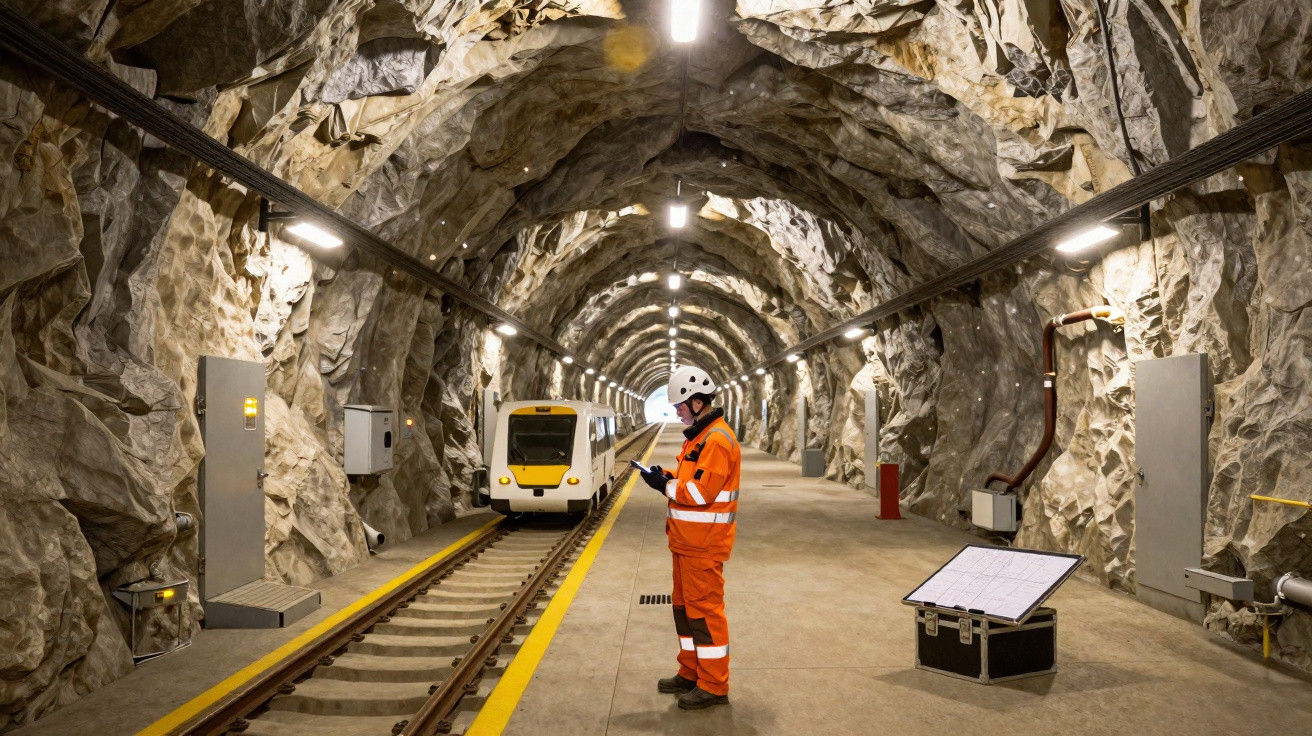
On a rain-soaked autumn morning in the Swiss Alps, the mountains seem to sound… hollow. Near Erstfeld, a freight train enters the rock, disappears as though the hillside has consumed it, then emerges 57 kilometers away on the far side of the country. Cows graze above, unaware that thousands of tonnes of steel and concrete are moving constantly deep beneath their hooves. On station platforms, commuters drink coffee, look at their phones and board trains that will make most of their trip within the earth itself.
For almost 30 years, Switzerland has discreetly drilled, blasted and excavated a hidden city beneath its peaks.
This city has no roads. It has tunnels.
The invisible network beneath the Alps
Once you begin to notice it, the sheer scale of Switzerland’s underground realm is difficult to forget. At ground level, there are postcard-perfect villages, unspoilt lakes and immaculate ski slopes. Below that landscape sits a tightly woven network of rail tunnels, road tunnels, emergency galleries, ventilation shafts and service caverns, with a footprint comparable to that of many medium-sized cities.
What appears on a map as a straightforward tunnel is frequently a structure on several levels: twin tubes, cross passages at intervals of 325 meters, concealed maintenance bunkers, drainage channels and vast amounts of cabling.
The Gotthard Base Tunnel is the attention-grabbing centrepiece of this subterranean story. It opened in 2016 and runs for 57.1 kilometers beneath the Alps, making it the world’s longest railway tunnel. But this “tunnel” is actually a network of more than 150 kilometers of galleries once its two tubes and access passages are included.
Its construction lasted 17 years, with mining crews working rotating shifts, often 24/7. Eight workers died. Thousands of others spent a decade or longer travelling not simply to a building site, but directly into the core of a mountain.
Gotthard was not where this began. Since the 1990s, Switzerland has pursued a national scheme called NEAT (New Rail Link through the Alps), transforming how Europe crosses this mountain barrier. Rail tunnels at Lötschberg and Ceneri, scores of road tunnels including the Gotthard Road Tunnel and San Bernardino, plus smaller regional connections, have added one layer after another.
Gradually, the country has moved a substantial share of its transport, logistics and even strategic reserves underground. The Alps were once a barrier; now they are infrastructure.
How Switzerland carves tunnels through rock
From above ground, tunnel construction can sound like little more than making a hole with an enormous drill. Below ground, it is much more like surgery. Before any blast is set off, geologists examine the mountain as a doctor would examine a scan. Using seismic tests, core drilling and decades of archived records, they predict how the rock may behave after it is opened.
Next come the tunnel boring machines (TBMs), or drill-and-blast crews, progressing a few meters at a time, every day, for years.
The Swiss have made this process an exercise in dependable precision. At certain sites, the night shift becomes a world of its own. In prefabricated canteens, workers eat raclette and trade jokes in Swiss German, Italian and Portuguese. They travel down into the mountain by lift or train, sometimes completing entire 10-hour shifts without seeing daylight.
When a TBM encounters a pocket of water or unstable rock, the atmosphere shifts for everyone. Progress slows, engineers gather around screens, and one unspoken thought emerges: the mountain always has the last word.
Why commit so much, over such a long period, to these underground arteries? One answer is practical: Switzerland sits in the middle of Europe and is dominated by mountains. Lorries and trains have to get through somehow. The more profound explanation, however, is political and cultural. During the 1990s, voters supported the Alpine Initiative, in effect declaring that they wanted freight off the roads, out of valleys and onto railways.
Tunnels were the only means of following the geography while honouring that vote. Frankly, no country opts to spend tens of billions and three decades underground unless the whole nation considers that compromise worthwhile.
What the underground city means for daily life
The benefits become clear not while studying a map, but while travelling across the country. A Zurich–Milan journey that once felt like an endurance challenge across twisting mountain passes now passes beneath the Alps in around three hours. Freight trains that previously laboured up spiral tunnels can now run on an almost level route, more quickly and cheaply while using less energy.
The noise and pollution that would once have filled the valleys are instead confined to a hidden realm of concrete linings and ventilation ducts.
For residents of mountain villages, the change is about more than transport. Fewer lorries bring less danger in winter, fewer nights interrupted by engine braking and less dust in the air. Tourism follows a different pattern too: visitors have easier access, while the landscape suffers less visible “scarring”.
There is a subdued sense of relief in knowing that the difficult, polluting task of crossing the Alps takes place out of sight, where the rock is thick and the public rarely ventures.
Meanwhile, this subterranean city has changed the way Switzerland approaches risk and resilience. Many tunnels contain parallel safety tubes, cross passages and evacuation areas that resemble miniature stations concealed within the mountain. They include fire doors, pressure-resistant walls, backup-power rooms and command centres tracking everything from wind speed to train location.
“People see a clean tunnel and think it’s just a hole in the mountain,” a Swiss engineer once told me. “What they don’t see is the hospital-like level of redundancy we hide behind those walls.”
- Multiple tubes: one for each direction, often accompanied by a service or safety tube
- Cross passages: escape routes every few hundred meters, comparable to emergency corridors in a shopping centre
- Ventilation caverns: enormous concealed chambers able to remove smoke or cool the air
- Monitoring systems: sensors that detect the rock, temperature and vibration
- Access tunnels: narrow galleries seen only by staff and rescue teams
Switzerland’s unusual intimacy with its mountains
There is an almost paradoxical quality to Switzerland’s relationship with the Alps. Above ground, the country promotes an image of untouched nature: hiking trails, timber chalets and clean rivers. Below, those same mountains are riddled like a piece of Emmental, containing rail tubes, road tunnels, military bunkers, emergency shelters and storage depots.
We have all experienced it: leaving a long tunnel into sunlight and feeling as if we have leapt through time or space. In Switzerland, that sensation is part of everyday life.
This dual existence poses a subtle question: how extensively can a landscape be used before its meaning changes? Many Swiss people would argue that tunnels shield the Alps from surface damage, and there is some truth in this. Less infrastructure above ground means more activity below it. Others fear that dependence on invisible mega-projects can separate people from the true scale of what is undertaken in their name.
You cannot sense a 57-kilometer tunnel beneath your feet in the same way as a motorway cutting through your village.
At the same time, the underground city invites a new way of imagining the future. Climate pressure is increasing, extreme weather is becoming more common and space at the surface is limited. Some planners are now discussing underground capacity for data centres, energy storage and even protected farming laboratories. Switzerland already possesses the expertise, equipment and consensus-based culture required for projects of this kind.
The simple reality is that, over three decades, the country has developed not only tunnels but also the expertise to live with the mountain from within. Whether this becomes an example for others or a warning remains a story being written far beneath the snow.
| Key point | Detail | Value for the reader |
|---|---|---|
| Scale of underground network | Decades of tunnelling have produced a multi-layered system comparable with medium-sized cities | Helps you understand how infrastructure can transform a landscape while remaining unseen |
| Gotthard Base Tunnel as emblem | 57.1 km rail tunnel, ~150 km of galleries, 17 years of work, billions invested | Provides a tangible example of what is required to connect regions reliably beneath mountains |
| Everyday impact | Quicker travel, cleaner valleys and sophisticated safety systems concealed in the rock | Demonstrates how major projects quietly affect your journeys, air quality and safety |
FAQ:
- How long has Switzerland been building these tunnels? Most of the modern underground network has been created over roughly the past 30 years, with major Alpine base tunnels constructed from the mid-1990s to the 2010s, building on a century-old tradition of smaller tunnels.
- Is the Gotthard Base Tunnel the only huge tunnel in Switzerland? No. It is the flagship, but belongs to a broader system including the Lötschberg and Ceneri base tunnels, dozens of long road tunnels, safety galleries and service caverns.
- How safe is it to travel through these tunnels? Safety requirements are exceptionally strict, involving multiple tubes, escape routes, advanced monitoring and regular exercises with firefighters, medics and rail staff.
- Why does Switzerland invest so much underground instead of building more surface roads? The combination of steep terrain, environmental safeguards and public votes favouring the transfer of freight from road to rail makes tunnels the most realistic option for maintaining mobility without covering valleys in motorways.
- Can other countries copy this underground model? Technically, yes, but it requires long-term planning, political agreement, enormous budgets and a culture prepared to accept projects lasting several decades whose most significant elements remain unseen by most citizens.






Comments
No comments yet. Be the first to comment!
Leave a Comment