
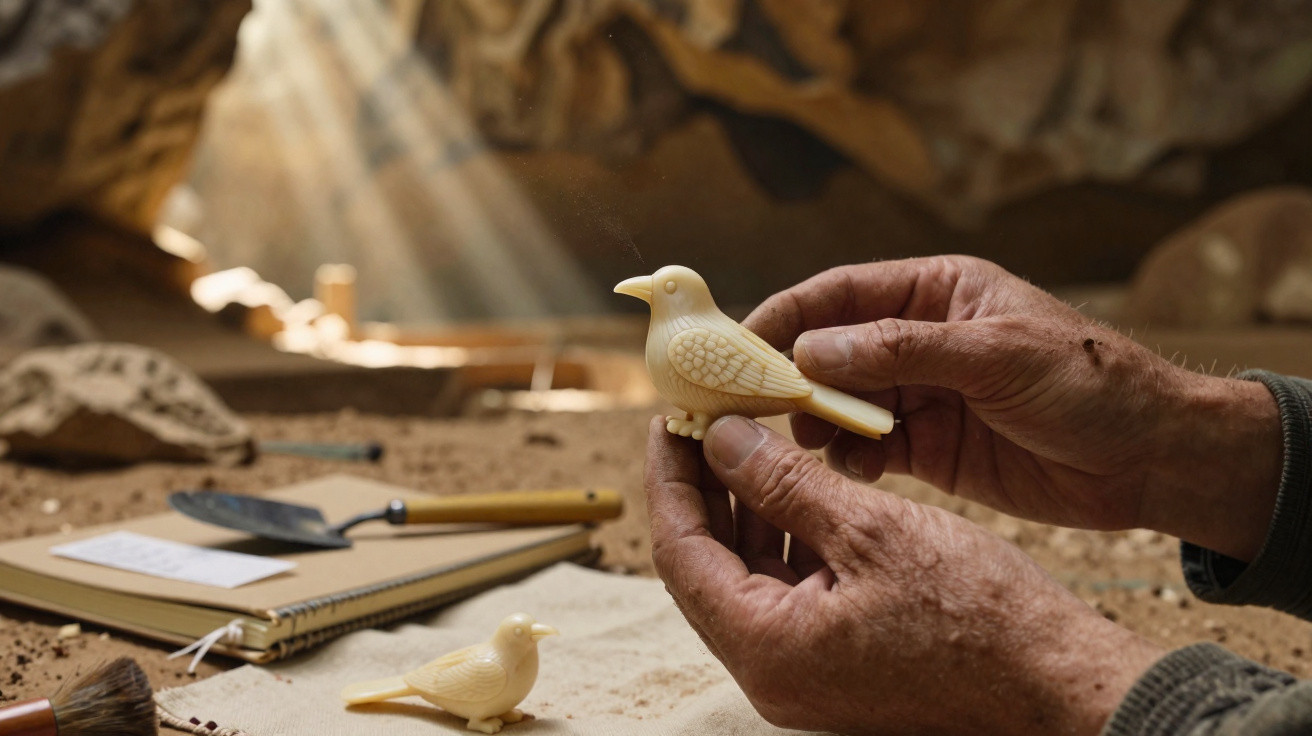
Two bird figures no bigger than a fingernail, carved from mammoth ivory around 40,000 years ago, are giving archaeologists a fresh perspective on the creativity of Europe’s earliest modern humans. Discovered in Hohle Fels Cave in south-west Germany, these miniatures are remarkable not only for their age but also for the precision of their detailing in objects weighing little more than one gram.
What makes these birds so extraordinary?
Archaeologists from the University of Tübingen recovered the two figurines in 2025 from Aurignacian layers at Hohle Fels Cave. Measuring about 2 centimetres long, 1 centimetre wide and just half a centimetre thick, they are regarded as the smallest known representations from this period.
Professor Nicholas Conard, who leads the excavations, says the objects demonstrate that early artists had mastered advanced ivory-carving methods and could create exceptionally delicate motifs. Since the figures came from the same layer and were found only 1.5 metres apart, researchers even consider that they may have been made by the same individual.
Which birds did Ice Age artists depict at Hohle Fels?
One carving is intact and portrays a bird apparently resting on the ground, perhaps incubating eggs. Its eyes are clearly shown, and its pose may identify it as a ptarmigan, a species already recognised among the animal remains recovered from the cave itself. The other object is incomplete and depicts spread wings.
Archaeologists are still debating the species and movements captured in these tiny works:
- The resting bird may depict a ptarmigan incubating its eggs.
- The open-winged figure may be in flight, landing or displaying courtship behaviour.
- The second carving could also portray a grouse-family bird or even a bird of prey.
- Clear markings on the wings seem to indicate feathers, while the beak has been carefully shaped.
Details point to close observation of nature
Conard emphasises that the carvings are not merely abstract or heavily stylised forms. They include distinctive features that imply direct observation of animal behaviour. This enables researchers to consider not only which species is shown, but also what the bird may have been doing at the moment selected by the artist.
This is especially striking because many sculptures from the Swabian Jura present animals in comparatively static poses. By contrast, the newly found birds appear to capture particular actions. One rests close to the ground, while the other opens its wings, producing an unusual impression of movement in objects made tens of thousands of years ago.
Why would anyone carry such tiny sculptures?
According to Conard, the objects weigh just 1.3 and 0.7 grams, raising an intriguing question about their purpose. They could have been carried with ease and may have served as personal talismans, symbolic items or markers of identity. However, there is not enough evidence to establish with certainty what they meant to their owners.
Another unresolved question is why these figures are concentrated at Hohle Fels. The cave has already yielded three carefully made bird sculptures, whereas other nearby sites have not produced similar examples. In Conard’s view, each of the region’s four sites containing figurative art appears to reflect its own relationship between community, landscape and social setting.
What do these miniatures reveal about people 40,000 years ago?
The find strengthens an increasingly complex picture of the first modern humans to inhabit the Upper Danube region. They did more than make tools: they watched animals, created art and made musical instruments. Stefanie Kölbl, managing director of the urmu museum, notes that birds were already part of that landscape, and that their hollow bones, along with mammoth ivory, were used to produce flutes.
The new figurines will be displayed at the Museum of Prehistory and Ice Age Art in Blaubeuren, in an exhibition scheduled to run until 4 April 2027. Looking at these minute birds means confronting striking evidence of artistic sensitivity with 40,000 years of history, transforming a few centimetres of ivory into a direct connection with Palaeolithic human imagination.





Comments
No comments yet. Be the first to comment!
Leave a Comment