
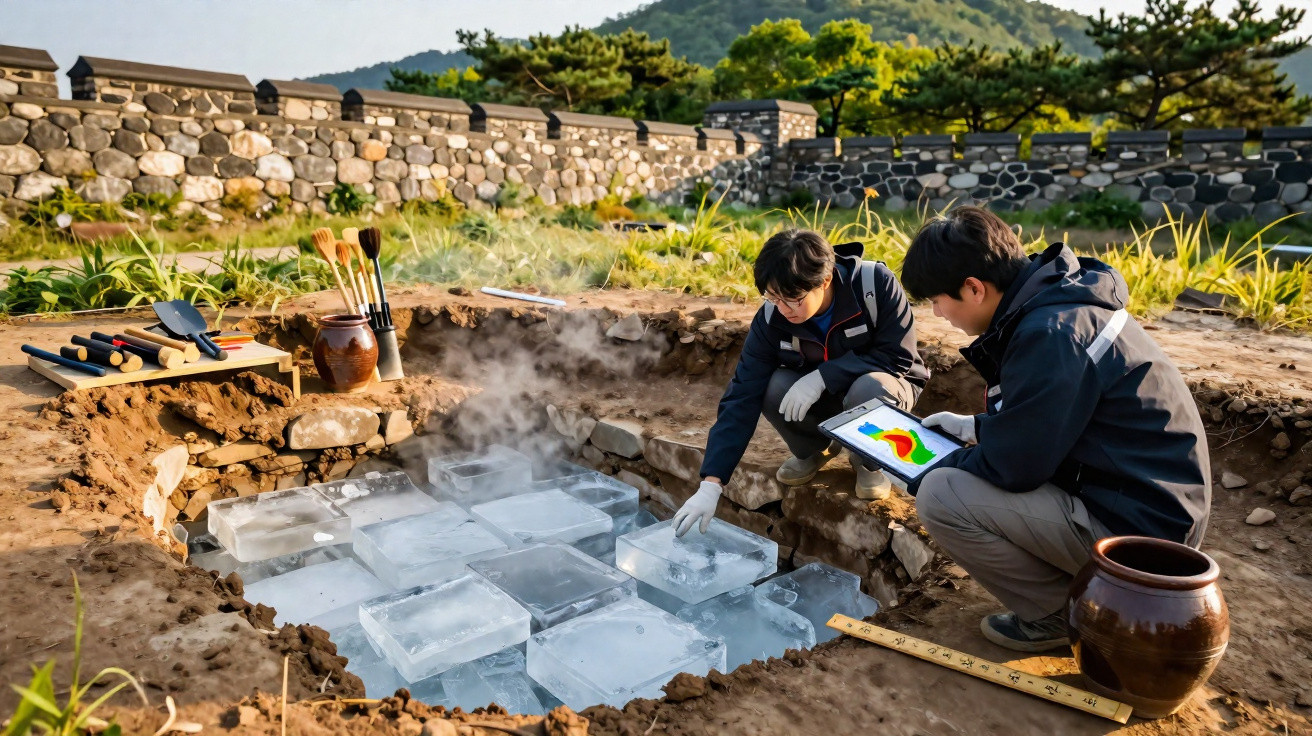
Beneath Busosanseong Fortress, archaeologists have revealed a complete 1,400-year-old ice storage chamber dating from the Baekje Kingdom-a cool-headed solution from a sweltering age, concealed in full view.
The day the earth gave way began unremarkably: drizzle in the air, boots in a row and the muted tap of trowels. Then came a hollow knock-stone striking stone-from a slab unlike the surrounding granite. An opening appeared. Cool air drifted upwards, carrying a faint scent of wet soil and an old pantry. Torchlight followed torchlight into the tight entrance, while the hillside released a history nobody had anticipated. Inside was a modest chamber of dry-laid stone, covered by a roof of overlapping layers. Standing there, you could feel summer slip from your skin. The cold held a memory-one older than memory itself.
What was found beneath a UNESCO-listed hillside
Busosanseong slopes gently above Buyeo, where pine and zelkova trees shade its paths and its ramparts quietly recall the Baekje capital that once prospered below. Residents take their dogs for walks there. Schoolchildren gather at the viewpoint, passing down the story of a kingdom’s fall. Hardly anyone suspected that a functioning icehouse had endured beneath their feet. The chamber is small, about the scale of a compact room, with walls assembled as a precise stone puzzle. A faint current of air runs through it. Light glints from lime-washed joins, evidence that its builders took care to make darkness last. It is not showy; it is ingenious.
Consider what such a room represented during Sabi-era summers, when Buyeo sweltered and monsoon humidity clung to every surface. Ice meant authority, relief and medicine. Cut in winter from ponds and shaded water, blocks could be piled on straw, wrapped and placed in chambers like this one to remain there until the harvest season. Picture a feast on a stifling evening: chilled fruit, cold soup, perhaps fish preserved longer than the river’s coolness could manage alone. On occasion, royals and envoys may even have been served cooled wine. Everyone knows the grace of an unexpected breeze in extreme heat. The Baekje engineered a space that could preserve that feeling.
Its success came from stone and time working gradually in partnership. Banks of earth softened the sun’s heat. Substantial walls held cold as a battery stores power. Vents pulled warmer air upwards and outwards, leaving the dense, cool air to settle below. Drainage channels removed meltwater, keeping the stored ice dry. There was no magic involved-only physics and patience in a region of harsh winters and humid summers. The startling element is that this icehouse survived below a fortress path, inside the UNESCO-listed Baekje Historic Areas. It closes a subtle gap between royal records and the everyday practicalities of maintaining cool conditions. At times, the most sophisticated technology is simply a carefully positioned underground room.
How the Baekje Kingdom ice storage preserved cold
A closer look makes the design clear. Its entrance is low and narrow, limiting the flow of warm draughts. The interior chamber sits slightly lower than the doorway, allowing the heaviest, coldest air to collect there. Inward-leaning stone layers create a corbelled roof, which diverts moisture while preventing weight from bearing directly across the opening. Anyone adapting the idea for a shed or cellar used to store garden produce should begin with shade, thermal mass and a route for warm air to rise as cool air gathers. Put small vents high up and drainage low down. It may not sound romantic, but it works.
Insulation receives most of the attention, yet water is just as important. Dampness undermines cool conditions: it lets heat in, reduces ice to slush and encourages decay. Baekje builders accounted for this, keeping the floor dry, ensuring the layers could breathe and maintaining gentle airflow. Their goal was not absolute zero, but a controlled microclimate. Realistically, few people manage that kind of control daily. Still, the same reasoning applies to modern routines-making a garage less oppressive, storing a harvest without relying too heavily on a fridge, or understanding why one room feels pleasant while another becomes airless. Minor adjustments to shade, sealing and ventilation can have major effects.
Standing above the excavation, it is easy to sense centuries settling into a constant coolness.
“It’s the kind of cold that doesn’t bite; it settles around you, like stepping into a church on a hot day.”
- What it is: An intact Baekje-era stone icehouse beneath Busosanseong, probably used to keep winter ice and perishable goods through the summer.
- Why it matters: It provides rare physical evidence of the everyday technology supporting royal life-food, medicine and ceremony-at a UNESCO site.
- What to watch: Stabilisation, documentation and possible public access after conservation specialists complete their careful, lengthy work.
The wider meaning of the discovery
This find makes climate memory tangible. The Baekje were more than artists of lacquerware and stone pagodas; they also designed for comfort. As cities grow hotter and power grids come under pressure, historic cooling methods appear newly relevant: earth-sheltered buildings, night-time air flushing and thermal mass used honestly through breathable materials. The icehouse beneath Buyeo is not a relic demanding nostalgia. It is an invitation to think differently. How might we regulate the temperatures in our own lives with less effort and greater skill? That may be why this little chamber feels so vivid: it teaches without speaking.
| Key point | Detail | Why it matters to readers |
|---|---|---|
| Ancient technology, modern relevance | The Baekje icehouse demonstrates passive cooling that remains effective | Practical ways to keep spaces cooler while using less energy |
| UNESCO setting | The discovery lies within Busosanseong, part of the Baekje Historic Areas | Travel interest and cultural depth in a single destination |
| Intact structure | The stone chamber retains vents, drains and a corbelled roof | A rare opportunity to picture daily life 1,400 years ago |
FAQ
- Is the icehouse open to visitors? Not yet. Conservators generally stabilise, document and secure a structure before allowing public access. Temporary covers and notices are likely while the teams work.
- How do archaeologists date a feature like this? They combine context-including layers, nearby artefacts and historical records-with material analysis and comparisons of construction styles at other Baekje sites.
- Did Baekje people cut ice from rivers? Yes. Harvesting ice from ponds and rivers during winter was common, after which blocks were kept on straw in shaded, insulated chambers such as this one.
- What was the ice used for? It cooled food and drink, prolonged the freshness of fish and meat, and stored ingredients or medicines requiring consistently low temperatures.
- Can we build something similar today? The guiding principles can be adopted: shade, earth shelter, thermal mass, high vents and dry floors. It is the kind of survival knowledge you can feel in your bones.




Comments
No comments yet. Be the first to comment!
Leave a Comment