
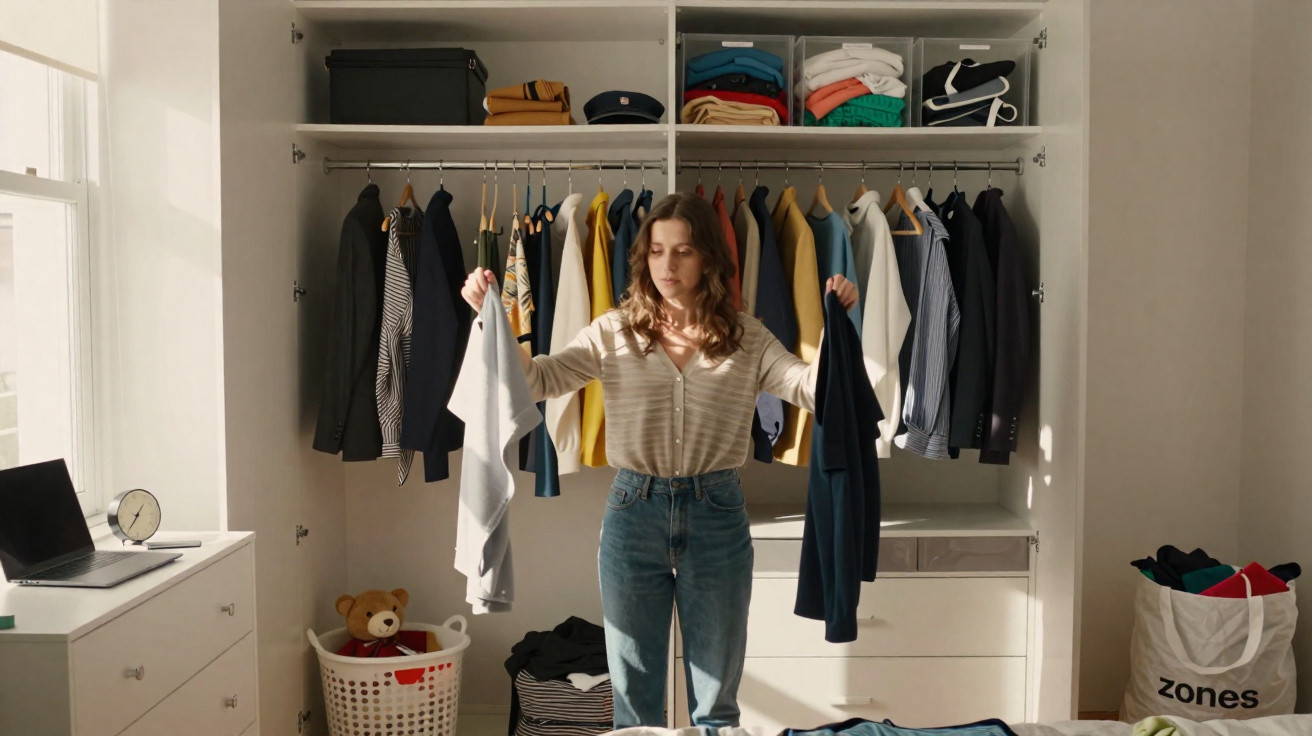
Coffee, a quick shower, notifications and thoughts colliding. You fling open your wardrobe doors… and draw a blank.
Stacks collapse, a hanger squeaks, and there is a creased shirt that “was supposed to be clean”. You scan the shelves, feel a jumper, then change your mind. One pair of trousers goes on the bed, followed by another. It feels as though you are wasting time before your day has even begun.
We have all had mornings when simply getting dressed feels like an unexpected test. What if the issue is not your style, but the way your wardrobe chooses your stress level for you each morning? Often, the answer starts with moving one hanger to the right place.
Why your wardrobe is secretly draining your energy
Forget the notion of a “small creative mess”. Your wardrobe is a mental interface. Every badly stored item, duplicate and pair of jeans that no longer fits asks a silent micro-question the moment you open the door: “And me, are you wearing me today?”
You answer without realising it: a glance, a sigh, a moment of hesitation. It may seem insignificant, yet these tiny decisions build up before you have even finished your second coffee.
That is where decision fatigue begins. Not with major career choices, but with the T-shirt you push aside for the fourth time that week.
A frequently cited study on decision-making shows that the more choices we make in succession, the more likely we are to default to an easy option. That is what happens when you wear the same outfit that “works for anything” for the third time because you no longer have the energy to think about it.
Think about a typical morning. You try on a shirt and put it back. You search for a belt but cannot find it. You swap shoes because the jeans do not hang quite right. In ten minutes, you have already made around fifteen micro-decisions, many of them unnecessary.
At the office or on a video call, you are still wondering whether you should have worn something else. That nagging inner voice does not disappear when you close the wardrobe door. It trails through your day like a browser tab left open in the background, nibbling away at your attention.
When your wardrobe is not arranged to make decisions for you, it charges you a mental tax every morning. You think you are considering your style, when you are really just managing clutter. A poorly structured wardrobe mixes contexts-work, relaxing and sport-as well as seasons and even sizes.
The result is that your brain has no reference points. Instead of reaching for pre-filtered groups of choices, it has to scan the entire wardrobe. A good storage system pre-sorts decisions once, then frees you from them every day.
Organising your wardrobe is not about making it look pretty on Instagram. It is about improving an environment that affects your mood and energy levels before 9 am.
Advanced strategies to make your wardrobe think for you
The first advanced method is to create zones by life scenario rather than garment type. Instead of storing “all trousers together”, make areas for “office”, “city weekends”, “sport” and “evenings / events”.
Each area should hold complete or nearly complete outfits: jeans, compatible tops, a jacket, a belt and sometimes accessories too. You should be able to reach in and put together a coherent look in 20 seconds.
Use the highest sections for the things you wear least often, such as eveningwear and occasional items. Keep weekday clothes at eye level only. In effect, you are building a physical mental map of your life on your hangers.
Next comes the idea of a “modular capsule”. Unlike an ultra-minimalist capsule wardrobe, this means creating smaller capsules for each role: “comfortable but presentable working from home”, “important meeting” and “weekend with no thinking required”.
Ideally, each capsule contains no more than 10 to 15 pieces. Everything works together. You could almost get dressed in the dark without making a mistake. That is where the magic begins: fewer possible combinations, but every one is a winner.
To decide what belongs in these capsules, watch what you genuinely wear over a month. At the start of a season, turn your hangers the wrong way round, then keep only regularly worn pieces in the key zones as they return to your natural rotation. Everything else becomes a back-up item or leaves.
The final underlying strategy is to rank clothes by visibility. What you can see gets worn; what vanishes behind a stack becomes dead weight. Keep your basics visible and at the front. Move “maybe one day” pieces into closed boxes or onto the back rail.
Your brain reads visibility as a suggestion. If the first thing you see is three neatly arranged shirts that work with your two favourite pairs of trousers, you will no longer even think about the complicated jacket you never dare wear. You reduce the temptation to make life difficult for yourself at 7.45 am.
Concrete systems you can set up in a single afternoon
Start by creating an “express rail” for rushed mornings. This is a dedicated section of hanging rail containing 5 to 7 complete, ready-to-wear outfits suited to your real life, not your Pinterest life.
Put each outfit on one wide hanger, or on two linked hangers: top, bottoms, and perhaps a jacket or cardigan. Prepare this rail on Sunday evening, or whenever you have a little mental breathing room. Let us be honest: nobody really does this every day.
This rail becomes your autopilot button for difficult days. No thinking and no hesitation: take the next outfit, get dressed and move on.
Set up clearly visible “transition” boxes as well. Have one for “to repair / alter”, one for “to donate / sell” and one for “to reconsider in a month”. This takes those pieces out of circulation without forcing you to decide immediately.
If you hesitate over an item for three mornings running, it goes into one of these boxes. Your main rail is no longer clogged with false contenders that eat up your time. It is a very simple rule, but a formidable one.
You can also try colour-coded hangers. Use a ribbon or coloured clip to identify “high-impact” pieces-the ones that make you feel confident in two seconds. These become your core wardrobe, around which you build everything else.
Most common mistake number one: trying to organise everything in one perfect day. You exhaust yourself, give up halfway through and shove everything back in any old way. The outcome is even more chaos.
Instead, treat it as a series of 30-minute mini-projects. Spend one afternoon on tops, another day on trousers and a separate session on shoes. You should end every session with one small, visible win, not an exhausting marathon.
Most common mistake number two: organising for your imagined ideal rather than your actual routine. If 80% of your week consists of smart casual dressing or working from home, your wardrobe should reflect that. Occasion dresses and rarely worn suits do not need centre stage.
Show yourself some compassion during the process. You will inevitably keep one or two hopeful items or sentimental pieces. The aim is not perfection; it is to make your mornings lighter, smoother and almost gentle.
“Your wardrobe should be a quiet ally at 7 a.m., not a noisy meeting where every garment demands to be heard.”
To stay on track, use a few practical markers:
- The 30-second rule: if it takes longer than 30 seconds to find a “decent” outfit, your system needs adjusting.
- Keep just one folding level on each shelf: as soon as you create a double stack, half your clothes disappear from view.
- One in, one out: whenever you buy a new item, another one leaves your active wardrobe.
| Key point | Details | Why it matters to readers |
|---|---|---|
| Build role-based zones | Split your wardrobe into clear areas for work, casual wear, sport and evenings. Keep complete outfits or compatible pieces together within each zone. | Mornings become a choice between 3–4 “modes of life”, rather than 40 random items, reducing hesitation and stress. |
| Create an “express rail” | Set aside 5–7 hangers for pre-planned outfits that work in almost any situation. Update them once a week rather than daily. | On rushed or tired mornings, you can dress on autopilot and save your mental energy for genuine decisions later. |
| Use visibility as a filter | Place frequently worn basics at eye level, and put rarely used or “maybe” items higher up or in closed boxes. | You will naturally reach for clothes that suit your current life, rather than feeling guilty about pieces you never wear. |
Rethinking your relationship with clothes and time
Once your wardrobe starts to run smoothly, something subtle shifts in the way you get up. You get dressed more quickly, certainly, but above all with greater calm. Your first decisions of the day are no longer made in panic or guilt.
You stop seeing those overly tight jeans as a silent reproach, or the shirt bought on impulse as a mistake hanging on its hanger. You become the person in control, rather than a guest inside a cupboard that judges you. It is a small freedom, but it carries real weight across a week.
Your wardrobe then says something beyond style. It shows what you choose to simplify in order to breathe more easily. It becomes a fairly honest reflection of who you really are at 7.32 on a Monday morning, when you simply want things to flow a little better.
Perhaps the next major change in your life will not come from a new productivity app, but from a moved hanger, a donated T-shirt or a pair of trousers finally put in the right place. You will quickly see that the changes you make in your wardrobe spill over into other areas.
FAQ
- How many clothes do I really need for a streamlined wardrobe? There is no magic number, but many people manage very well with 25–40 “active” everyday items, excluding sportswear and formal outfits. The point is not to become minimalist at all costs, but for every piece to have a genuine reason to be there and work with at least three outfits.
- Is a capsule wardrobe realistic if my job and weekends are very different? Yes, provided you think in role-based capsules rather than one single capsule for your entire life. You can have a work capsule, a relaxed weekend capsule and a sports capsule. The key is to limit unnecessary overlap and keep each capsule clear and easy to picture.
- How often should I review and reorganise my wardrobe? Two proper reviews a year generally work well: one at the beginning of the colder season and another at the beginning of the warmer season. Between them, small 15-minute adjustments are enough: move a zone, remove pieces you constantly reject and refresh the well-known “express rail”.
- What if I feel guilty about letting go of expensive or gifted clothes? That guilt is exactly what keeps you tied to a wardrobe that no longer reflects you. You can make these items useful by selling them, giving them to someone who needs them or transforming them through alterations, dyeing or customisation. The aim is for their story to continue, even if it is no longer on your shoulders.
- How can I keep my wardrobe organised if I’m naturally messy? Your system must then be extremely simple, almost mess-friendly. Use one type of hanger, generously labelled boxes such as “light tops” and “dark trousers”, and no complicated folding. If putting something away takes under 20 seconds, your future self will be less tempted to leave everything on the chair.






Comments
No comments yet. Be the first to comment!
Leave a Comment