
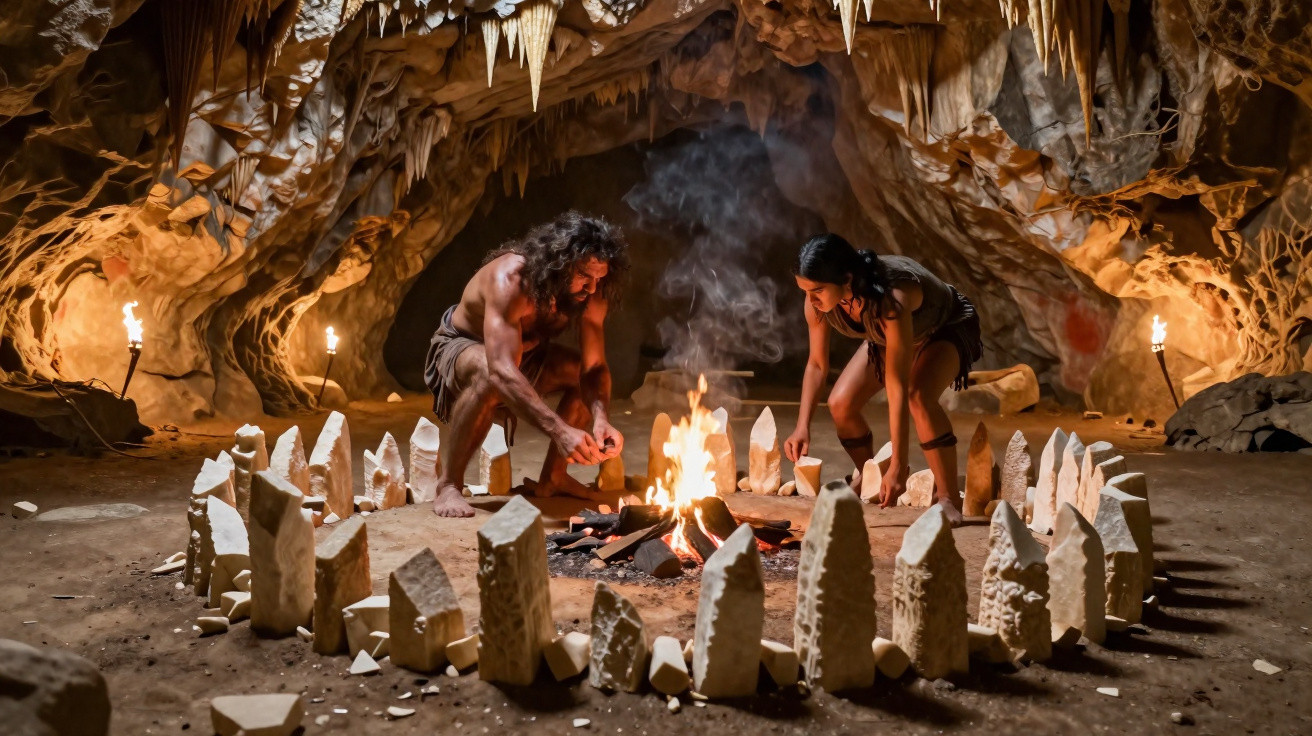
At a point 336 metres from the entrance of a cave in south-west France, beyond the reach of daylight, someone snapped hundreds of stalagmites, chose particular fragments and arranged them into large rings. This took place around 176,500 years ago, long before Homo sapiens arrived in Europe. The date leaves virtually one possible maker: Neanderthals.
What did Neanderthals build inside Bruniquel Cave?
Bruniquel Cave contains two main ring-shaped constructions and four smaller piles formed from broken stalagmite sections, which researchers call “speleofacts”. The study published in Nature estimated roughly 400 fragments, with a combined mass of 2.1 to 2.4 tonnes.
These formations do not appear to have resulted from natural processes. The pieces were moved and arranged: some were stacked in rows, while others acted as wedges and supports. Jacques Jaubert and his colleagues interpret this layout as evidence of a planned process involving the selection, breaking, transport and placement of stalagmites.
How do we know the structure is 176,500 years old?
The crucial breakthrough came when researchers used uranium-series dating directly on the calcite formations. This technique dated mineral growth that occurred after the stalagmites had been broken and rearranged, producing an age of 176,500 years, with an uncertainty of about 2,100 years.
Several lines of evidence make Bruniquel particularly difficult to account for without deliberate human involvement:
- Around 400 stalagmite pieces were chosen, broken and arranged into clearly defined structures.
- The constructions lie about 336 metres inside the cave, far beyond natural light.
- Burnt bone fragments, charcoal and heat-altered calcite point to activities involving fire.
- Some elements were laid in layers and secured using simple bracing methods.
- The date places the construction in the time of early Neanderthals, long before modern humans are known to have been present in Europe.
How did they travel so far into the darkness?
This question is among the site’s most compelling mysteries. A 2026 study in Quaternary Science Reviews reconstructed the cave’s former entrance using 3D surveys, geological evidence, electrical tomography and new dating. It found that the entrance passage was probably under two metres high and became dark very quickly.
That finding strengthens the case that artificial lighting was needed to reach the chamber. The research also suggested that the natural entrance had closed before approximately 142,900 years ago, independently supporting the conclusion that the constructions are far older. Fire, route planning and familiarity with the underground space were probably essential.
What purpose did the mysterious rings serve?
This is precisely what archaeology has yet to establish. Heat traces show that fire-related activities occurred, but they do not disclose the purpose of the structures. Shelter, the organisation of some practical activity and symbolic behaviour have all been considered, yet the Nature article makes clear that the function remains uncertain.
Caution is necessary, since an unusual construction cannot automatically be described as a temple or ritual area. Even so, the CNRS notes that travelling so far underground, managing light and intentionally modifying the subterranean environment represent a way of occupying the cave that was not expected of such early Neanderthals.
Why did Bruniquel change our view of Neanderthals?
The study’s authors argue that a construction on this scale required some degree of collective organisation. People had to select materials, shift hundreds of pieces and arrange them while the group was hundreds of metres inside the cave. The team regards Bruniquel as one of the oldest securely dated human constructions known.
The discovery does not establish exactly what those Neanderthals thought, but it challenges the notion that they lacked the capacity for sophisticated planning. Questions still lie hidden in that 176,000-year-old darkness. Each new analysis of Bruniquel offers a reason to discard old caricatures and look more closely at how far Neanderthals were truly able to go.






Comments
No comments yet. Be the first to comment!
Leave a Comment