
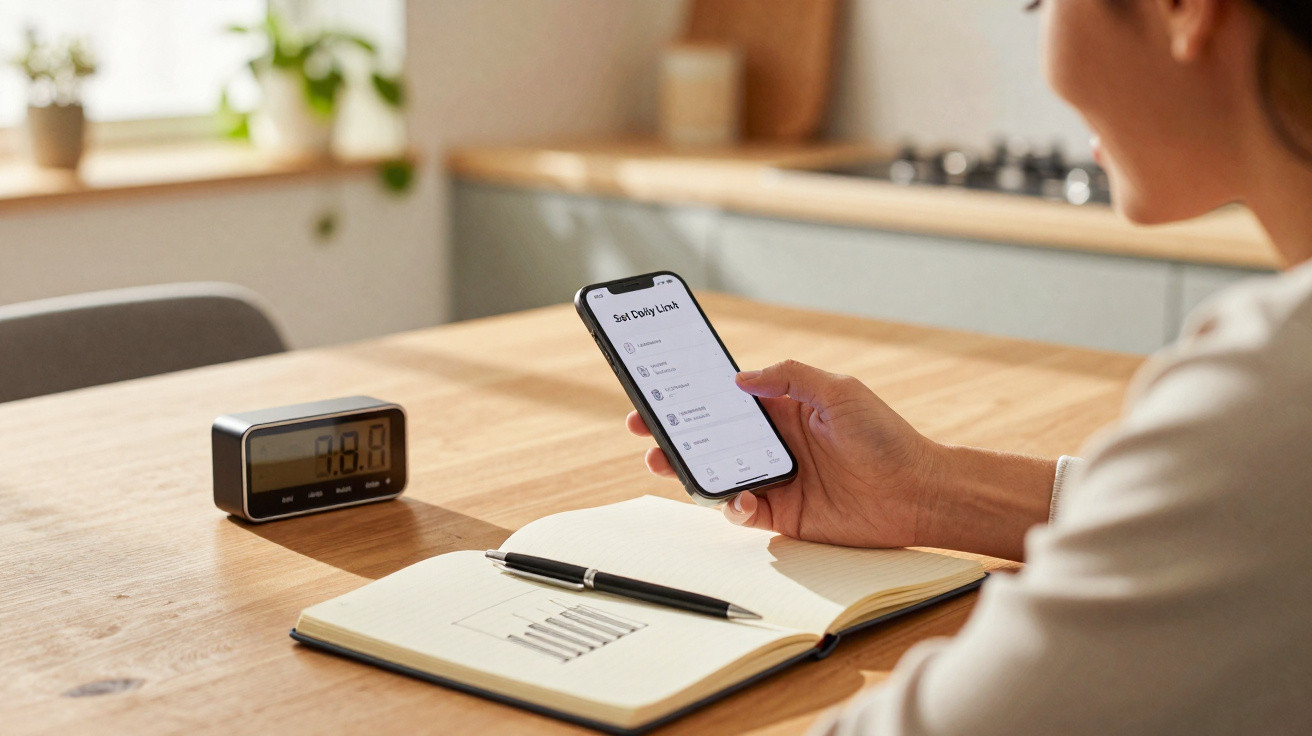
The figures on how much time we spend looking at our phones are sobering. Individual habits naturally vary widely, but an ‘average’ user may be expected to spend six hours a day on their phone and unlock it twice an hour.
Questions continue over the effects that our constantly present digital companions have on health and well-being. A growing number of studies and trials are therefore examining how phone use might be controlled – and one of the most effective strategies may also be among the simplest.
Choosing your own screen time limits
Researchers at institutions in India and Spain, reporting in Social Science & Medicine, have found that people are more likely to follow screen time limits when they select those limits for themselves.
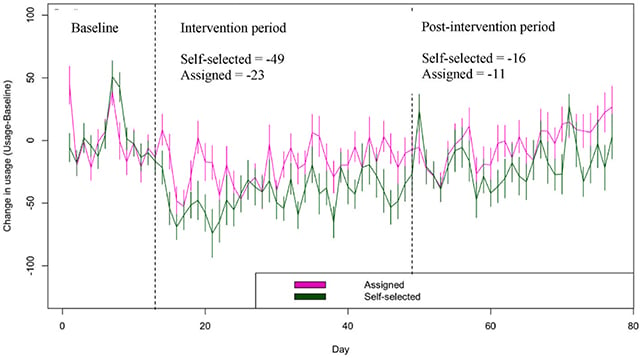
On average, smartphone use dropped more in the group that chose its own goals. (Sachdeva et al., Soc. Sci. Med. , 2026)
"Allowing individuals to choose their own goals may strengthen engagement and support healthier digital behavior," the researchers write in their published paper.
"Incorporating opportunities for goal-selection may represent a simple addition to digital-health and public-health interventions aimed at helping individuals moderate smartphone use and improve well-being."
For the 35-day experiment, the researchers recruited 149 volunteers and divided them into three groups. Of these, 55 participants could select a screen time reduction target of 10, 20, or 30 percent; 62 were instructed to pursue a 14 percent reduction in screen time; and the remaining 32 were assigned no targets, although their screen time was still monitored.
Volunteers who had a target received the same incentive: a modest financial reward for each day they met it. Participants’ phones logged screen time data automatically, with monitoring continuing for a further 28 days after the main intervention ended, although incentives were no longer offered.
Self-selected targets reduced smartphone use most
The participants who chose their own targets produced the strongest results. Their screen time fell by an average of 49 minutes per day, versus 23 minutes among participants given a target. The ‘self-selected’ group also met its daily target 11 percent more frequently. By contrast, average use in the control group rose by 11 minutes a day.
"Reductions in phone use persisted into the post-intervention period in both intervention conditions," the researchers write. "Participants in the self-selected condition continued to use their phones about 16 minutes less per day than at baseline, while participants in the assigned condition used their phones about 11 minutes less per day than baseline."
"In contrast, phone use in the control condition was 2 minutes higher than baseline."
Questionnaire results also associated meeting targets with better well-being scores. However, only 93 people completed this portion of the study, and the differences between the self-selected and assigned groups were not statistically significant.
"Although the mental health findings should be interpreted with caution, the direction and magnitude of changes observed here are consistent with the possibility that reducing total smartphone use may be associated with improvements in psychological well-being for some individuals," the researchers write.

Limits of the study and what may explain the effect
Before declaring global smartphone addiction cured, it is important to note that the sample was relatively small and tracked for a comparatively brief period. Studies involving larger and more diverse groups will be required to verify these findings.
Even so, the research points to an intriguing prospect: people may have a straightforward, cost-free way to manage their phone usage more effectively.
Related: Screen Time in Bed May Raise Insomnia Odds, Study Suggests
The researchers offer several possible explanations. Greater ownership of a goal might improve motivation and commitment, or tailoring a target to the individual may make it more achievable. Future research can investigate this further.
"Many people feel they use their phones more than they would like, yet struggle to cut back," the researchers write. "This study suggests that allowing individuals to set their own goals can support healthier digital habits."
The research has been published in Social Science & Medicine.
This article was fact-checked and edited by Fiona MacDonald. Although we take pride in our process, we are only human. If you spot an error, please let us know.






Comments
No comments yet. Be the first to comment!
Leave a Comment