
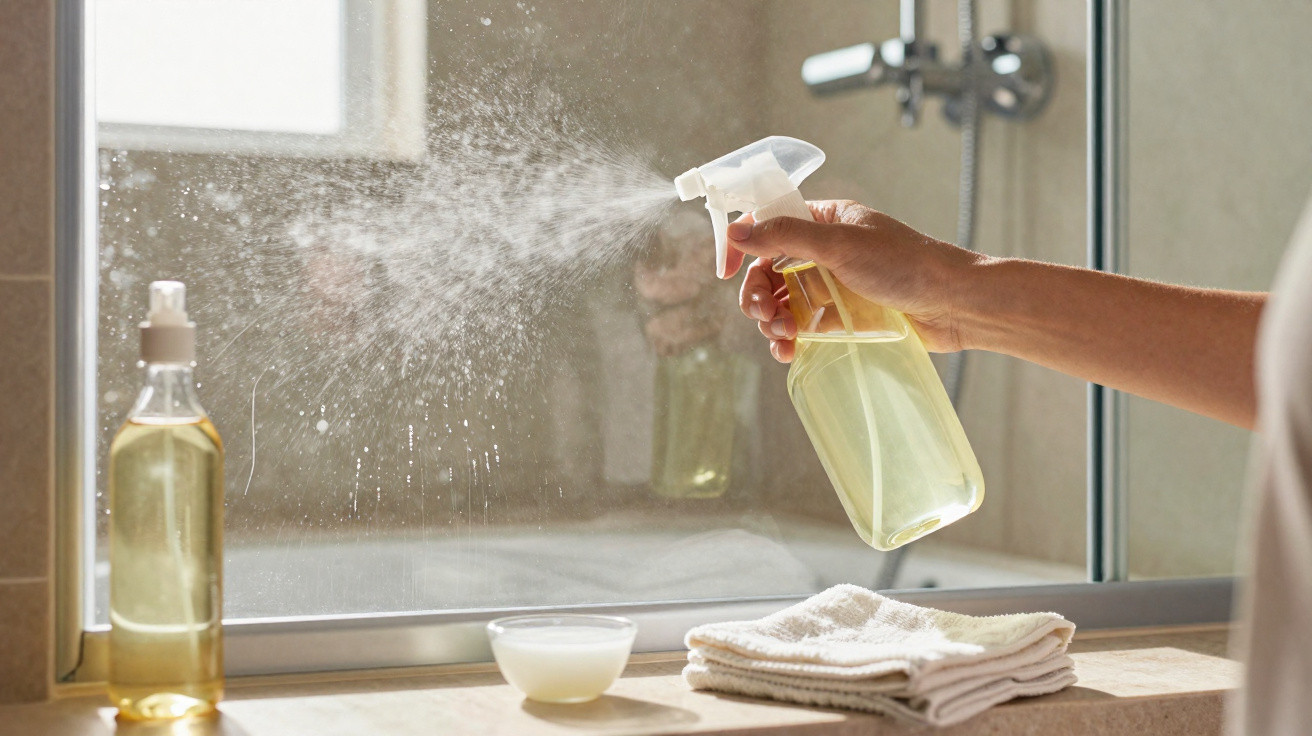
Whitish marks appearing on shower enclosure glass are not always simply dirt. In areas with mineral-rich water, regular shower use can leave deposits on the surface, creating stains that become more noticeable once the glass has dried. A straightforward homemade solution may help loosen some of this residue, but it must be used carefully around metal and delicate finishes.
Why does shower enclosure glass become covered in water marks?
While showering, tiny droplets remain on the glass before evaporating naturally. If the water contains dissolved minerals, some can be left behind on the surface after evaporation, producing those whitish or cloudy marks.
The longer these deposits stay on the glass, the harder they may be to remove through routine cleaning. For this reason, regular cleaning is usually easier than waiting for a thick layer of residue to build up.
How can vinegar help clean shower enclosure glass?
White vinegar contains acetic acid, which can help dissolve mineral deposits found in certain water marks. A simple way to try this method is to apply a small amount of vinegar diluted with water to the glass.
Allow the solution to work for a few minutes, then wipe the surface with a soft sponge or non-abrasive cloth. Afterwards, rinse the surface thoroughly and dry it to prevent fresh water residue from remaining on the glass.
Do the metal parts of the shower enclosure require care?
Yes. A product that may be useful on glass is not necessarily suitable for every material used in a shower enclosure. Metals, natural stone, specialist coatings and certain finishes may be sensitive to acidic solutions.
Therefore, do not allow vinegar to remain in prolonged contact with frames, hinges, handles or other metal components. Test it on a small area and, whenever possible, check the recommendations from the shower enclosure and material manufacturers.
How can you use this trick without scratching the glass?
There is no need to scrub hard in an attempt to remove the marks. Once the solution has softened the residue, use a microfibre cloth or a sponge designed for glass, applying gentle movements.
Avoid wire wool, rough sponges and abrasive products, as these can leave scratches or affect the finish of certain surfaces. If the marks are particularly old, repeating a gentle clean may be safer than increasing the scrubbing force.





Comments
No comments yet. Be the first to comment!
Leave a Comment