
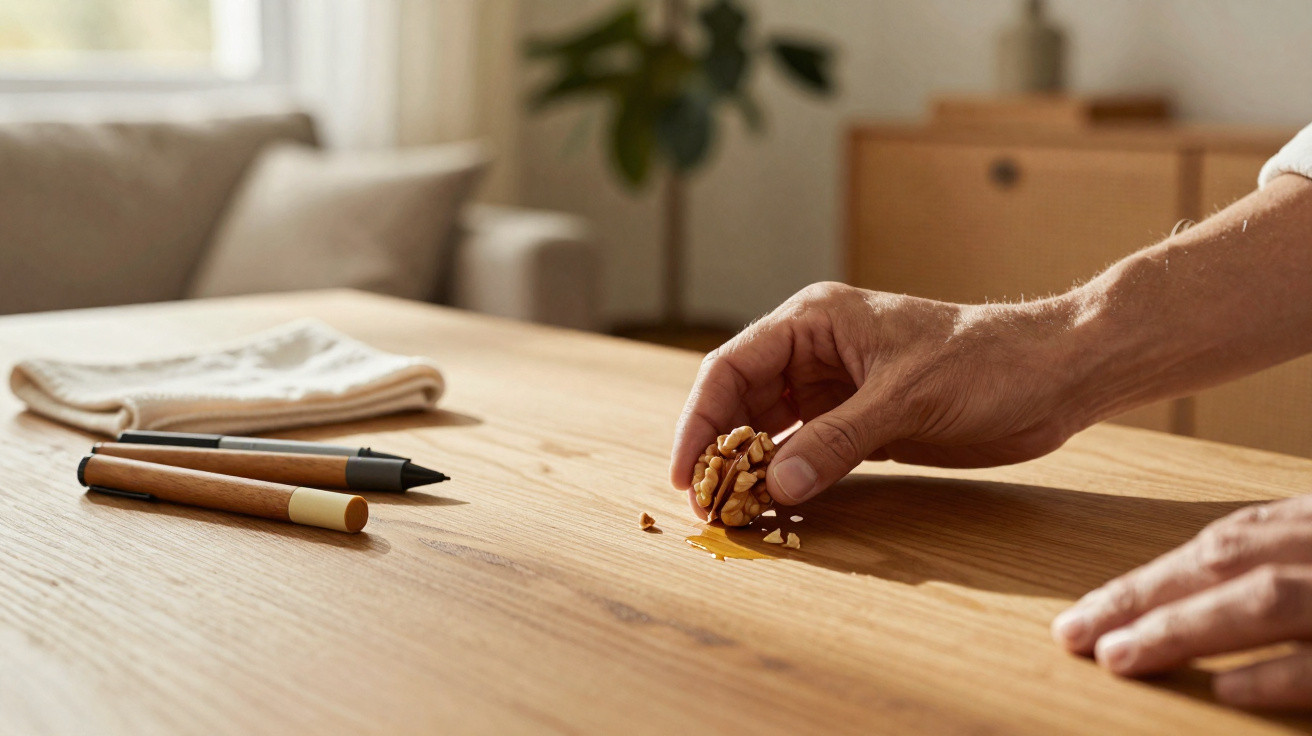
Small scratches in wooden furniture do not always call for professional restoration or replacement of the item. If the damage is limited to the finish, a wax crayon in the right shade, a touch-up pen or even a walnut can conceal the mark and restore a more even appearance. The suitable choice depends on the scratch depth and the material, as solid wood, painted MDF and faced MDF react differently.
How can you tell whether a scratch is superficial or deep?
Gently run a fingertip over the mark. If there is virtually no change in level and only the finish colour has been affected, it is a superficial scratch. If your fingernail catches in the groove or a pale layer is visible beneath the surface coating, part of the indentation will need filling before the colour is corrected.
Before starting any repair, wipe the area with a soft cloth to remove dust and grease. Dirt can affect both adhesion and how the colour appears.
- Visual mark only: a touch-up pen is usually enough;
- Small groove: a wax crayon can fill the indentation;
- Lightly scratched natural wood: a walnut may darken the affected area;
- Deep chip: this may require a wood-specific filler;
- MDF with lifting facing: the issue has already gone beyond a simple touch-up.
When is a touch-up pen the easiest option?
A wood touch-up pen is most effective on fine scratches where some colour has been removed but no deep cavity has formed. Pick a shade close to that of the furniture, apply it only along the line, then immediately wipe away any excess around it with a clean cloth. Several light applications generally leave a less noticeable result than trying to darken the whole mark in one go.
How should you use a wax crayon to fill slightly deeper scratches?
Where there is a shallow groove, a wax crayon close to the furniture colour can act as a filler. Rub it across the mark so the wax is pressed into the indentation, then clear any surplus from the surface with a plastic card or soft cloth.
Finish with gentle polishing to smooth the area without removing the material just worked into the scratch. This technique usually works better on dark furniture or matt finishes, where slight variations in sheen are less obvious.
- Start with a shade slightly lighter before trying a darker one;
- Fill the groove only;
- Do not spread wax over a wide area;
- Remove excess material before polishing;
- Test it first on a concealed section.
Can rubbing a walnut really hide scratches in wood?
On certain items made from solid wood, it can. A walnut’s natural oils and pigments may temporarily darken small pale scratches, making them less noticeable. Lightly rub the inside of the walnut over the mark, leave it for a few minutes, then buff it with a dry cloth. Results are unpredictable on MDF, laminate and very pale finishes, so testing in an unobtrusive area is essential.
The best repair is one that matches the furniture finish
A scratch in natural wood should not automatically receive the same treatment as a mark on melamine-faced MDF, gloss varnish or lacquered paint. On laminated surfaces, for example, a walnut will do very little to restore the lost decorative layer, whereas a compatible touch-up pen may achieve a better visual result. On glossy pieces, too much wax can create a noticeable dull patch.
For small scratches in furniture, the principle is to begin with the least invasive method: clean the area, test the colour and work only within the mark. A pen addresses superficial colour changes, a wax crayon helps with minor grooves, and a walnut can camouflage pale scratches in some natural woods. However, where there are large chips, raised facing or deeply exposed wood, repair using filler and a suitable finish is likely to last longer than attempting to disguise everything with a household trick.





Comments
No comments yet. Be the first to comment!
Leave a Comment