
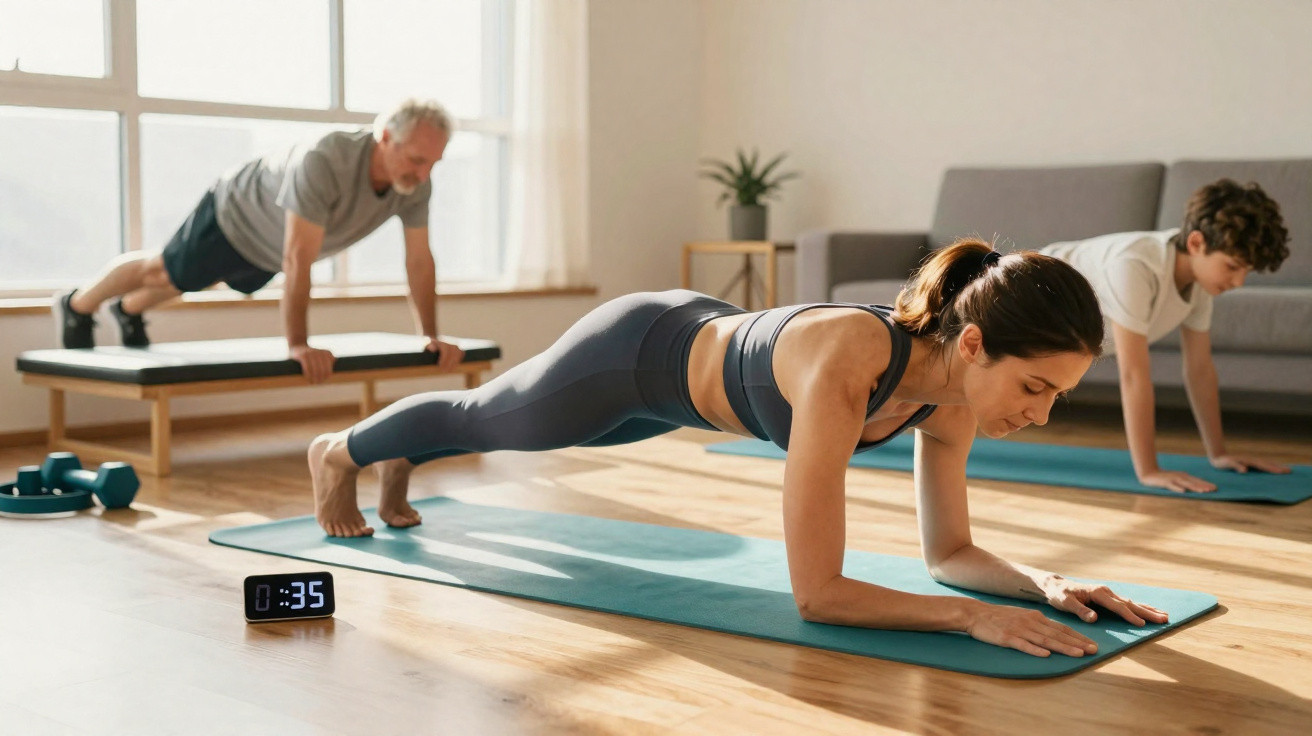
The plank position has become increasingly popular in gyms and home workouts because it trains the core in a practical way without requiring equipment. It is an isometric exercise: although the body stays still, the muscles must work firmly to hold the position. The question most people ask is how long they should hold a plank and whether there is a benchmark by age. However, correct form is always more important than trying to set a time record.
How long is a good plank hold?
Planks are generally used as a straightforward way of assessing core endurance in healthy people without back pain. For younger adults, holding a plank for 45 to 90 seconds is commonly regarded as a good sign of endurance, while ranges of 20 to 60 seconds are often used for people over 60.
These ranges are only approximate reference points, rather than compulsory targets. Body weight, training background, injuries, breathing control and the type of floor can all have a substantial effect on the result. For this reason, many trainers recommend paying greater attention to personal progress over several weeks.
How can you compare plank time by age safely?
When discussing “plank time by age”, the most common variation is the forearm plank. It relies heavily on the rectus abdominis, obliques and deep muscles that stabilise the spine, making it particularly useful for quick endurance assessments.
To make these comparisons easier, some professionals use time bands for age groups among people with no significant medical limitations. The practical examples below can help you identify your current level and the direction in which you may progress:
- 18 to 39 years: 45 to 90 seconds for the general population; 60 to 120 seconds for people who train regularly.
- 40 to 59 years: 30 to 75 seconds for active people; 45 to 90 seconds for higher fitness levels.
- 60 years or over: 20 to 60 seconds for most people; 30 to 75 seconds for those who maintain a regular exercise routine.
How do you perform a plank correctly and avoid back pain?
For the plank to deliver genuine benefits, technique needs attention from the outset. The basic position depends on simple alignment: place the elbows beneath the shoulders, rest the forearms on the floor, extend the legs, keep the spine neutral and press firmly through the toes, with the head following the line of the spine.
- Lie face down with your forearms resting on the floor.
- Set your elbows in line with your shoulders.
- Raise your body onto your forearms and toes.
- Engage your abdominal muscles, glutes and thighs, keeping your body in a straight line.
- Breathe continuously without holding your breath until you reach the intended time.
How can you increase plank time gradually and effectively?
To extend your plank time safely, it helps to follow a slow, planned progression. A common approach is to start with sets of 15 to 20 seconds, repeated two or three times, then add 5 to 10 seconds to each set as long as the technique remains stable and pain-free.
Adding other core exercises, such as the side plank, bird-dog and dead bug, supports improved endurance and spinal protection. In practice, the plank is usually more effective when it is challenging but controlled, offering greater benefits than attempting to hold it for several minutes with compromised form and an overloaded spine.






Comments
No comments yet. Be the first to comment!
Leave a Comment