
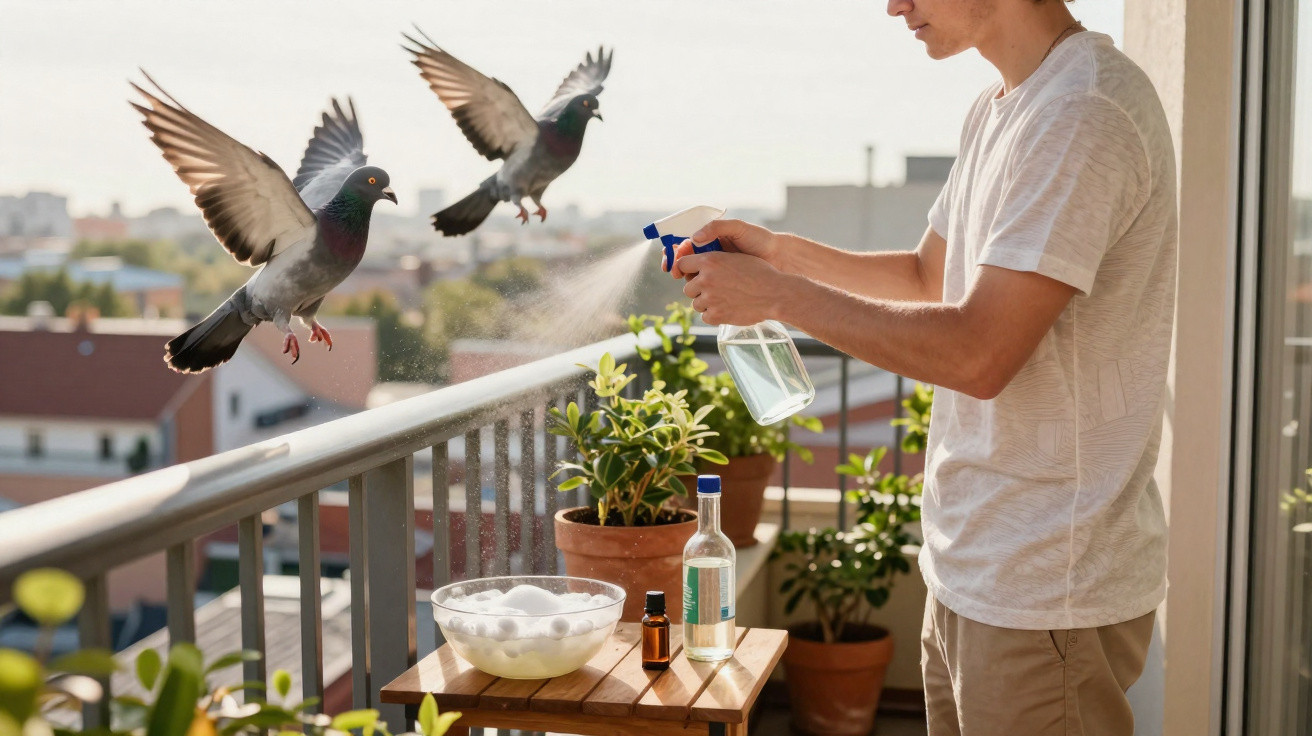
From the first mild morning in April, balconies can become a trouble spot for many city residents. Pigeons suddenly appear, bring in twigs, leave mess behind and are rarely quick to move on. A straightforward, inexpensive mixture made from items available at chemists or pharmacies can reliably put a stop to this, without costly specialist installations.
Why pigeons love balconies
Pigeons have long recognised urban homes as an ideal habitat. Food is readily available near people, they are accustomed to noise, and balconies appeal to them for several reasons:
- Sheltered from wind: Walls and balustrades provide protection from draughts.
- An elevated position: Predators such as cats find it harder to reach them.
- Covered overhead: Canopies and awnings shield them from rain.
- Quiet corners: There is little disturbance, especially on balconies that are seldom used.
The breeding season is at its busiest between April and August. At this time, the birds search particularly determinedly for secure nesting sites. Anyone who does not act promptly may find a completed nest on their balcony within days, complete with persistent occupants.
Pigeon droppings are more than an appearance issue
For most people, the mess is the main annoyance. Pigeon droppings are sticky, corrosive and difficult to remove. Balcony tiles, railings and furniture can soon look neglected.
There are health concerns too. Pigeons may carry pathogens and parasites. Families with children or pets are understandably uneasy when a pigeon nest is being built directly beside the balcony door.
“Those who take action early save themselves weeks of trouble – and prevent a few twigs from becoming a protected nest that can no longer simply be removed for animal welfare reasons.”
The crucial point: act before the nest is complete
Take notice as soon as twigs, feathers or small piles of leaves begin to collect on the balcony. This is often the first sign that a nest is being built. Pigeons commonly return repeatedly to precisely the same spot to ‘test’ it.
At this stage, you should:
- Remove twigs immediately.
- Clean the area thoroughly.
- Eliminate scent traces so that the location remains less appealing.
This is exactly when a simple household method can help. It has quietly proved effective in many homes for years, without wire spikes, nets or electrical gadgets.
The anti-pigeon mix: water, essential oil, vinegar and soap
Pigeons rely heavily on their sense of smell. They find certain powerful scents unpleasant and avoid areas where they occur. This can be used to your advantage.
How to prepare the solution
The following quantity is enough for an average-sized balcony:
- 2–3 litres of warm water
- At least 30 drops of essential oil – suitable options include:
- Lemon oil
- Eucalyptus oil
- Peppermint oil
- A splash of clear household vinegar or vinegar essence, heavily diluted
- A small squirt of liquid soft soap or a grated piece of plain household soap
Stir everything thoroughly in a bucket until the soap has dissolved. The mixture should have a strong fragrance, but it should not sting your own nose. If unsure, begin with slightly less vinegar and add more gradually as required.
“The combination of potent essential oils, vinegar and soap creates a barrier of scent that pigeons find extremely disturbing – while people usually barely notice it after a short time.”
Applying the pigeon deterrent on the balcony
Use a cloth, mop or scrubbing brush to spread the solution wherever pigeons tend to land or perch:
- Floor areas, particularly corners
- The balustrade and railings
- Window sills
- Frames around balcony and patio doors
If the balcony is heavily soiled, clean it as normal first and remove all larger debris. Then apply the scented protective mixture. This helps the fragrances adhere more effectively and last longer.
How often should the method be repeated?
Rain, wind and sunshine gradually weaken the scent. For dependable results, it helps to follow a regular schedule:
- Wipe down again at least once a week.
- Reapply the mixture after every heavy shower.
- During the breeding season, it is better to clean a little too often than not often enough.
Many people report that, after two to three weeks, pigeons stop trying to fly to the area altogether. Instead, they choose easier targets, such as roof overhangs or unprotected window ledges nearby.
Alternative and additional measures against pigeons
The water, essential oil and vinegar mixture is a strong first measure. Those dealing with especially persistent visitors, or living in an area with a major pigeon problem, can also take further steps:
- Create the impression of movement: Gently fluttering ribbons, wind chimes or rotating objects can unsettle pigeons.
- Make surfaces less inviting: Dense planters, furniture or decorations reduce available landing space.
- Do not provide food: Leftover food, uncovered pet food and crumbs on the balcony are highly attractive to pigeons.
- Do not ‘reward’ nesting sites: If a nest is tolerated once, the birds often become regular visitors for the long term.
Many experts advise against pointed metal strips and harsh chemicals. They may injure animals or pose a risk to children and pets. The scent method relies on deterrence rather than harm.
Legal and ethical limits when deterring pigeons
In Germany, birds are generally regarded as animals worthy of protection. Nesting sites containing eggs or young birds receive particular protection. Anyone who destroys an occupied nest may be committing an offence.
The most important rule of thumb is therefore:
“Take action before there are eggs in the nest – and use only methods that do not injure the animals.”
The scented solution serves precisely this purpose: it makes the location unattractive, does not harm the birds and merely encourages them to find another site.
Why essential oils have such a strong effect on animals
Many birds react with extreme sensitivity to smells. Essential oils are highly concentrated plant extracts, and only a few drops can noticeably fragrance a room. A scent that smells pleasantly fresh to people can be overwhelming for birds.
Citrus, eucalyptus and peppermint scents mask the subtle orientation traces that pigeons use. The birds feel insecure in this kind of environment and avoid it. Small quantities are generally not a problem for pets such as dogs and cats, but they should nevertheless not come into direct contact with the oils.
Practical examples: fitting the method into everyday life
Many urban residents already use their balconies for a spring clean. The anti-pigeon mixture can easily be included in this routine:
- Clear the balcony and sweep away loose debris.
- Clean the floor and railings using an ordinary cleaner.
- Then wipe everything down thoroughly with the scented mixture.
- Place a small remaining bowl of the solution in a corner that children and animals cannot reach, creating an additional scented point.
Anyone who regularly plants flowers or rearranges balcony furniture can simply combine this with wiping down surfaces using oil and vinegar. This establishes a routine that prevents pigeons from becoming regular visitors in the first place.
It can also help to observe the times of day when pigeons appear and respond specifically. For example, briefly wipe the railings and window sills in the morning before work. After a few days, the birds learn that the balcony is ‘unpleasant’ and quietly choose another destination.



Comments
No comments yet. Be the first to comment!
Leave a Comment