
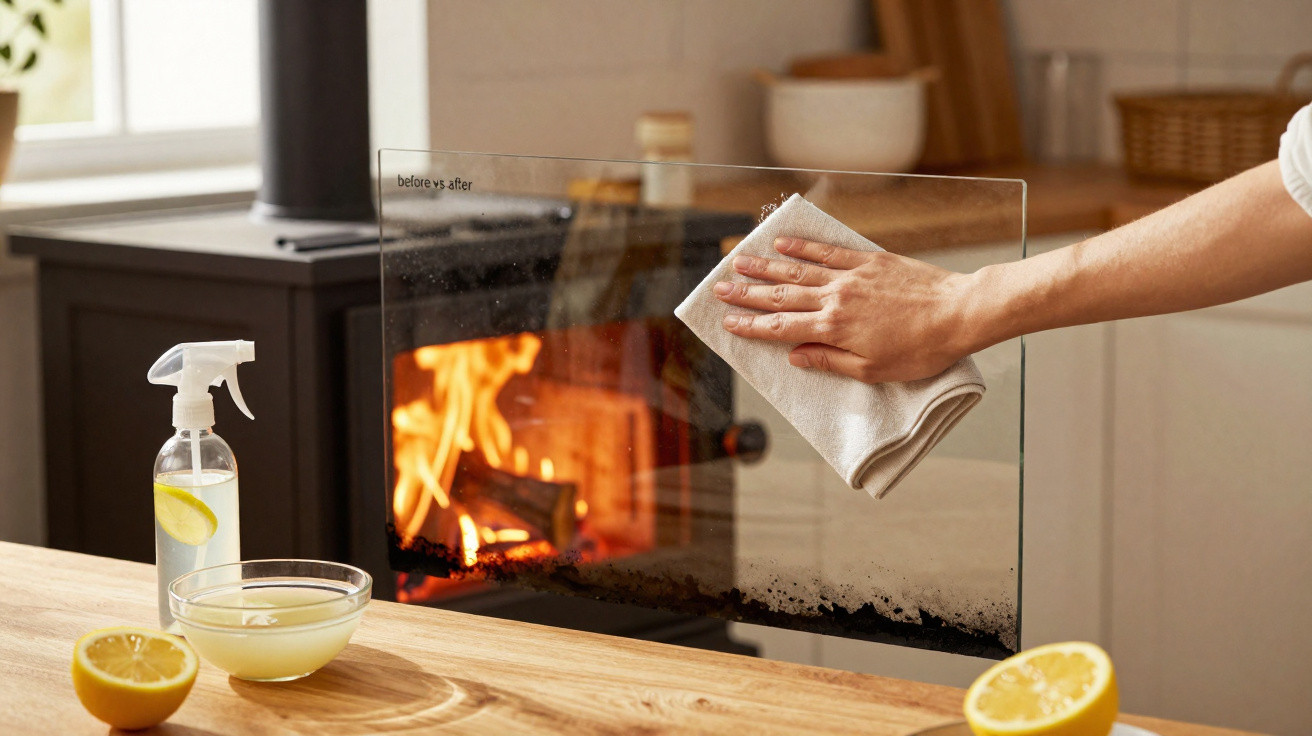
Many people resort to rubbing ash over the glass, only to be frustrated by smears and grime. Yet there is a far easier and quicker way, using items that almost everyone already has at home. A straightforward blend of two household staples removes even stubborn soot deposits, without harsh chemicals or laborious scrubbing.
Why stove glass turns black so quickly
Before starting the cleaning, it is worth understanding the causes. Reducing soot build-up means you will need to reach for cleaning products far less often.
- Damp or poor-quality wood: Firewood with excessive residual moisture produces a great deal of smoke. Its particles settle inside the firebox and on the glass. Wood with less than 20 per cent moisture is ideal.
- Incomplete combustion: If the fire burns too cool or receives too little oxygen, it creates more soot particles, which then stick to the glass.
- Incorrect air supply settings: When the primary or secondary air control is closed too far, the fire lacks oxygen. The result is black streaks across the glass panel.
- Constant low-burning operation: Many people turn their stove down heavily to save wood. The fire then merely smoulders away, creating ideal conditions for soot and deposits.
Anyone who stores their wood properly, provides sufficient air and does not continually let the stove merely “smoulder” will keep the glass clear for much longer.
The simple household method: cleaning stove glass without ash
The familiar method of using damp ash does work, but it often leaves grey streaks and black sludge behind. A more convenient option is a mixture of clear household vinegar and bicarbonate of soda.
Why this combination works so well
- Household vinegar breaks down grease and soot: Its mildly acidic solution softens burnt-on deposits.
- Bicarbonate of soda provides gentle abrasion: The powder has a slight polishing action without scratching the glass.
- The fizzing reaction helps loosen deposits: When vinegar and bicarbonate of soda meet, they produce a fizzing reaction that works underneath particles stuck to the surface.
The result is clean glass in a short time, without having to scrub for hours.
How to clean stove glass step by step
Step 1: Mix the natural cleaner
Important: the glass must be completely cold. Never clean hot glass, as there is a risk of cracking.
- Put two parts household vinegar into a bowl or an old cup.
- Add one part bicarbonate of soda.
- Leave the mixture briefly until the initial foaming subsides.
The gentle foaming is intentional and shows that the two ingredients are reacting. The cleaning effect remains afterwards.
Step 2: Apply the solution and loosen the deposits
- Dip the soft side of a sponge or a microfibre cloth into the mixture.
- Work over the glass in circular movements, from top to bottom.
- Apply a thicker layer to heavily soiled areas and leave it to work for two to three minutes.
If preferred, you can also apply the vinegar mixture with a spray bottle and sprinkle the bicarbonate of soda directly onto the glass. This creates the reaction on the surface and can help with particularly heavily encrusted areas.
Step 3: Wipe, rinse and dry
- Use a damp cloth to remove all remaining soot and cleaning product.
- Rinse the cloth several times, until it is barely turning grey.
- Finally, polish with a clean, dry cloth or kitchen roll so that no streaks remain.
Those who wipe carefully and dry the surface thoroughly can achieve glass that looks almost new – in just a few minutes.
Other natural alternatives for stove glass
If you do not have bicarbonate of soda or vinegar at home, other items from the cleaning cupboard can also help, provided the glass is cold.
- Black soap: A squirt in lukewarm water is enough. Apply it with a sponge, leave it briefly, then wipe away and dry the surface.
- Rubbing alcohol: This removes soot and greasy deposits very quickly. Apply it with a cloth, taking care not to let it run onto the seals.
- Hot water and newspaper: Suitable for lighter soiling. Dampen the newspaper, rub the glass and then polish it dry.
How to prevent stove glass from becoming dirty quickly
Cleaning regularly is useful, but operating the stove in a way that produces less soot is even better. A few habits can make a real difference.
- Use well-seasoned wood: Hardwood such as beech or oak, when dry and stored correctly, burns hot and comparatively cleanly.
- Allow enough air: Open all air vents generously when lighting the stove. The air supply can be reduced only once the fire is burning strongly.
- Do not keep the stove permanently turned down: It is better to heat strongly during distinct heating periods and allow the stove to cool than to run it continuously at half output.
- Give the glass a light clean more often: Wiping it over briefly on a regular basis prevents thick, burnt-on layers that are difficult to remove.
Why household remedies are often better than chemical cleaners
Although specialist shop-bought cleaners work quickly, they often contain highly irritating substances that not everyone wants to spray in their living room. In addition, many of these sprays can damage seals if they run towards the edges of the glass.
Vinegar and bicarbonate of soda cost little, have hardly any impact on indoor air and are entirely sufficient for most everyday dirt.
There is another advantage: both ingredients can be used for many other household jobs, including in the kitchen and bathroom. Keeping them in stock saves you from filling the cleaning cupboard with a whole range of single-purpose products. Many households with children or pets feel considerably more comfortable using these simple remedies.
Practical tips for an even clearer view
- Use water sparingly: Too much liquid can run past the seals and enter the stove. It is better to work with only lightly damp cloths.
- Avoid abrasive tools: Steel wool and sharp blades have no place on stove glass. Fine scratches will immediately collect soot again the next time the fire is lit.
- Wear protective gloves: Soot stains heavily. Simple rubber gloves make washing your hands afterwards much easier.
Anyone who looks after their wood-burning stove in this way will soon notice the difference: watching the flames becomes part of the evening ritual again, rather than an irritating cleaning task. With this household method, cleaning takes only a few minutes and can easily be done every one to two weeks.
One further note: if the glass still turns black again very quickly despite good-quality wood, correct air supply and regular cleaning, it is worth checking the instruction manual or speaking to a specialist. Sometimes the cause is a faulty sealing ring, a misadjusted draught control or a problem with the chimney – and even the best cleaner will then offer only a temporary solution.






Comments
No comments yet. Be the first to comment!
Leave a Comment