
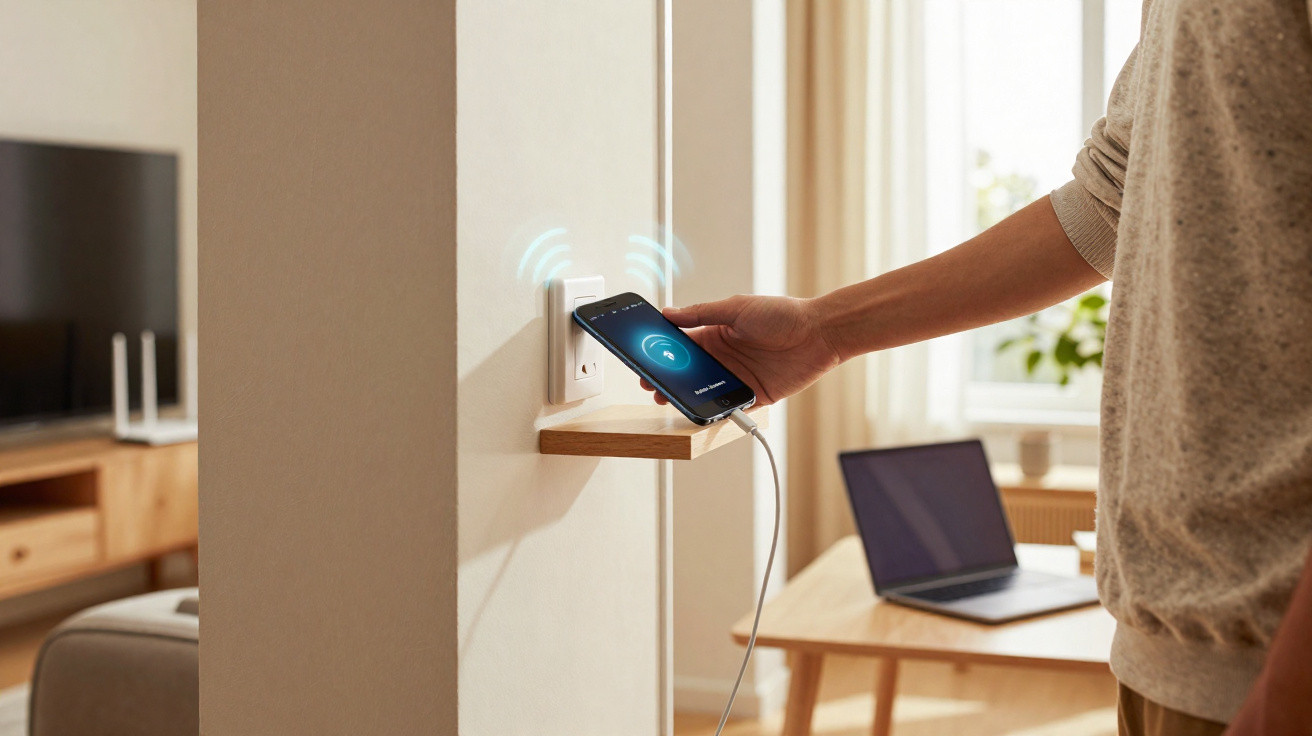
An old Android workhorse that nobody uses any more can do more than gather dust. With a few targeted settings, a retired smartphone can become a Wi-Fi extender, helping to eliminate irritating dead zones without spending money on an expensive mesh system or plug-in repeater.
Wi-Fi dead zones at home: why wireless networks often struggle
Internet providers advertise impressive gigabit figures, yet in day-to-day use little of that speed reaches many rooms. The problem is rarely the broadband connection itself; it is usually the home.
- Thick concrete or brick walls severely weaken the wireless signal.
- Reinforced-concrete ceilings and underfloor heating can act as a barrier to radio waves.
- Microwaves, baby monitors and Bluetooth devices interfere with the 2.4 GHz frequency.
- Routers are often placed poorly: in a hallway, inside a cupboard or right beside a tangle of cables.
“Where Wi-Fi arrives with only one bar, streams cut out, videos load at a snail’s pace and online gaming becomes a test of patience.”
Many people instinctively order a costly repeater or a complete mesh kit. However, anyone with an old Android smartphone lying around can often achieve the same result free of charge.
Using your old Android device as a Wi-Fi extender: what you need
Before starting, it is worth quickly checking whether the old device is actually suitable.
Requirements for the smartphone
- An Android version that offers “Mobile Hotspot” or “Tethering”
- A Wi-Fi module that still works
- A reasonably healthy battery, or the option to keep it permanently charged
- A reliable power source near the intended location
The newer the wireless chip, the better the result is likely to be. Very old devices supporting only earlier Wi-Fi standards can extend coverage, but may also reduce speeds. Even so, that is sufficient for many everyday uses, including browsing, email and standard streaming.
How to set up an Android smartphone as a repeater
The principle is straightforward: the old phone connects to your router over Wi-Fi while simultaneously creating its own small Wi-Fi network, which devices in the dead zone can join. The feature has slightly different names depending on the manufacturer, but the process is broadly similar.
Step 1: Reset and clear the device
If the retired handset still contains old data, performing a factory reset is worthwhile. It reduces potential sources of errors and eases the strain on the battery.
- In Settings, select “System” or “General management”.
- Choose “Reset”, then restore the device to factory settings.
- After restarting, enable only the essential options; a Google account is not required.
Apps and services running in the background increase power consumption. Keep the system as lean as possible.
Step 2: Connect to your home Wi-Fi
Connect the device to your existing network as normal:
- Under “Wi-Fi”, select your home network.
- Enter the Wi-Fi password and establish the connection.
- Check that websites can be opened in the browser.
Important: Bluetooth and mobile data can be turned off if they are not needed. This saves power and avoids sources of interference.
Step 3: Enable the mobile hotspot
Now switch on the key feature: the mobile hotspot.
- Open Settings.
- Depending on the interface, go to “Connections”, “Network & Internet” or “Tethering/Hotspot”.
- Enable “Mobile Hotspot” or the similarly named option.
- Set a network name (SSID) and password.
“Use a secure password for the hotspot and, where possible, WPA2 or WPA3 – anything else is no longer up to date.”
You can base the hotspot name on that of your main Wi-Fi network, for example “MyWiFi_Repeater”. This makes it easy to see which wireless point your laptop or television is connected to.
The best location for your smartphone Wi-Fi extender
Positioning determines whether the experiment works or comes to nothing. The device should not sit directly beside the router, nor should it be placed at the furthest point inside the dead zone.
| Position | Effect |
|---|---|
| Directly next to the router | Hardly any coverage improvement; merely a second source of wireless radiation |
| Halfway between the router and the dead zone | A good compromise between signal quality and coverage |
| Deep inside the dead zone | Incoming signal is too weak, resulting in a slow or unstable connection |
Ideally, place the smartphone where it can still receive a decent signal from the router – for example, two to three bars on the Wi-Fi icon – while also being noticeably closer to the room that previously had little or no reception.
Practical tips:
- Place the device slightly higher up on a shelf rather than on the floor.
- Do not position it directly against large metal surfaces or behind the television.
- Route the charging cable so nobody can trip over it or pull the phone down.
Keep an eye on power consumption and security
A permanently active hotspot uses power. An old device’s battery can suffer if the phone remains at 100 per cent charge and becomes very hot.
A few adjustments can help:
- Reduce screen brightness to a minimum and set a very short screen timeout.
- Leave only Wi-Fi and the hotspot enabled, disabling all other wireless services.
- If possible, keep the battery slightly below full charge, for example by using a timer plug.
Security matters just as much for this secondary network as it does for the main Wi-Fi. Use a separate, long password and avoid obvious terms. Very old devices may lack modern encryption standards; in that case, this setup is better suited to non-critical uses such as streaming to a second television.
Where the smartphone solution reaches its limits
This improvised repeater is not the best choice in every situation. Professional mesh systems offer several advantages:
- Easier management of several access points through one central app
- Automatic switching between access points while moving around
- Higher maximum data rates and modern antenna technology
Anyone regularly transferring large amounts of data, such as editing 4K video material on the home network or working on Wi-Fi with many people at once, will usually benefit from dedicated hardware. For typical homes with a dead zone in the bedroom or home office, though, a smartphone repeater is often entirely adequate.
Alternative use: a Wi-Fi bridge for older devices
The idea can also work in reverse: the old Android smartphone can act as a bridge for devices with no Wi-Fi at all or support only outdated standards. One example is an older smart TV that can use only a slow wireless connection.
In this situation, connect the phone to the fast router via Wi-Fi, then link the television using a USB Ethernet adapter or, on some models, Bluetooth tethering. This allows older technology to benefit from a more stable network connection.
Why the experiment is almost always worthwhile
Old smartphones often sit unused in drawers for years, despite containing fully functional hardware. From the perspectives of resources, household budgets and the environment, reusing these devices makes more sense than immediately buying new electronics.
“Anyone who uses an old Android phone as a repeater not only protects their bank balance, but also reduces a small amount of everyday electronic waste.”
For families with children, the project can even provide a small lesson in technology: where should the router be placed? How do radio waves behave? Why does one extra bar on the Wi-Fi icon mean Netflix runs without stuttering? Trying different positions and settings quickly gives you a feel for how sensitive a home network is to a building’s physical layout.
Ultimately, the result is a practical one: a DIY repeater from a drawer will not replace every professional solution, but it surprisingly often solves the everyday problem that causes the most frustration – the one room where Wi-Fi always misbehaves precisely when it is needed most.




Comments
No comments yet. Be the first to comment!
Leave a Comment