
Many people impulsively buy attractive plants at the DIY store, fill the boot of the car to take them home – then find a few weeks later that everything has dried out or withered away. Often, this is not down to having a “black thumb”, but to demanding species, an unsuitable position or simply too little time. Yet a small selection of exceptionally undemanding long-lasting plants is enough to create a bed that largely looks after itself.
Why beginners benefit from easy long-lasting plants
People new to gardening can easily take on too much: too many different varieties and overly ambitious requirements for soil, watering and maintenance. That soon becomes frustrating. It is far more relaxed to rely on a handful of hardy stalwarts that forgive missed watering sessions and less-than-perfect soil.
With six inexpensive, resilient plants, you can create a bed that shows colour for almost the entire year – without constantly buying replacements.
The key is to create a kind of flowering relay. As one plant enters its resting period, the next takes over the job of adding colour. This keeps the bed lively, even though it contains only a small number of species.
- Low cost – plant once and enjoy them for years
- Flowers from winter until late autumn through a clever combination
- Highly forgiving, making them ideal for beginners and busy workers
The 6 inexpensive plants that grow almost by themselves
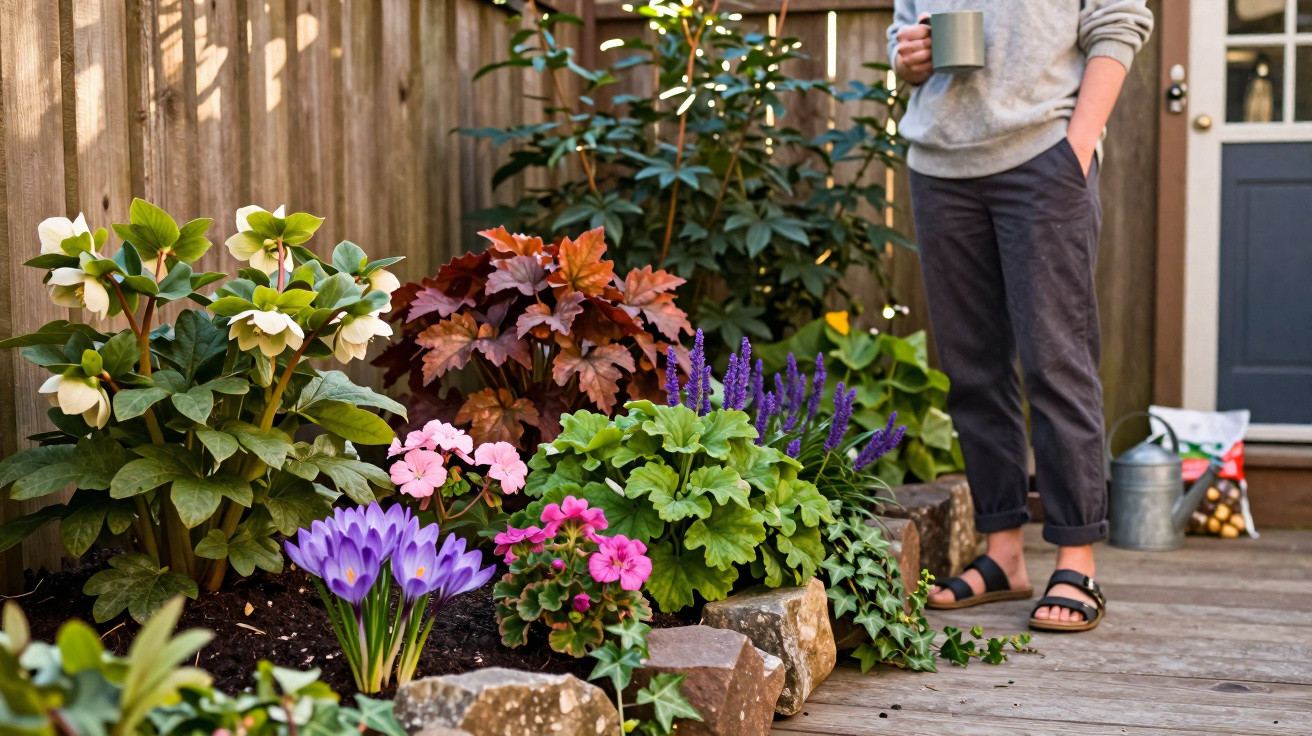
For an easy-care starter bed, gardening professionals repeatedly recommend the same compact selection: cranesbill (hardy geraniums, known horticulturally as Geranium), crocuses, hellebores (Helleborus), coral bells (Heuchera), bugleweed and ivy. All six are relatively inexpensive at garden centres and even supermarkets, often discounted in spring or autumn.
| Plant | Flowering period | Typical strength |
|---|---|---|
| Hellebore (Helleborus) | December to March | Flowers in winter, very frost-hardy |
| Crocus | February to March | Grown from bulbs and returns every year |
| Cranesbill (Geranium) | May to October | Long flowering season, dense ground cover |
| Coral bells (Heuchera) | May to July (depending on variety) | Decorative foliage in many colours |
| Bugleweed | April to June | Spreads low across the ground and suppresses weeds |
| Ivy | No conspicuous flowers | Evergreen and extremely hardy |
1. Hellebore: the winter hero for lazy gardeners
When everything else in the garden looks bleak, hellebores get going. They flower in the middle of winter, sometimes even before Christmas. Snow and overnight frosts cause them no difficulty. A semi-shaded position beneath a shrub is enough, while ordinary to slightly lime-rich soil is suitable.
Once established, they prefer to be left alone: no frequent digging and no complicated fertiliser schedule. Simply remove old, spotted leaves in spring so that new shoots have room and air around them.
2. Crocuses: a burst of colour at winter’s end
Crocuses are among the least expensive spring-flowering plants available. Bags containing 25 or 50 bulbs cost only a few pounds. Plant the small bulbs in autumn at a depth of around 10 centimetres, ideally in groups.
From their second year onwards, flowers often emerge in new places as the bulbs gradually multiply underground. If you plant crocuses in a lawn and wait until after flowering before mowing, you will have a natural “carpet of flowers” every year without replanting.
3. Cranesbill: continuous flowers from spring to autumn
Cranesbill, meaning hardy Geranium varieties, is one of the most dependable perennials for home gardens. Depending on the variety, it blooms from May well into October. At the same time, it covers the ground densely enough to leave weeds with barely any opportunity to establish themselves.
Many varieties cope equally well with sun and partial shade, needing only reasonably free-draining soil that does not become completely parched. Cutting it back after the first flush of flowers can even encourage a second display.
4. Coral bells: an explosion of colour from foliage
Coral bells are prized mainly for their ornamental leaves. Their colours range from lime green and rusty red to almost black. They therefore provide structure even when nothing is in flower. They are especially happy in partial or full shade.
By mixing several varieties, you can design an entire bed through leaf shape and colour alone. A little compost in spring is enough to keep them thriving.
5. Bugleweed: a natural weed barrier
Bugleweed stays very low but forms dense mats. In spring, small, usually violet flower spikes rise above them and attract bees and bumblebees. Its ground-covering habit crowds out many unwanted weeds.
It requires very little attention: contain it occasionally if it starts spreading too enthusiastically, and water now and then in high summer if the soil becomes exceptionally dry.
6. Ivy: green when nothing else is green
Ivy is considered almost indestructible. It covers walls, fences, shady gardens and bare patches of ground where other plants have long since given up. For beginners, classic green-leaved ivy is the best choice, as variegated varieties are slightly more sensitive.
The only important point is to guide it from the start: rather than allowing it to climb newly insulated façades, use it on a fence or as ground cover. Regular pruning keeps its growth under control.
How beginners can genuinely save money when buying plants
Rather than purchasing lots of individual plants in large containers, look in three areas: small pots, multipacks and bags of bulbs. Cranesbill, coral bells and bugleweed in particular are often sold in small 9 cm pots at considerably lower prices.
- Choose bulbs and tubers where possible – they offer the lowest cost per flower
- Use autumn and very early spring to find bargains
- Visit local plant markets or plant-swapping events
A little patience saves even more money. Small young plants may take an extra year to get properly established, but they then develop a strong root system and adapt better to their position.
These plants can be propagated for free
The biggest saving comes after two or three years. By then, many of these species will be so well established that you can divide them and replant the sections elsewhere.
Starting with only a few plants, division and cuttings can fill an entire garden within five years – without spending an extra penny.
Typical candidates include:
- Cranesbill and coral bells: Divide them into several pieces with a spade in spring or autumn, then replant them.
- Bugleweed: Separate individual rooted runners and plant them where you want them.
- Ivy: Cut off shoots with aerial roots, insert them into soil and keep it evenly moist.
In this way, a small starter bed gradually becomes an entire garden room. If you have neighbours, you can also swap varieties and expand your collection without needing to buy anything.
How to protect your inexpensive plants effectively from animals
Freshly planted specimens often suffer from cats, birds and slugs. They dig in the soil, pull up young plants or nibble buds. There is a simple, low-cost deterrent popularised by amateur gardeners in the United Kingdom: hot spices.
A light scattering of cayenne pepper powder across the soil surface bothers the sensitive noses of cats and many other animals without harming the plants themselves. Its pungent compound irritates the mucous membranes but does not cause lasting damage at normal quantities. Reapply the layer after heavy rain.
Simple physical barriers help too: cut branches arranged as a loose protective grid, wooden sticks, old forks or plant labels positioned directly beside young plants. Animals soon lose interest in digging where it is uncomfortable.
Position, soil and watering: the three basics for laid-back gardeners
For these six budget-friendly plants to last well, follow three straightforward rules:
- Position: Hellebores, coral bells, bugleweed and ivy like partial shade; cranesbill also tolerates sun; crocuses thrive in open, lightly shaded lawns.
- Soil: Ordinary garden soil is entirely adequate. Avoid waterlogging, and improve compacted soil with sand or fine grit.
- Watering: Water regularly during the first few weeks after planting, then intervene only during prolonged dry spells.
Anyone who broadly follows these three points does not need to study detailed care charts. For people with busy jobs or frequent travel, this kind of “forgiving planting” is a real stress reliever.
How to build a harmonious bed from the six plants
A practical layout for beginners is to place hellebores and cranesbill at the back as the foundation, coral bells in the middle row and bugleweed right at the front. Distribute crocus bulbs between them. Ivy works well as edging or for covering a wall in the background.
For a harmonious appearance, limit the palette to a few colours, such as white, pink and violet. This creates a calmer effect than numerous isolated bright colours. You can expand the system over time, but the core idea remains the same: a small number of hardy plants that will not drive you mad.





Comments
No comments yet. Be the first to comment!
Leave a Comment