
Craft work demands precision at every stage to achieve flawless results. When thread tangles in the fabric, progress slows and frustration soon follows. Simple handling techniques can prevent snarls while protecting the quality of every stitch.
Why does thread tend to tangle during hand sewing?
Constant friction between the fibres and the fabric creates unintentional twists as the needle passes through. Overly long threads build up excessive tension with every pull, making unwanted loops more likely to form. This irregular movement disrupts the rhythm of craft production.
Choosing a thread thickness that is unsuitable for the fabric also increases mechanical resistance. Once the fibre loses its original structure, small bends can appear quickly. Understanding these factors makes it easier to retain complete control over each movement.
Why does running thread through beeswax prevent knots?
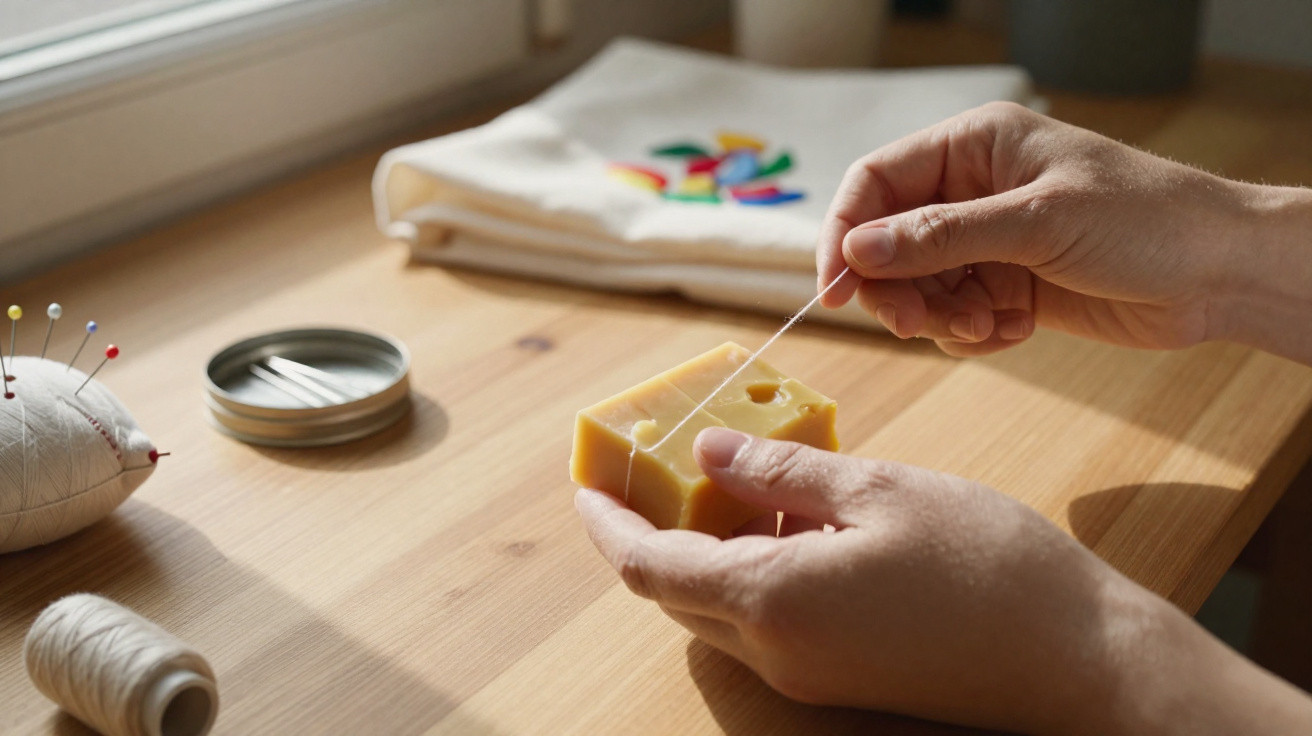
Beeswax forms a protective coating that reduces friction against the fabric and aligns the fibres, allowing the thread to move more smoothly.
Read more
How does beeswax help thread glide?
Conditioning with natural wax seals loose filaments and gives every type of thread greater stability. When the skein is drawn across the block, the beeswax forms an even film that encourages smooth gliding through the weave.
This protection considerably limits wear caused by the needle’s continual friction during hand finishing. The treated material gains the right amount of firmness without sacrificing flexibility, ensuring neat, even sewing without irritating interruptions in everyday work.
Below is a video from the Clube do Bordado YouTube channel demonstrating how to condition threads in practice:
Which items are essential for preparing thread?
Arranging the right tools before beginning any craft project prevents improvised solutions that may damage delicate pieces. Sharply honed scissors trim the ends without fraying them, while a compatible needle prevents unnecessarily large holes in the fabric with every hand-sewn pass.
Keeping suitable waxes and organising holders available leaves your work surface ready for efficient handling. Proper conditioning shields the fibre from moisture and dust, maintaining the distinctive sheen of skeins throughout the creative process.
Essential kit
Indispensable materials for sewing without knots
Keep these items within easy reach to make the work easier:
- Beeswax disc with a protective holder;
- Precision scissors with well-sharpened blades;
- Hand-sewing needles suited to the thickness of the thread.
How can you keep thread aligned at every sewing stage?
Cutting thread into moderate lengths is one of the most effective ways to prevent tangling while stitching. Working with comfortable lengths reduces excessive handling and lowers the risk of accidental loops forming in the fabric weave.
In addition, maintaining a steady pace and occasionally letting the needle hang free releases the natural twists that build up while finishing. Regulating the pressure applied to each loop produces a secure, even finish that remains free of unwanted knots in any handmade creation.
Make these simple practices part of your working routine:
- Cut thread to an approximate length of between 40 and 50 centimetres.
- Run the skein through beeswax before threading the needle.
- Allow the needle to hang for a few seconds to release mechanical twists.
What effect does finishing have on a piece’s durability?
Conditioned thread, sewn without excessive tension, maintains the fabric’s structural integrity for much longer. Uniformly worked stitches prevent premature breakage of the fibres and enhance the overall appearance of a handmade piece.
Careful attention to technical details turns straightforward repairs and intricate embroidery into genuinely long-lasting, sophisticated work. Investing in small preparation techniques ensures impeccable results, raising the standard of every hand-crafted project completed with consistent dedication.

Comments
No comments yet. Be the first to comment!
Leave a Comment