
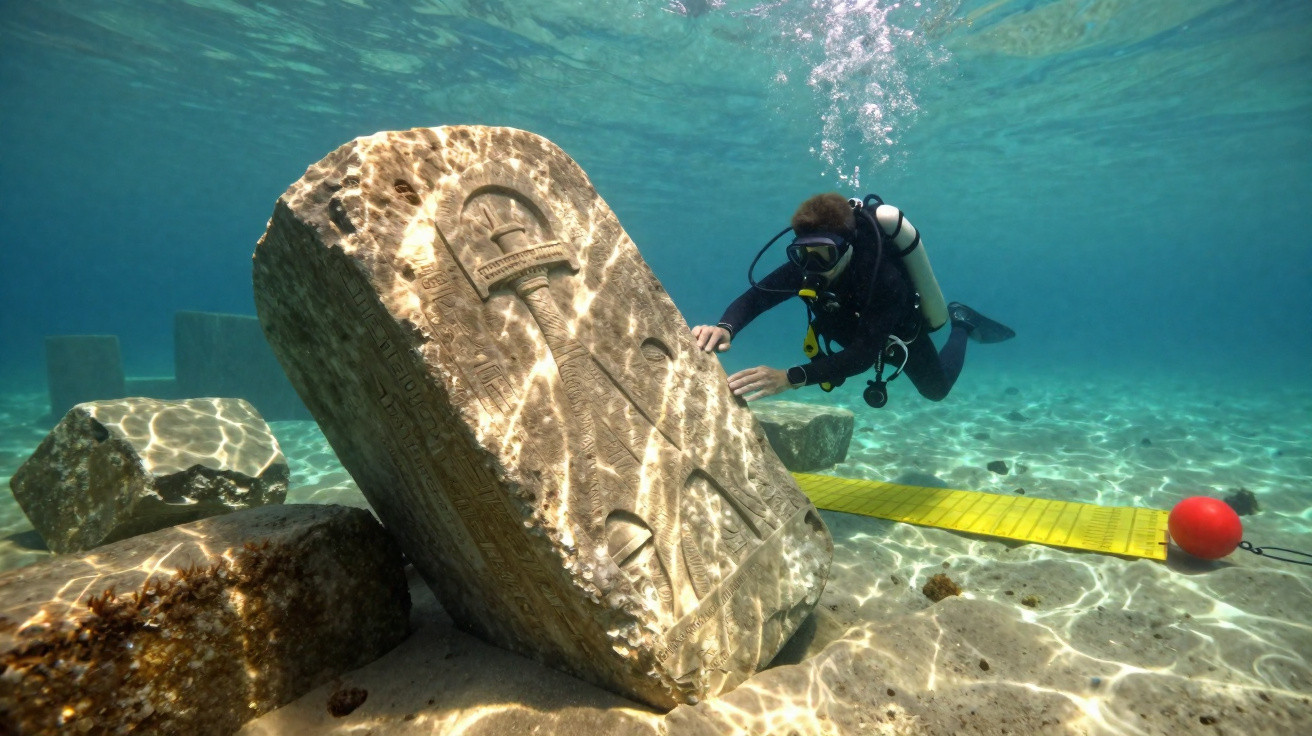
For centuries, parts of one of the Seven Wonders of the Ancient World lay scattered across the floor of the Mediterranean. An archaeological operation has now brought 22 enormous blocks linked to the Lighthouse of Alexandria to the surface, including monumental elements weighing as much as 70 to 80 tonnes. These pieces could help researchers create a digital reconstruction of a building lost for centuries.
What did archaeologists recover from the Mediterranean?
Scientifically led by CNRS archaeologist and architect Isabelle Hairy, the operation retrieved some of the largest pieces ever examined at the site. They include lintels and jambs from a monumental doorway, a threshold, and vast slabs believed to have formed part of the ancient lighthouse’s base.
Another discovery has drawn particular interest: sections of a previously unknown monument, identified as a pylon featuring an Egyptian-style gateway made using Greek techniques. According to the Dassault Systèmes Foundation, which supports the PHAROS project, these structures may show how distinct architectural traditions converged in Hellenistic Alexandria.
How are such massive stones examined?
Lifting the blocks required a barge and crane, yet the process does not end once a stone reaches the surface. Every item is documented through high-precision photogrammetry, a method that combines numerous overlapping photographs to generate three-dimensional models preserving details of shape, dimensions and surface texture.
The newly recovered pieces will join more than 100 blocks that have already been digitised underwater over the past decade. Once processed, engineers can arrange them virtually, compare possible joins and test competing theories about the monument’s architecture. The aim is not to rebuild the lighthouse physically, but to develop an increasingly detailed scientific model.
- Twenty-two large blocks were lifted from the water during the archaeological operation.
- Some of the monumental pieces weigh between 70 and 80 tonnes.
- More than 100 blocks had previously been digitised on the seabed.
- Three-dimensional models make it possible to test virtually where each fragment may have stood within the building.
Why did the Lighthouse of Alexandria ruins remain underwater?
Built in the early 3rd century BC, the Lighthouse of Alexandria stood on the island of Pharos and rose to roughly 100 metres. For more than a millennium, it served as a landmark for sailors approaching the city and as a symbol of Alexandria’s economic and technological power.
The monument suffered gradual damage and ceased operating in 1303. Its stones were subsequently reused as building material until the Fort of Qaitbay was completed on the site in 1477. Some elements that fell into the sea escaped this reuse and remained preserved in the submerged environment.
Watch the video shared by the YouTube channel ROBOLIZANDO, which shows several blocks from the Lighthouse of Alexandria being lifted from the sea.
How long have researchers explored these ruins?
Systematic research into the submerged remains gained momentum in the 1990s under the leadership of Jean-Yves Empereur, an archaeologist at the Centre for Alexandrian Studies. CEAlex itself states that 36 pieces recovered from the sea in 1995 and 1996 can now be seen in Alexandria, including fragments of colossal statues, architectural elements, sphinxes and obelisks.
Three decades later, the PHAROS project brings together archaeologists, architects, historians and specialists from other fields to compare the physical evidence with coins, images and descriptions created over approximately 1,800 years. This combined approach helps close gaps left by a building that has survived into the present only in fragments.
Will it be possible to see the Lighthouse of Alexandria again?
Researchers do not possess every piece needed to reproduce every detail of the monument with complete certainty. Digital reconstruction therefore works as a vast scientific jigsaw: alternative joins and interpretations can be tested without changing the original objects, making it easier to separate archaeological evidence from architectural hypotheses.
Every block raised from the Mediterranean offers another clue to a structure that vanished hundreds of years ago. The next step is to make these stones “return” to their place in the virtual world. Following the project means watching, piece by piece, one of the Seven Wonders of the Ancient World take shape again before our eyes.




Comments
No comments yet. Be the first to comment!
Leave a Comment