
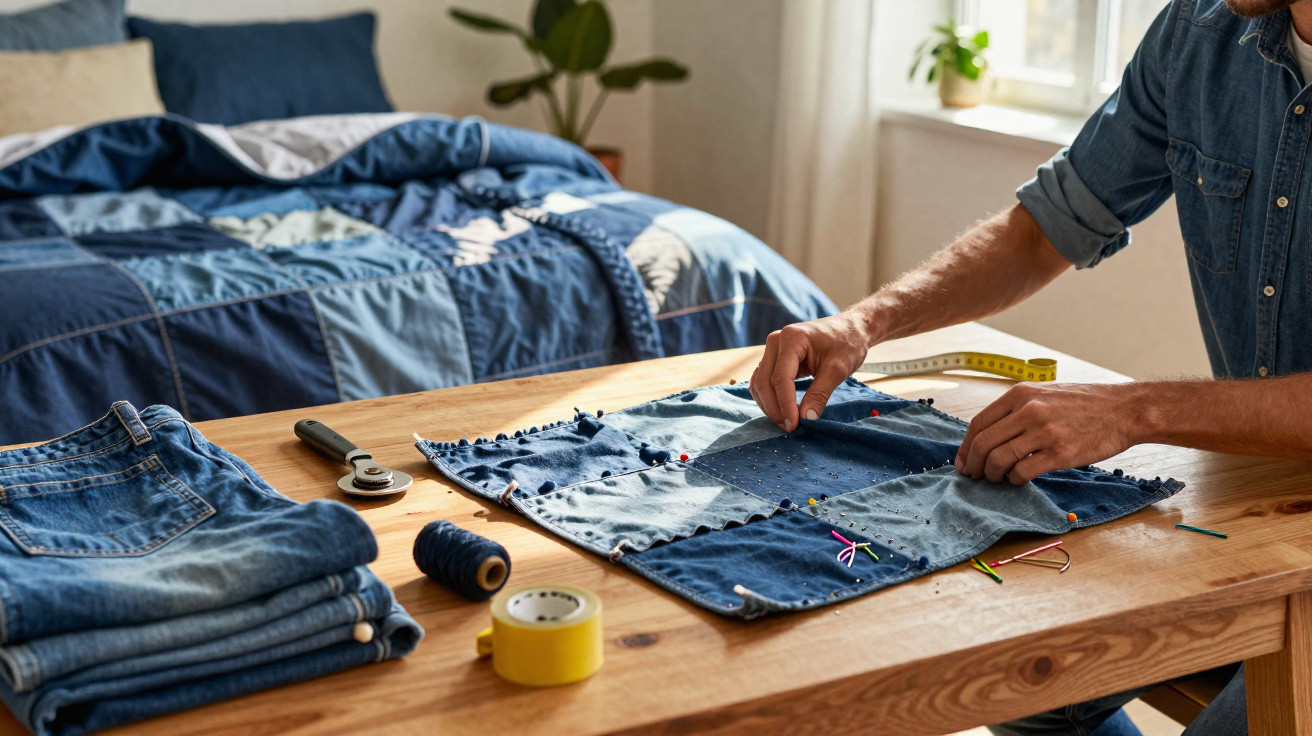
Those jeans that no longer fit, have faded, torn, or simply been left at the back of the wardrobe can have a far more worthwhile future than the bin. With a sewing machine, thread and a little patience, denim offcuts can become a hard-wearing, washable quilt with the character of a handmade piece-one that keeps you warm while adding style to the bedroom.
Why denim fabric is ideal for making a quilt
Denim is not an accidental choice for this project. It is among the toughest fabrics used around the home: it does not tear easily, withstands frequent washing without losing its shape, and is thick enough to hold the filling in place so it does not shift after the first few washes. Anyone who has sewn with lighter fabrics will know how much this matters to the longevity of the finished item.
The blend of shades is another benefit. Old jeans often come in a range of blues, from deep indigo to a faded, almost white blue. This natural variation between the squares produces a rustic, attractive look that no shop-bought quilt can replicate. If you have jeans in several colours and washes, the result will be even more distinctive.
- A good supply of old jeans: for a double bed, set aside 4 to 6 pairs; for a single bed, 2 to 3 pairs should be enough, depending on the size of the squares you choose.
- Strong scissors and a ruler: accurately cut squares ensure the sections fit together neatly when joined and keep the quilt properly aligned.
- A sewing machine and durable thread: a size 18 needle is ideal for denim, which is thicker than ordinary fabrics; polyester thread offers greater durability.
- Acrylic wadding or stuffing fibre: wadding is the filling that gives the quilt its loft and warmth; the amount depends on how heavy you would like the finished piece to be.
- Bias binding for the finish: navy or coloured bias tape sewn around the entire edge keeps the borders neat and gives the denim quilt a professional finish.
How to plan the size before you start cutting
Before reaching for the scissors, decide on the finished dimensions of the quilt and the measurements for each square. For a single-bed quilt (approximately 150 x 200 cm), 20 x 20 cm squares require a grid of 7 x 10 blocks, making 70 double squares in total. For a double bed (200 x 220 cm), this rises to around 110 squares. Every square requires two pieces of fabric, so always cut them in matching pairs.
Take the weight of the denim into account too. Heavier fabrics create a warmer, firmer quilt, but they are more difficult to sew in layers. For a lighter result suitable for autumn or mild winter nights, choose thinner denim jeans or combine them with another cotton fabric between the squares.
Step by step: sewing a denim quilt from individual squares
This is the square-by-square method, which creates a fuller, more three-dimensional quilt. Each block is assembled and filled separately before they are all joined together. This spreads the filling more evenly and stops it gathering on one side after washing.
Complete step-by-step guide to the denim quilt
Follow this order to achieve a firm, even and washable finish.
Cut every denim square to the same size, using a ruler and tailor's chalk or a fabric marker. Sort them into pairs, with two pieces for each block. Place each pair right sides together, sew along three edges, and leave an opening of about 5 cm on the fourth side for the filling. Turn the block right side out, insert acrylic wadding cut to the size of the square, then close the opening with an invisible stitch or a straight stitch placed very close to the edge.
Once all the blocks are ready, lay them out on the floor in your chosen arrangement before sewing. One useful approach is to alternate darker and lighter blocks to create visual contrast. Stitch the horizontal rows together first, then join the rows to one another. Finish by sewing bias binding around the full perimeter of the quilt, covering the raw edges and completing the piece. For added strength, sew an extra line over the meeting points of each square from the right side.
A quicker option for those comfortable using a sewing machine is to join all the squares first, creating the quilt's two outer layers, before adding the filling and closing the edge. This method requires greater care when spreading the filling evenly before sealing it, but it saves time compared with making individual blocks.
Other creative projects for leftover denim
After cutting the quilt squares, there will still be plenty of useful fabric left from the jean legs. These offcuts do not need to go in the bin. The tubular legs of the jeans are ideal for fabric organisers: simply cut them into equal lengths, sew one end closed, and use them as pencil holders, storage pots or drawer dividers. Shorter sections can be made into toiletry bags and pencil cases by sewing a simple zip into the opening.
Hair accessories such as headbands, bows and scrunchies can also be made easily from denim strips cut on the bias. Decorative cushions, handbags, backpacks and cushion covers are further projects that make use of the larger sections of the jeans. Denim is one of the few fabrics that looks good in almost any application, as its wear and variations in colour are part of the material's appeal.
Care that helps the denim quilt last much longer
Because it is made from denim, this quilt can be machine-washed without difficulty. However, a few simple measures will extend its lifespan considerably. Always wash it in cold or lukewarm water, never hot, to protect the filling and prevent the blocks from shrinking unevenly. When drying, hang it in the shade rather than using a tumble dryer, since intense heat can gradually distort the acrylic wadding. Shake the quilt thoroughly before folding it to redistribute any filling that may have become compressed during washing.
This is the sort of piece that becomes more attractive through use and over time, just like the jeans from which it was made. Share it with anyone who sews, or with anyone who has a drawer full of old jeans waiting for a new purpose.


Comments
No comments yet. Be the first to comment!
Leave a Comment