
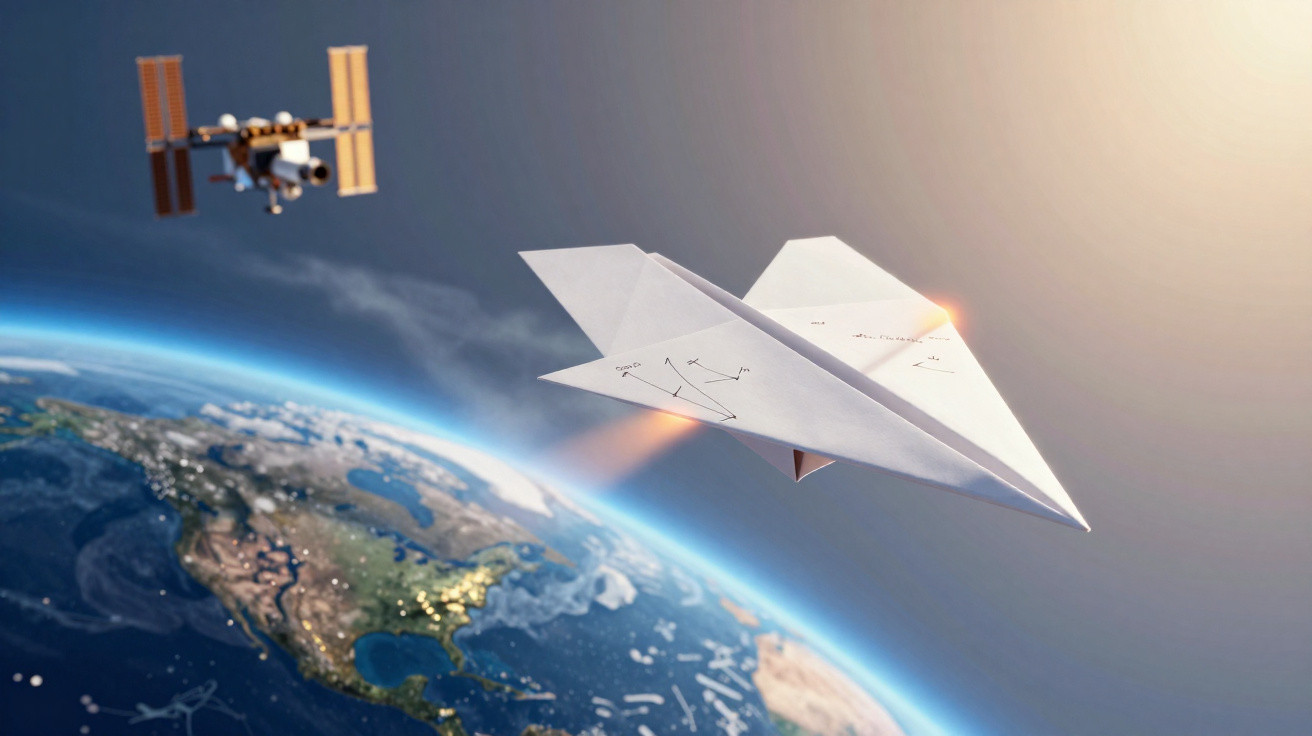
Some of life’s weightiest questions demand answers: "What is the meaning of existence?", "Are we alone in the universe?" and "What happens if you throw a paper airplane from the International Space Station?"
Fortunately, the third question has at last been addressed - as it was surely only a matter of time before somebody did.
A recent study by Maximilien Berthet and Kojiro Suzuki of the University of Tokyo examines "the dynamics of an origami space plane during Earth atmospheric reentry" - or, more simply, what would occur if a paper aeroplane were released from the ISS.
Before getting to the result, it is worth covering a few technical principles needed to make sense of this apparently straightforward idea.
The origami space plane and its descent from the ISS
Origami is the Japanese term for folded paper, and the researchers chose an ordinary white A4 sheet to create their paper aeroplane. The finished design resembles the sort of plane a primary-school pupil might fold to irritate the classmate in front, albeit one supported by considerably more aerodynamic modelling.
After creating the software model, the researchers were ready to test it. As the ISS travels in orbit at roughly 400 kilometres, or about 250 miles, they modelled the plane being released at that altitude and at a velocity comparable with the station’s own: 7,800 metres per second.
That velocity may sound as though it should instantly tear apart a paper aircraft, but the atmosphere at an altitude of 400 km is not yet dense enough to inflict much damage.
Indeed, this remains true for most of the craft’s return journey. Between 400 km and approximately 120 km above Earth, the plane remains reasonably stable because there is so little air.
Its low ballistic coefficient - a measurement of an object’s ability to overcome air resistance - does, however, make it descend very rapidly. Because of this low ballistic coefficient, the plane slows quickly and falls to 120 km in around 3.5 days.
On the positive side, such a low ballistic coefficient means that, after entering the atmosphere, the plane would have a lower terminal velocity than an object such as a cannonball.
It would not get that far, unfortunately. The simulations indicate that at roughly 120 km, the greater atmospheric density causes uncontrollable tumbling, placing the aircraft into the erratic flight pattern familiar to anyone who has folded and flown one.
Testing the paper aeroplane in a hypersonic wind tunnel
Yet simulations alone were not enough when the team had aerospace engineering expertise and could make a paper plane for scientific purposes. Nor was building a single aircraft sufficient when they could test it in a highly advanced wind tunnel at their university.
So the authors constructed a physical paper aeroplane model - though it did have an aluminium tail - and placed it in the University of Tokyo’s Kashiwa Hypersonic and High Enthalpy Wind Tunnel. Their aim was to determine the aerodynamic forces that the paper aeroplane could survive.
The testing conditions were far from gentle. The one-third-scale paper aeroplane faced Mach 7 winds for 7 seconds, approximating the forces encountered during genuine atmospheric re-entry. As might be expected, the flow bent the plane’s nose backwards, but it did not break apart - at least over that timespan.
Charring was also clearly visible on the nose and wing tips. This suggested that, had the test lasted longer, the paper plane would have burned up.
Possible uses for a lightweight atmospheric platform
Demonstrating that outcome was, ultimately, among the experiment’s goals. A number of mission architectures could potentially employ something resembling this paper aeroplane model. The LEAVES experiment for Venus exploration is one example, while various Earth-observation applications could also benefit from a lightweight, stable platform that gathers data before completely burning up in the atmosphere at the end of its operational life.
Any mission of that kind would need electronics and numerous other components, which would undermine the simple purity of testing a paper plane that a child might have made in class.
Still, science can be about inspiration just as much as exploration, and this paper’s findings offer an appealing combination of both.
Universe Today originally published this article. Read the original article.



Comments
No comments yet. Be the first to comment!
Leave a Comment