
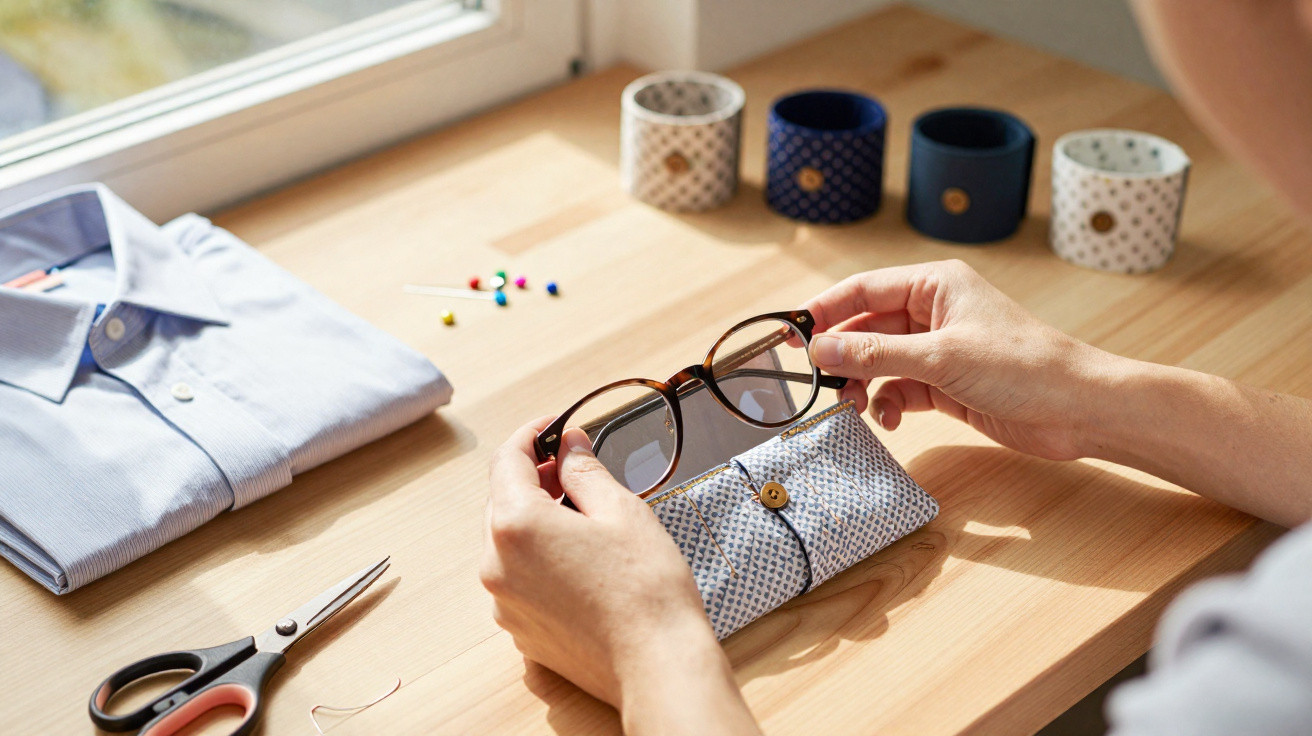
Many people have discarded shirts in their wardrobe with worn-through elbows but cuffs that still look immaculate. Rather than throwing them away, you can turn one into a surprisingly elegant glasses case – with no pattern, no extra purchases and barely any sewing experience. The secret lies in the already reinforced cuff section, which is ideally suited to delicate lenses.
Turn an old shirt cuff into a stylish glasses case
The principle is straightforward: the reinforced wrist section makes an ideal sturdy opening for a case. Where a hand once slipped through, sunglasses or reading glasses can now slide in. The existing button keeps everything securely closed, creating an accessory that could easily cost 20 euros in a shop.
This idea fits perfectly with the circular economy trend and the concept of upcycling: garments that might otherwise end up in the bin are given a second life. Shirts with worn areas are especially suitable, as their cuffs and collars are often still in excellent condition.
Using leftover shirt fabric saves money, cuts textile waste and gives you a practical everyday accessory with a personal touch.
Step by step: sew the case in 15 minutes
Preparation and cutting
Start by choosing the right shirt. A cotton shirt with a firm cuff, such as poplin or a similar fabric, works best. Checks, stripes and subtle textured patterns are particularly effective, adding visual interest to the finished case.
- Lay the shirt sleeve flat on a table.
- Slide your glasses into the sleeve as a test to estimate the required length.
- Using a ruler or quilting ruler, mark a straight line around 20 centimetres above the cuff.
- Cut the sleeve neatly along this line to create a fabric tube with the cuff at one end.
It is better to leave the piece slightly too long and trim it later than to cut it too short. Glasses with deeper frames need more room than slim metal frames.
Closing the base
To transform the tube into a glasses case, the cut end needs to be sealed:
- Turn the fabric tube inside out so that the seam allowances face outwards.
- Align the freshly cut edges precisely and smooth them flat.
- Sew straight across the opening close to the edge using a straight stitch – with a sewing machine, or by hand if the fabric is thick.
- Finish the seam allowance, for example with a zigzag stitch or overlocker, to prevent fraying.
- Turn the case right side out again – the cuff now forms its smart opening.
The shirt’s original button and buttonhole fasten your new glasses protector without needing an extra closure. If you wish, add a second button to adjust the width slightly.
Practical extras: an integrated cleaning cloth and soft lining
The project becomes even more useful with a detail that proves invaluable every day: a permanently sewn-in microfibre tab. Before closing the base, simply place a small square of lens-cleaning cloth into the bottom edge and catch it in the seam. Once the case is turned right side out, the tab hangs inside, so it will never disappear into the depths of a bag again.
Delicate lenses benefit from a soft surrounding. If the shirt fabric feels firm or slightly rough, add a simple thin lining made from cotton batiste or jersey. This can be sewn in as a separate tube and secured with the base seam. It requires little extra work while noticeably improving comfort.
| Option | Suitable for | Particular benefit |
|---|---|---|
| Without lining | Durable sunglasses | Quick to sew, very simple |
| With lining fabric | High-quality reading glasses and varifocals | Greater protection, soft interior |
| With microfibre tab | Glasses prone to fingerprints | Cleaning cloth always close at hand |
Why a shirt cuff protects glasses better than ordinary fabric
The cuff area is more technically interesting than it first appears. Beneath the outer layer is often a heat-bonded interfacing that gives it structure. This concealed layer adds stability without making the cuff overly rigid. In effect, it acts like a built-in shock absorber.
That combination is exactly what protects the glasses: the interfacing absorbs minor impacts while the cotton fabric remains gentle on the lenses. At the same time, the opening hardly loses its shape, even when the case is carried every day in an overfilled handbag. The button keeps the contents secure, and the form remains remarkably stable for years.
The cuff works rather like a free, ready-made case opening – complete with fastening and reinforcement.
Another advantage is that the case can be washed just like an ordinary shirt. Anyone who regularly handles make-up, sun cream or hand cream will know the issue of greasy lenses. Wash it at 30 or 40 degrees and the fabric will feel fresh again.
Personalise your glasses case: from simple protection to a fashion statement
Small changes, big impact
A few quick additions can turn this practical upcycling project into a one-of-a-kind fashion piece. Many sewing enthusiasts replace the plain shirt button with something more striking: mother-of-pearl, a metallic finish, wood or a small glitter button can completely change its character.
Popular options include:
- an extra decorative button on the cuff alongside the functional button
- a small sewn-in fabric loop for attaching the case to a bag
- a tiny embroidered initial in one corner of the cuff
- sewn-on woven labels or scraps of gift ribbon as an eye-catching detail
If you wear very narrow glasses, you can alter the width by sewing another seam along the existing lengthwise seam, positioned slightly inwards. This narrows the tube without significantly changing the cuff itself. The shape can therefore be tailored quite precisely to your own glasses model.
A project that inspires more ideas
If the second cuff remains after making the first case, it has an obvious use: make another case for your partner’s sunglasses, a phone sleeve with a little additional padding, or a pen case for a handbag. The remaining shirt fabric can also be used for a flat zip pouch for tickets, cosmetics or headphones.
Many people who begin with this 15-minute project soon realise how much potential old clothing holds. Cotton shirts are particularly well suited because the fabric is sturdy enough without feeling stiff. Once you make several versions, you will quickly notice differences in quality, texture and durability between fabric types.
Sustainable benefits and practical tips
Every small project reduces the pile of old clothes that might otherwise be thrown away. At the same time, it creates a supply of useful everyday items that also make thoughtful gifts. A handmade glasses case made from a family member’s former favourite shirt often carries an emotional value that shop-bought accessories rarely achieve.
A few points will help you avoid frustration:
- Test the glasses before making the first cut to ensure that both the width and height fit properly.
- For very smooth metal frames, choose a soft lining so they do not slide about.
- Before giving the case as a gift, check that the button is securely attached and easy to fasten.
- With strongly patterned shirts, consider how the pattern placement will look across the cuff.
Anyone exploring the subject in more detail will soon come across terms such as the circular economy and zero-waste textile use. The idea behind them is simple: keep existing materials in use for as long as possible instead of constantly buying new ones. Small projects such as this glasses case show that the approach need not be abstract; it can be put into practice in everyday life.
This is especially useful for sewing beginners, as it is a project that can barely go wrong: there is just one seam, no complicated curves and no zips. Those who overcome their fear of the sewing machine in this way often feel ready to try larger projects. More experienced makers, meanwhile, can use the shirt cuff as a canvas for embellishments, embroidery and individual details – until an old shirt becomes a small, highly personal favourite item.






Comments
No comments yet. Be the first to comment!
Leave a Comment