
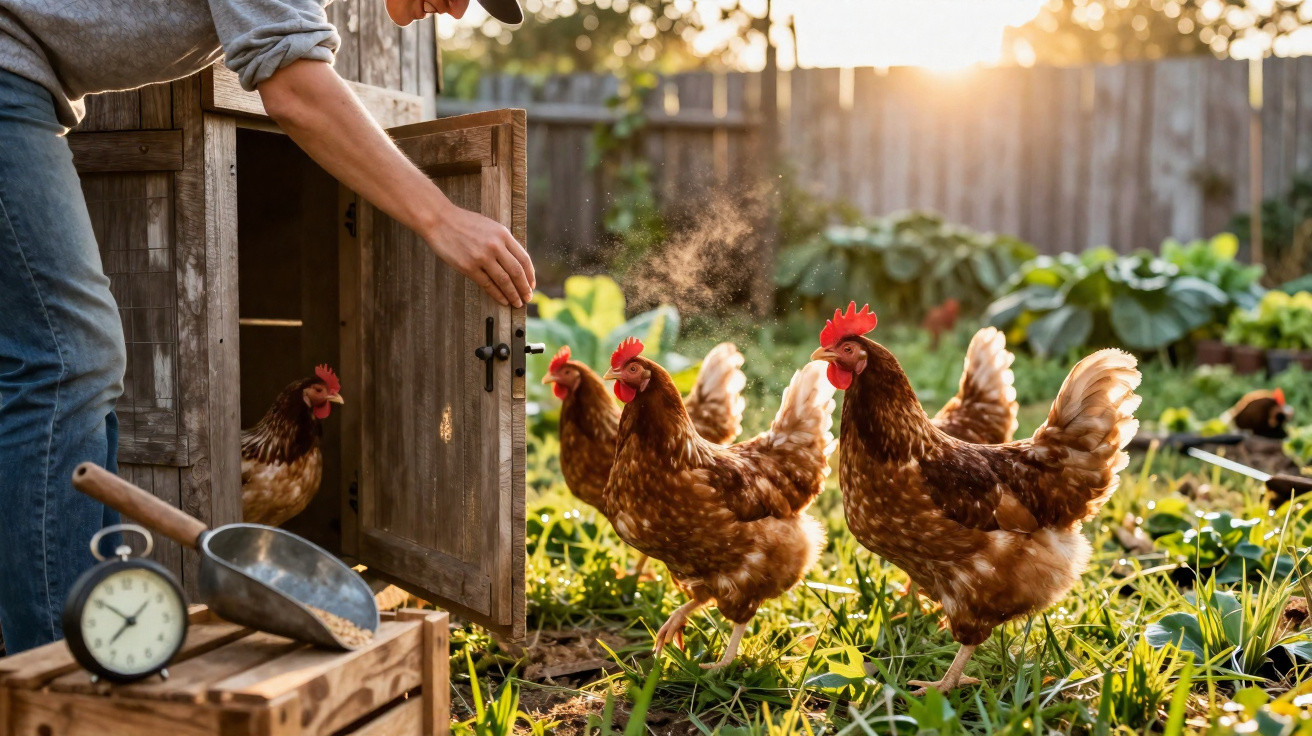
Keeping chickens quickly makes one thing clear: these birds follow a rhythm all of their own. They start clucking early, want to get outside, eat and scratch at the ground. But when is the right time to open the coop in the morning? Opening too early carries risks, while doing it too late disrupts their routine – and both can affect their health and egg production.
Chickens’ natural daily rhythm
Chickens do not live by the clock; they live by the light. Their internal clock is guided directly by the sun’s position. As dawn breaks, their bodies and metabolism become active, then return to rest mode as daylight fades.
“Chickens follow the sunrise – not our alarm clock.”
In practical terms, they become active with the first daylight. You will then hear stamping, clucking and scratching inside the coop. If they remain shut in for much longer, this conflicts with their natural routine. Birds may become unsettled, anxious and, in some cases, aggressive.
At the same time, darkness offers protection. During the early morning, when it is still nearly dark, many predators are active: foxes, martens and birds of prey at dawn. Letting chickens out into half-light substantially increases the risk of attacks.
When is the best time to open the coop?
The practical rule of thumb is to open the coop once it is light enough outside for a person to see clearly where they are stepping. That means not at the first grey dawn, but when outlines are plainly visible.
- In summer: usually very early, often between 5 and 6 am
- In spring and autumn: roughly between 6 and 7.30 am
- In winter: considerably later, often only between 7.30 and 9 am
The exact time will vary with the region, season and weather. Fog, heavy cloud cover or a shaded garden can keep conditions dark for longer. The light level is therefore more important than the time on the clock.
“As a guide: open the coop as soon as there is sufficient daylight outside and the surroundings can be clearly seen.”
If the coop is routinely opened far too late, the birds’ whole daily schedule shifts. They have less time for scratching, dust baths and feeding. Some chickens may lay more erratically or retreat into the coop because they cannot follow their normal rhythm.
Food, water and a good start to the day
Opening the coop does not just mean access to the run; it also begins the breakfast service. Chickens peck at small quantities of food throughout the day. As soon as they are let out, they need:
- fresh water in clean drinkers
- readily available staple feed
- if needed, a little mixed grain for scratching
A rushed morning check can mean the birds do not get enough food or clean water until hours later. This creates stress, encourages pecking-order disputes and makes vulnerable hens more susceptible to illness.
“A well-planned morning with light, food and fresh water relieves stress for hens – and pays off in health and eggs.”
Automatic doors as a practical solution
Many keepers work, have children or simply do not want to get up at five o’clock at weekends. This is precisely where automatic door systems come in. These compact devices open and close the chicken coop independently.
How do automatic openers work?
There are two main types:
- Timer-controlled models: These open and close at fixed times set in advance.
- Light-controlled models: These respond to brightness and work more closely with the natural rhythm.
Anyone who does not want to keep adjusting settings between summer and winter will benefit from sensor-controlled models. They give the birds fresh air and daylight in the morning without the keeper needing to be there. Many of these systems also close automatically in the evening once darkness falls.
“A reliable door opener ensures that chickens’ daily routine remains stable – even when nobody is there early in the morning.”
Why a consistent routine matters so much
Chickens thrive on predictability. They become accustomed remarkably quickly to repeated routines: feeding at the same times, opening at a similarly early hour and a comparable closing ritual in the evening. This routine has a calming effect and reduces stress reactions within the flock.
Once outside, they engage in typical activities: scratching in the soil, dust bathing to combat parasites, short bursts of running, wing flapping and social interaction with the group. All of this requires time and daylight. Opening the coop consistently at a similar early time each day encourages exactly these behaviours.
Signs that timing and care are right
The chickens themselves reveal whether the coop is being opened at a suitable time. Positive signs include:
- lively scratching shortly after they are let out
- regular, consistent egg production
- glossy, smooth plumage
- calm social behaviour without noticeable scuffles
Warning signs that call for a rethink include:
- dull, lacklustre feathers
- noticeably irregular egg laying
- nervous pacing or excessive calling
- little activity after the coop is opened
“Anyone who watches their chickens closely will soon notice whether the opening time is right – their behaviour tells the whole story.”
Seasons, weather and possible risks
The ideal time for opening the coop changes considerably over the course of the year. At the height of summer, chickens are happy to make use of the cooler morning hours. Later in the day, they are more likely to seek shade and spend more time in the coop or beneath trees. An especially early start can be beneficial in these conditions, as long as it is safe outside.
Winter brings a different risk: bitter cold and frost. A sudden change from a warm coop to freezing air puts strain on weakened birds. Keepers of hens with respiratory problems, or older birds, should not send them out into darkness and sharp sub-zero temperatures. They cope far better once it is properly light.
Predators are another consideration. Foxes and martens often still roam around the property early in the morning. A secure run, ideally with fencing and overhead netting, greatly reduces the danger. The coop should never be opened in half-light if the run is not properly protected.
Practical tips for everyday chicken coop care
Those just starting out, or looking to improve their routine, can use these steps as a general guide:
- Watch for several days to establish when it is genuinely light enough at your location.
- Set the coop-opening time for that point, plus a few minutes.
- Use an automatic door opener if the time is regularly missed.
- Check every one to two weeks as the seasons change whether the timing is still suitable.
- Keep an eye on the birds’ health and behaviour, adjusting the routine if anything seems unusual.
Following this approach means using chickens’ natural rhythm as the guide rather than forcing them to fit rigid human schedules. The birds receive light, exercise and food at an appropriate time. This reduces stress, keeps them fit for longer and often results, almost as a side benefit, in more well-filled nesting boxes.






Comments
No comments yet. Be the first to comment!
Leave a Comment