
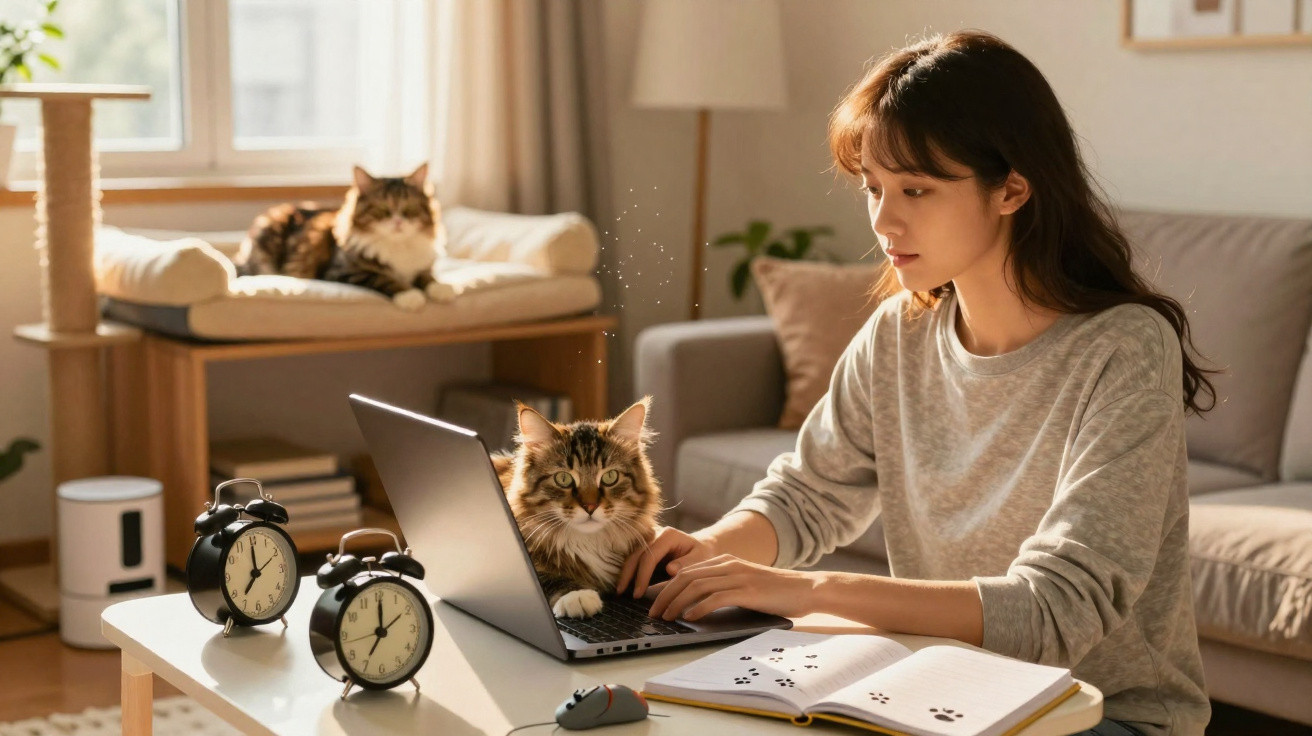
A paw in the face at night, meowing in your ear in the morning: many people think they run the household until one look at their four-legged companion tells a different story.
Anyone living with a cat knows the feeling: you pay the rent, buy the furniture and arrange daily life – yet it can still seem as though your small furry housemate has long been in charge. Suddenly, your wake-up time, the routes you take through the home and even breaks on the sofa are dictated by an animal weighing less than 5 kg.
Who is in charge here? When the cat quietly takes control
The question of whether a cat “dominates” may initially sound like exaggerated pet drama. Look more closely, though, and there is a very real phenomenon behind it: cats shape our routines and how we use our homes more than many of us care to admit.
Behavioural researchers are less likely to call this power and more likely to describe it as clever adaptation: cats create an environment that gives them the greatest possible security, control and predictability. To people, that can quickly feel like a small furry dictatorship.
Cats rarely rule the household – they ruthlessly optimise it around their own needs.
Strategic resting spots: how cats “occupy” the home
Cats do not settle down in a spot simply because it looks nice. There is usually a purpose connected with territorial control, safety and a clear view of their surroundings.
Up high: the ideal observation post
Whether it is on top of a cupboard, a shelf or the back of the sofa, elevated places serve cats like watchtowers. From there, they can see:
- who is moving where in the home
- which doors are open and which are shut
- whether potential “danger” is approaching – or whether the person who opens the food is on the way
At the same time, they are difficult to reach themselves. This gives many cats a sense of protection and control. To humans, it can look as though they are governing the living room from above – and that is not entirely inaccurate.
Right in the middle: lying in the way is no accident
The familiar situation of a “cat blocking the hallway” is about far more than comfort. When a cat lies in the middle of a passageway, doorway or in front of the basement stairs, it:
- monitors who enters particular rooms
- prompts eye contact and a response
- marks the area with scent from glands in its skin
This creates invisible yet distinct territorial boundaries. Anyone constantly stepping around the cat, or even changing their route, reinforces its control over the paths through the home.
Whoever lies in the doorway quietly decides who goes where – a subtle source of power.
When the cat replaces the alarm clock: control over time and routine
Alongside space, time is the second major lever. Many cat owners know the routine: paws appear on their face before the alarm is due, loud meowing begins, and doors are worked on with determination.
Why cats wake us so early
Cats are naturally crepuscular. They are particularly active in the morning and evening. At home, another factor is added: they learn exceptionally quickly how to get food.
If the following happens just once…
- The cat wakes you at 5 am.
- Annoyed, you give it food so that you can go back to sleep.
- The cat learns: waking you = food.
The programme is then installed. From that point onwards, the cat “sets” your waking time – not out of spite, but because it is securing its food supply.
The human as a trained operator
What may seem like cheeky blackmail is actually classic conditioning. Many people respond immediately to meowing in the kitchen, scratching at doors or insistent head-butting on the sofa. Every response – food, stroking or opening a door – reinforces the behaviour.
Often, it is not the cat that has been trained, but the human – unnoticed and highly effectively.
Anyone wanting to break this pattern needs consistency:
- Never give food immediately after being woken; wait until after your own morning routine.
- Do not respond to night-time fussing in bed when food is the aim.
- Ignore meowing at the bedroom door overnight, provided there is no medical reason for it.
This separates food and attention from the unwanted time of day. It may be noisy for several days, but it usually pays off clearly afterwards.
Does the cat really dominate – or is it simply ensuring its survival?
The image of a “feline dictator” is amusing, but biologically it is too human-centred. Cats are creatures of habit with a strong need for control and predictability. Sudden changes cause them stress.
By:
- occupying key positions in the home,
- monitoring access to resources such as food, water and the litter tray,
- and influencing their humans’ routine,
cats create a system in which their survival and wellbeing appear relatively secure. To people, this can sometimes feel like a power game, but at its heart it is a survival strategy.
Power game or clever adaptation?
Behavioural observations indicate that cats rarely think in our terms of “ruling” or “submitting”. They respond to experience and adapt their behaviour when it benefits them. They test boundaries, remember successful methods and organise their daily lives around them.
Their aim is not a throne but reliability: When will food arrive? Where can I rest without being disturbed? Who responds in what way to my behaviour?
How to restore balance in everyday life with a cat
Anyone who no longer wants to be directed by morning paws or blocked doorways does not need to become a “cat general”. Small but clear adjustments are often enough to put the relationship on a calmer footing.
Practical ways to influence everyday life
- Fixed feeding times: Set two or three regular times each day and stick to them, regardless of meowing.
- Use automatic feeders: Technology can break the direct link of “human = food provider in my line of sight”.
- More elevated resting places: Extra shelves or cat trees provide security without turning the wardrobe into a permanent fortress.
- Evening play sessions: 10–15 minutes of intensive hunting-style play before bedtime can reduce morning activity.
- Manage doors deliberately: Do not give in to every closed door, or the cat will train itself to become the door monitor.
Anyone who gives their cat structure needs to react to its rules less often.
What lies behind your cat’s typical “power gestures”
Many situations that appear to be dominance can be understood more accurately with a little basic knowledge:
| Cat behaviour | Likely reason |
|---|---|
| Lies on the laptop or keyboard | Warmth, closeness to the person, securing attention |
| Blocks the bed | A safe, soft resting place and closeness to its main person |
| Meows as soon as you enter the kitchen | Learned signal: human + kitchen = chance of food |
| Constantly walks in front of your feet | Seeking contact, controlling movement, expecting a response |
| Stares rigidly from above | Overview, territorial check, and sometimes simply habit |
When it becomes too much: when “control” turns into a problem
In most homes, the whole situation remains an amusing power game with clear limits. However, there are signs that should prompt a closer look:
- The cat aggressively guards food, the sofa or certain rooms.
- It attacks when someone approaches its “territory”.
- It seems permanently tense, hides frequently or grooms itself excessively.
Such cases may point to stress, pain or negative past experiences. In that situation, a check-up with a vet and, where needed, advice from a cat behaviour consultant are sensible.
It is also useful to understand common specialist terms: when experts refer to “resource guarding”, they mean food, water, resting places, human contact or even a view from the window – anything the cat considers valuable. If it strongly controls these resources, this often reflects insecurity rather than a sense of entitlement.
Ultimately, one provocative question remains: are you really paying rent only for yourself – or have you long been a lodger in the home of an animal that precisely shapes your daily life? Those who understand this dynamic can guide it rather than be overwhelmed by it. The cat will continue to cleverly seek its advantages. But whether this becomes a quiet reign depends largely on your own behaviour.





Comments
No comments yet. Be the first to comment!
Leave a Comment