
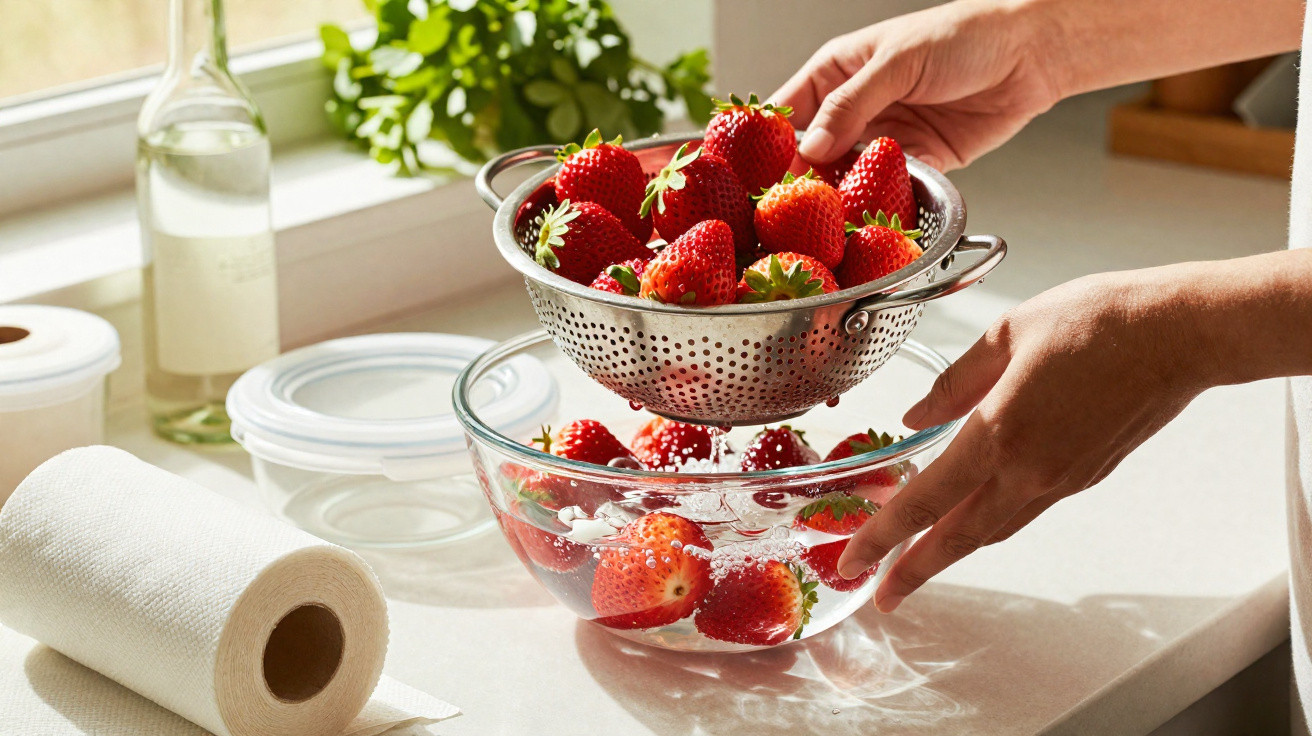
The simple kitchen ingredient used to extend the life of strawberries is white vinegar diluted with water. The mixture can reduce microorganisms on the fruit’s surface, but the real secret is a complete routine: sort the strawberries, wash them briefly, dry them thoroughly and store them in a ventilated container lined with kitchen paper.
Why do strawberries go mouldy so quickly?
Strawberries are fragile, high in moisture and have a porous surface. By the time they arrive home from a greengrocer or supermarket, they may carry fungal spores, damaged berries and droplets of water trapped inside the packaging. One mouldy strawberry can affect those around it, which is why the USDA advises throwing away mouldy strawberries as well as any that were touching them.
Moisture is another key factor. Food-safety guidance recommends washing strawberries only just before eating them, as washing before storage may speed up spoilage if the fruit is not dried completely.
How does white vinegar work on the fruit’s surface?
Vinegar is acidic and may help lower the amount of surface fungi and bacteria. This is why many people use a solution of 1 part white vinegar to 3 parts water before storing soft berries. Kitchen experts present this approach as an exception to the rule against washing fruit before storage, provided the strawberries are dried exceptionally well afterwards.
This detail is crucial: vinegar alone is not a miracle solution. If strawberries are stored while wet, the remaining moisture can encourage mould and make them soft. Drying is therefore just as important as the vinegar wash.
What is the correct proportion to use?
The most common ratio is 1 part white vinegar to 3 parts cold water. For a standard punnet of strawberries, combine 1 cup of white vinegar with 3 cups of water in a large bowl.
- Choose ordinary white vinegar, with no sugar or flavourings.
- Keep the strawberries whole, with their stalks and leaves attached.
- Do not leave them soaking for an extended period.
- Do not put already mouldy fruit into the same wash.
- After the vinegar treatment, rinse them briefly if you wish to remove any lingering smell or taste.
Step-by-step: keeping strawberries fresh for longer
First, sort through the strawberries. Eat the ripest ones first, and discard any that are crushed or mouldy. Strawberries should be refrigerated to slow fungal growth, and, when no preservation treatment is used, eaten within a few days.
- Take the strawberries out of their packaging and discard any that are mouldy or badly damaged.
- Combine 1 part white vinegar with 3 parts cold water.
- Submerge the whole strawberries for 2 to 5 minutes, moving them gently.
- Drain them and, if preferred, give them a quick rinse in cold water.
- Dry each strawberry individually with kitchen paper or a clean cloth.
- Leave them for a few minutes on dry paper until no visible moisture remains.
- Store them in a shallow container lined with kitchen paper, with the lid slightly open or with ventilation.
Which container keeps strawberries best?
The ideal container is shallow, clean and allows air to circulate. You can use the original packaging after cleaning it and lining it with kitchen paper, or a wide container with a lid that is not sealed completely. Fully closed containers can trap moisture and encourage condensation.
Driscoll’s experts recommend keeping dry, unwashed strawberries in the fridge, preferably in ventilated packaging. When using the vinegar method, the same principle still applies: strawberries must go into the fridge dry and with airflow around them.
How often should you check the strawberries?
Inspect the container every day or every other day. If you spot a berry that is soft, leaking liquid or showing signs of mould, remove it straight away to protect the rest. Replace the kitchen paper too if it becomes damp.
This straightforward habit matters because storage is not static. Even after a vinegar wash, strawberries continue to ripen, release moisture and become more delicate over the following days.
The trick works, but drying and ventilation are essential
White vinegar can extend strawberries’ shelf life because it helps reduce surface contaminants, but it is no replacement for refrigeration, sorting the fruit and drying it fully. Strawberries stored wet will spoil more quickly, even after an acidic wash.
For the best outcome, use the 1 to 3 ratio, leave the solution to work for only a few minutes, dry the berries carefully and store them in a ventilated container with kitchen paper. This keeps strawberries firm, clean and at lower risk of mould for far longer than if they are left forgotten in damp greengrocer or supermarket packaging.





Comments
No comments yet. Be the first to comment!
Leave a Comment